




by Noemi Capoccia 19/02/2026



Categories: Ancient art / Disclaimer
Delivered to the Mexican Embassy in Lisbon a female figure from Jalisco, a polychrome Mayan vase and a Zapotec urn from Oaxaca. This is Portugal's first official return to Mexico and marks a step in cooperation against the illicit trafficking of cultural property.


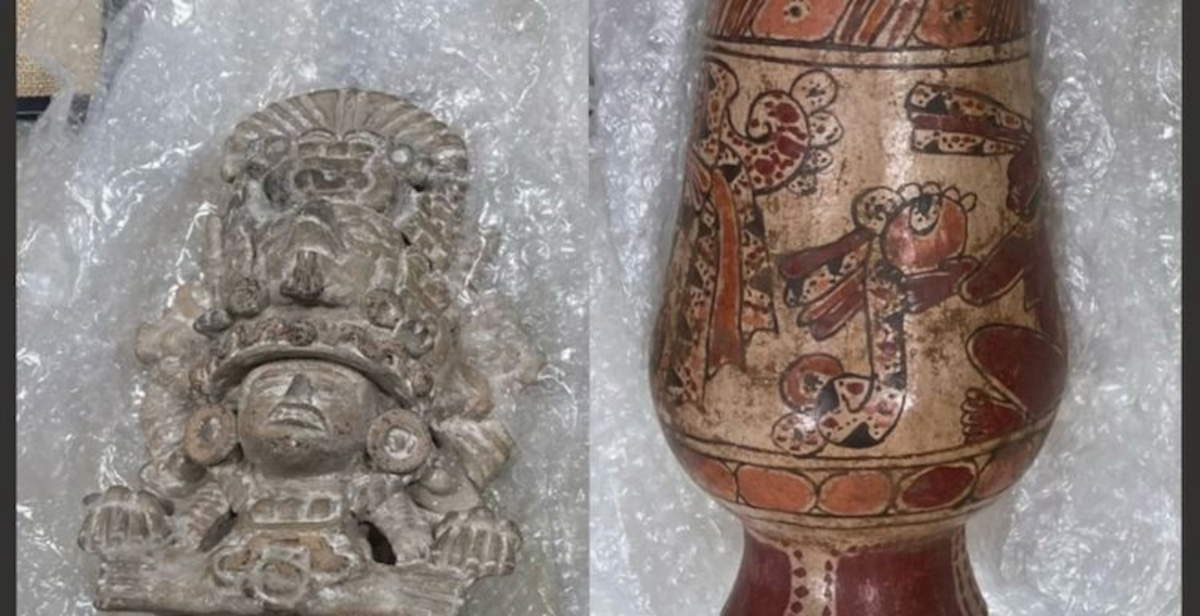
For the first time, Portugal has returned to Mexico archaeological goods illegally removed from its territory. The handover took place on Feb. 12, 2026 at the headquarters of the Mexican Embassy in Lisbon, where Portuguese authorities formally transferred three artifacts representative of different cultures and periods of the pre-Hispanic world. The works will be repatriated in the coming weeks via diplomatic suitcase. They are a female figure from the present state of Jalisco, a polychrome Maya vase datable to the Classic period, and aZapotec funerary urn from the Valles Centrales of Oaxaca.


According to information from theNational Institute of Anthropology and History (INAH), an entity attached to the Ministry of Culture of the Government of Mexico, the three objects had been illegally extracted from the national territory and were recovered thanks to the intervention of Portuguese judicial authorities. The return marks a precedent in relations between the two countries. It is in fact the first time that Portugal has officially returned archaeological goods to Mexico, in a context that authorities describe as one of institutional collaboration and shared commitment against the illicit trafficking of cultural goods.
“This restitution confirms that international cooperation protects who we are. Each restitution returns memory and identity to Mexico and reaffirms the shared commitment against the trafficking of cultural goods,” says the Secretary of Culture of the Government of Mexico, Claudia Curiel de Icaza.


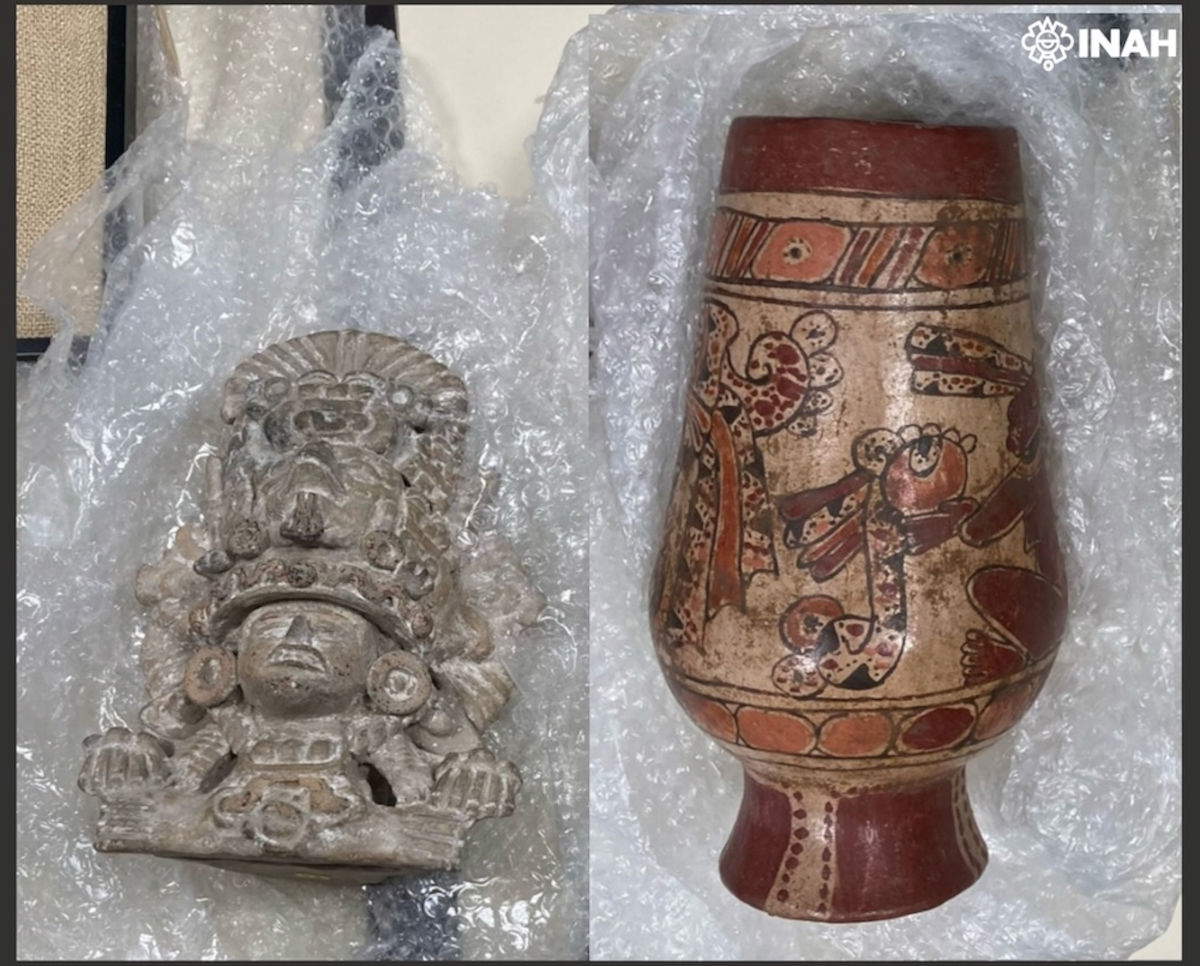
The identification of the works came about thanks to a timely tip from the Embassy of Mexico in Portugal. INAH specialists, made an initial identification based on images provided by local authorities, establishing that they belonged to the Mexican archaeological heritage. The artifacts had been recovered by the Judicial Police and the Camões Institute for Cooperation and Language. According to the report published by INAH’s Public Records Office, the first of the three artifacts, announced in an auction in 2024, is a 43-centimeter-high molded clay female figure with a polished surface, pastillaje applications (plastic relief applications) and carvings. The figure is depicted sitting on her knees, with a bare torso, a skirt and a conical headdress; scarifications appear on the shoulders. The work belongs to the Tala-Tonalá style of the Tumbas de Tiro (Well Tombs) cultural tradition and comes from the area of present-day Jalisco. The artifact is associated with fertility and maternity rituals and dates from between 300 and 600 AD. The case is being investigated by the Lisbon prosecutor’s office.
The second object is a polychrome Maya vase, dated between 600 and 900 AD. Decorated with scenes depicting elite figures accompanied by glyphs, the vase may have been used in ritual contexts for the consumption of drinks such as cocoa. The artifact was seized by the Guimarães Province Public Prosecutor’s Office and, according to preliminary assessments, would most likely come from southeastern Mexico. The third artifact is a Zapotec funerary urn from the Valles Centrales of Oaxaca. The urn depicts Cocijo, deity of rain and thunder in the Zapotec religion, and can be dated between 600 and 1200 AD. The seizure was ordered by the Évora-Estremoz Public Prosecutor’s Office.
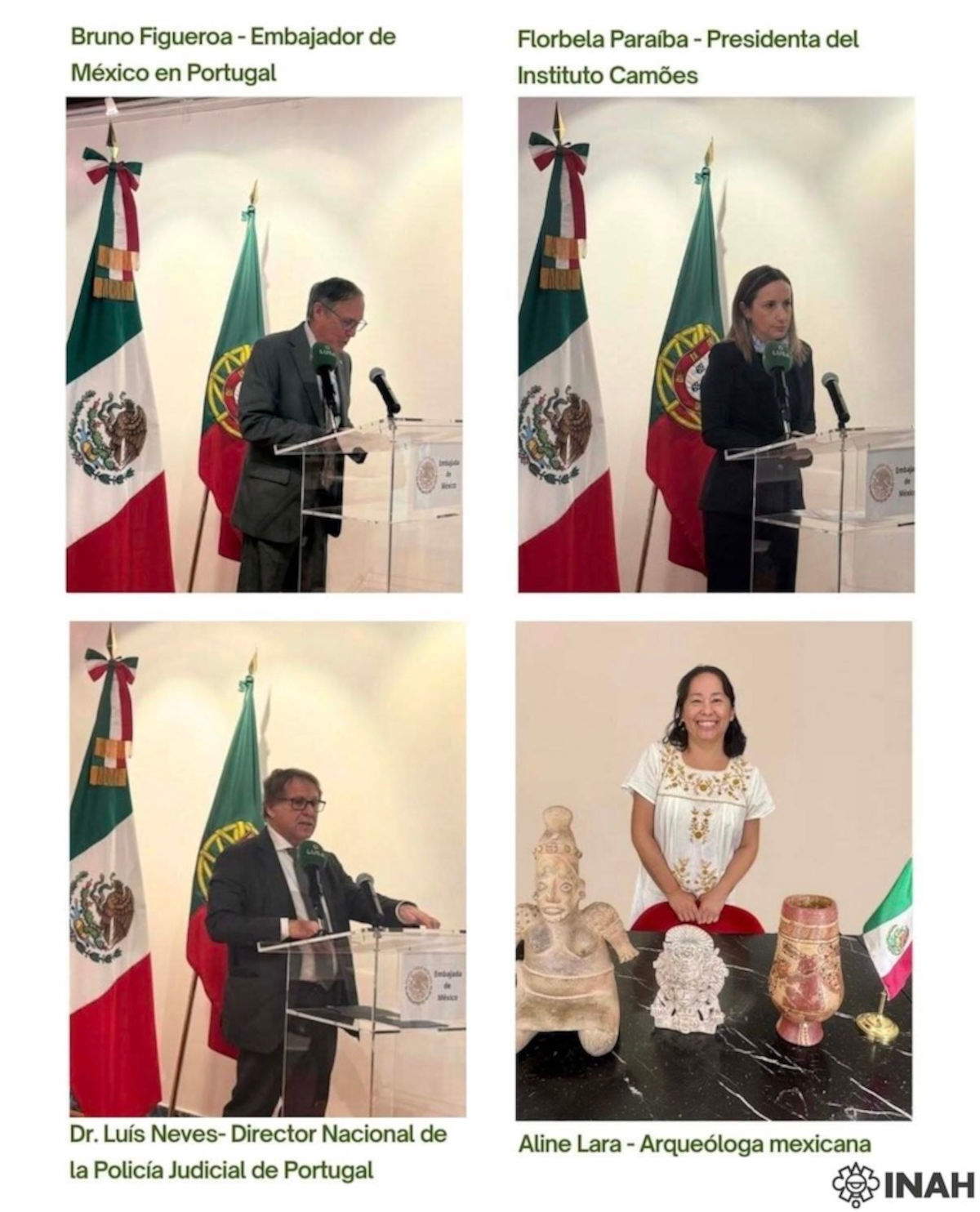
In 2025 Mexican archaeologist Aline Lara Galicia, a member of the Atlas Research Group (HUM694) at the University of Seville, was commissioned to conduct an in situ survey of the three works. The intervention, carried out at the request of the Portuguese authority and in support of Mexican institutions, confirmed the authenticity of the artifacts and their relevant symbolic function in the social, political and ritual contexts of the Mesoamerican cultures to which they belong. The handover ceremony was attended by Mexico’s ambassador to Portugal, Bruno Figueroa Fischer; the national director of the Portuguese Judicial Police, Luís Neves; the president of the Camões Institute, Florbela Paraíba; the head of the Lisbon and Tagus Valley Directorate of the Judicial Police, João Oliveira; while archaeologist Aline Lara spoke remotely. The Government of Mexico continues with legal actions and strategic initiatives aimed at recovering Mexican cultural heritage illegally held abroad, through operational coordination between the Ministry of Foreign Affairs and the Ministry of Culture.
 |
| For the first time, Portugal returns three illegally taken archaeological artifacts to Mexico |
Warning: the translation into English of the original Italian article was created using automatic tools. We undertake to review all articles, but we do not guarantee the total absence of inaccuracies in the translation due to the program. You can find the original by clicking on the ITA button. If you find any mistake,please contact us.