





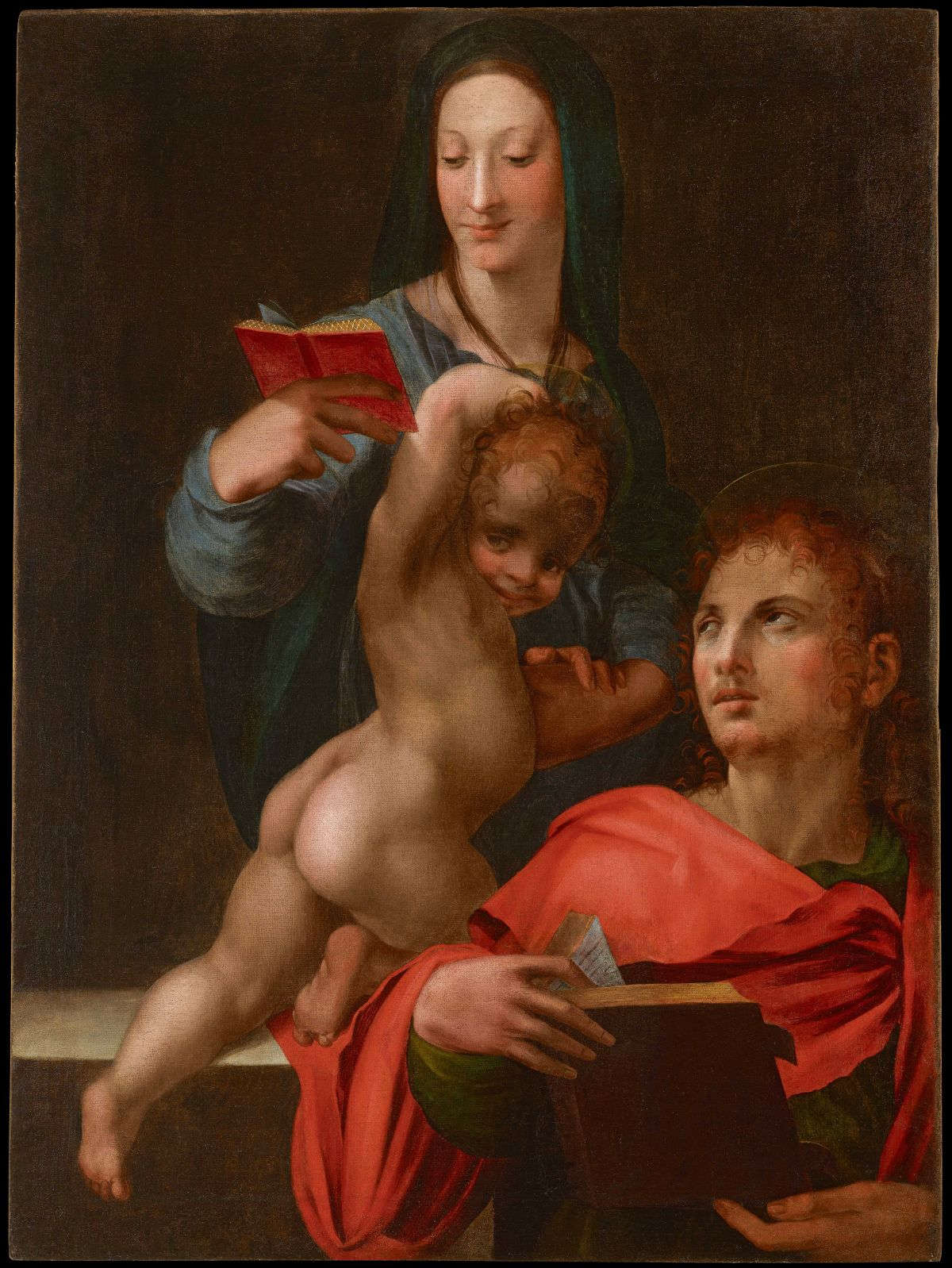
The Metropolitan Museum of Art in New York has announced plans to acquire a newly rediscovered painting by Rosso Fiorentino (Giovanni Battista di Jacopo; Florence, 1494 - Fontainebleau, 1540), one of the leading figures of Mannerism. The work, a Madonna and Child with St. John the Evangelist, had been thought lost for centuries and was only recently identified in a private collection following a restoration that removed a layer of repainting, bringing to light the figure of the saint in the foreground. The emergence of this element, probably concealed for centuries, allowed the painting to be recognized as the one described by Giorgio Vasari in his famous Lives, considered the work that marked the start of the young Florentine artist’s career. The discovery, the Met notes, not only restores a work thought to have been lost, but also redefines our understanding of the origins of Rosso’s pictorial language and, more generally, the artistic transformations of the early 16th century.
According to Max Hollein, director and managing director of the museum, the painting represents a pivotal moment in the artist’s production. “This painting,” he says, “is a rare and crucial early work by one of the most important painters of the 16th century, striking in its experimental ambition and psychological intensity. With its unusual arrangement of figures and bold poses, Rosso transforms a familiar devotional type into a charged encounter that engages the viewer in a complex interplay of vision, feeling and faith. The rediscovery of this work redefines our understanding of Rosso’s early production and the emergence of more expressive and dynamic compositions in 16th-century Florentine painting.”
Art historian Stephan Wolohojian, head of the museum’s Department of European Painting, also stressed the exceptional nature of the discovery. “Rosso’s paintings,” he explained, "are extremely rare, only about 20 exist, and many of his most famous works remain undocumented or unfinished. The discussion of this painting in the Lives, often described as the first book of art history, gives the work the additional distinction of having been part of art-historical discourse since the early days of the discipline. Executed on canvas and preserved in remarkably good condition, it is the earliest known painting by the artist. This work will form the centerpiece of the Met’s collection of 16th-century religious paintings, an exceptional and complementary group that elucidates key developments in painting for private devotion during the first quarter of the 16th century in Italy."
A central figure of early Mannerism, Rosso Fiorentino is distinguished by an innovative language that, along with that of artists such as Pontormo and Parmigianino, reworks the harmonious balance of the mature Renaissance in a more dynamic and expressive key. His works are characterized by sophisticated use of color, formal tensions, and a strong emotional charge, elements that would profoundly influence European painting. After his beginnings in Florence, where he was active in the first decade of his career, the artist moved to Rome in 1523, only to flee following the Sack of Rome. He then reached France, where he entered the service of King Francis I of France. Here, together with Francesco Primaticcio, he contributed to the birth of the so-called First School of Fontainebleau, working on the royal chateau and leaving a lasting mark on European artistic culture. Rosso remained in France until his death in 1540.
Information on his training is fragmentary. The few certain data include his birth on March 8, 1494, and his enrollment in 1517 in the Arte degli Speziali, the guild of Florentine painters. Some scholars speculate on an apprenticeship with Andrea del Sarto, but the evidence remains uncertain. Vasari, on the other hand, emphasizes the artist’s independence, pointing out that he studied Michelangelo’s cartoons and developed a personal vision often at odds with that of contemporary masters.
Shortly after joining the guild, Rosso produced the Santa Maria Nuova altarpiece in 1518, considered a turning point for his career. The work abandons the compositional and chromatic harmonies of the mature Renaissance to introduce tension, asymmetry and expressive intensity. Even earlier is the fresco of theAssumption of the Virgin in the Chiostrino dei Voti at Santissima Annunziata, commissioned in 1513, which already reveals an independent and innovative language.
According to Vasari, Rosso obtained that very commission by submitting to Fra Jacopo dei Serviti a painting depicting the Madonna and Child and St. John the Evangelist in half-length. “He worked above the door of San Sebastiano de’ Servi, being still bearded, when Lorenzo Pucci was made cardinal by Pope Leo, the arme de’ Pucci with two figures, which at that time made the artisans marvel, not expecting of him what succeeded,” we read in the Lives. “Hence his soul grew so great, that having he to master Giacopo friar de’ Servi, who attended to poems, made a picture of a Nostra Donna with the head of S. John the Evangelist half-figure, persuaded by him he made in the courtyard of the said Servants, next to the story of the Visitation which Giacopo da Pontormo worked, the Assumption of Our Woman, in which he made a sky of Angels all naked children, dancing around Our Woman acerchiati, who escort with beautiful going of contours and with most graziosissimo manner turned about in that air.”
The recent identification of the figure of the saint in the painting now housed at the Met would confirm, the Met says, the connection with that episode, allowing the work to be placed immediately before the 1513 fresco and to reconsider a crucial moment in Florentine artistic history.
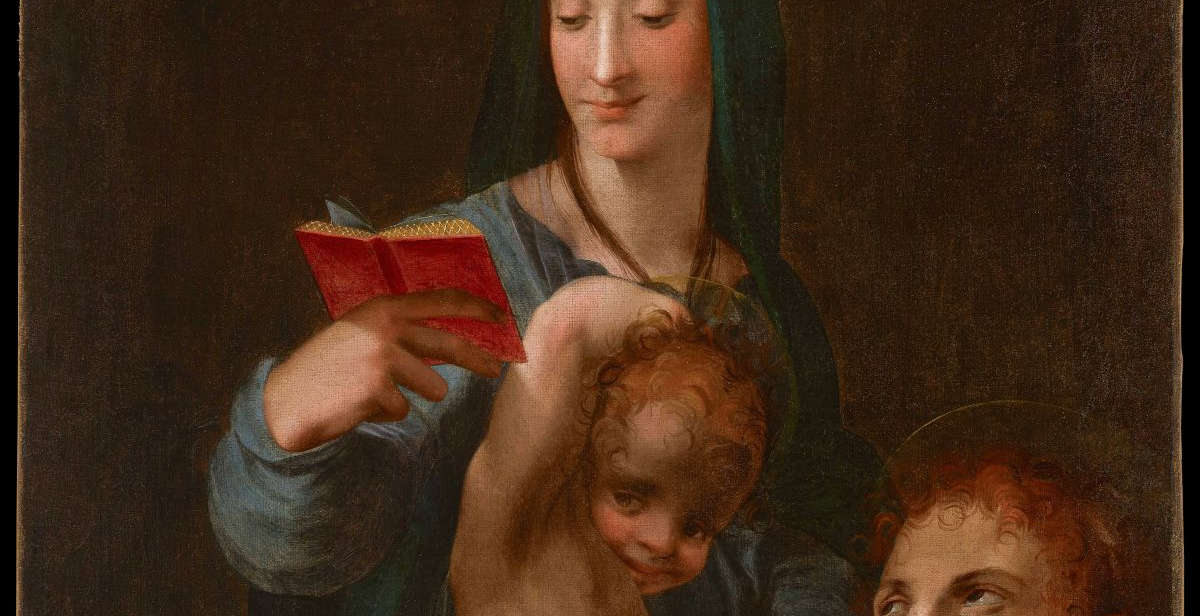
Stylistically, the painting already shows the tensions that would characterize the artist’s mature production. The Virgin appears motionless and solemn, with a grace that recalls Raphaelesque models, while the Child is distinguished by an accentuated physicality and an unstable pose that evokes both Donatello’s experiments and Michelangelo’s heroic nudes. Intensifying this dynamic is the presence of Saint John the Evangelist, placed in an intermediate position between the sacred scene and the viewer.
The saint is represented in a state of prophetic vision that reflects and amplifies the emotional involvement of the viewer, creating a bridge between the image and the viewer. This compositional solution, together with the use of formal tensions, anticipates the developments of Mannerism and testifies to the early originality of the artist.
The Madonna and Child with Saint John the Evangelist is currently on display in Gallery 609 of the museum’s Fifth Avenue headquarters, offering the public an opportunity to take a close look at a work that, after centuries of oblivion, once again occupies a central place in the history of Renaissance art.
 |
| Rosso Fiorentino's first painting rediscovered: the Met in New York will acquire it |

Warning: the translation into English of the original Italian article was created using automatic tools. We undertake to review all articles, but we do not guarantee the total absence of inaccuracies in the translation due to the program. You can find the original by clicking on the ITA button. If you find any mistake,please contact us.



























 IT
IT FR
FR DE
DE ES
ES CN
CN


