



by Redazione 05/01/2026



Categories: Contemporary art / Disclaimer
At Lagazuoi Expo Dolomiti, one of the highest exhibition spaces in Europe, located at 2,732 meters above sea level, Fulvio Morella's exhibition "Cortina di Stelle," the final chapter of the project I limiti non esistono (Limits do not exist), dedicated to the symbolic places of the Milan-Cortina 2026 Winter Olympics and Paralympics.
It opened on January 3, 2026, at the Lagazuoi Expo Dolomiti, one of the highest exhibition spaces in Europe, located at 2,732 meters above sea level, Fulvio Morella ’s Cortina di Stelle exhibition, the final chapter of the project I limiti non esistono (Limits do not exist), dedicated to the symbolic places of the Milan-Cortina 2026 Winter Olympics and Paralympics. Curated by Sabino Maria Frassà, the exhibition is part of the official program of theMilan Cortina 2026 Cultural Olympiad and can be visited until April 5, 2026, every day during the opening hours of the Lagazuoi Cable Car (9 a.m. to 5 p.m.).
Under the patronage of the Italian Paralympic Committee and INJA “Louis Braille,” the project, which focuses on the dialogue between art, inclusion and sport, comes to the spaces of the Lagazuoi Expo Dolomiti after previous stops in Val di Fiemme, at the Museum of Contemporary Art in Cavalese, and in Milan, at Palazzo Lombardia, the headquarters of the Region. The exhibition is also enriched by the direct testimony of some of the most important Paralympic athletes, including Renè De Silvestro (standard-bearer of Paralympic Italy at Milan Cortina 2026), Moreno Pesce and Francesca Porcellato, also selected in collaboration with FISIP - Federazione Italiana Sport Invernali Paralimpici.


The exhibition focuses on multisensory works that integrate braille, transforming this tactile language into an artistic experience and a tool capable of overcoming perceptual and conceptual barriers. Consisting of 36 works of art and historical memorabilia, the itinerary is fully in the context of the Milan Cortina 2026 Cultural Olympiad, the multidisciplinary and widespread program that will cross Italy to promote Olympic values and foster dialogue between art, culture and sports, in the run-up to the Olympic and Paralympic Winter Games to be held February 6-22 and March 6-15, 2026, respectively.

Fulvio Morella is known for his immersive and multisensory research. Winner of the Alfredo D’Andrade Lifetime Achievement Award 2023, he is featured in major international collections, including the Victoria and Albert Museum in London and the Kunsthistorisches Museum in Vienna. After celebrating the bicentennial of braille in Paris in 2024 with the exhibition Ailes de Mouette(Seagull’s Wings), Morella has continued to question the concept of limits, developing works that investigate how and why limits are often mental constructions. “To touch the sky with one finger,” he writes, “we must first stop fearing the gaze, knowledge and understanding of the infinity we hold within us. Let us look within to go beyond; let us look around to discover art and win together.”
The first cycle of works, titled Blind Wood (wood and braille), includes sculpture-paintings made of wood and metal, enriched with braille lettering. In these works, Morella combines circles, squares, ovals, reflective dots and colors that recall famous monuments observed from above: from the temple of Delphi to the Arena of Verona, from the Pantheon in Rome to the red domes of Palermo. Braille indications guide the public toward a deeper reading of the works, conceived as a reflection on the concept of limits and the partiality of individual perception.
This core is joined by Starry Braille, a large corpus designed to celebrate the bicentennial of the braille alphabet. In this series, braille dots are transformed into stars and constellations to be explored by touch, composing night skies punctuated by quotations from St. Francis, Jung, and Saint-Exupéry. Only those who know the Braille alphabet have the ability to decode the messages enclosed in his works. Like the one encapsulated in Bach’s Pupil: “Perfection has no limits” from Jonathan Livingstone’s Seagull. Fulvio Morella’s stars are cryptic for those who ignore the Braille alphabet but perfectly readable for those who know it. In this way, Morella manages to transform Braille into a new aesthetic language.
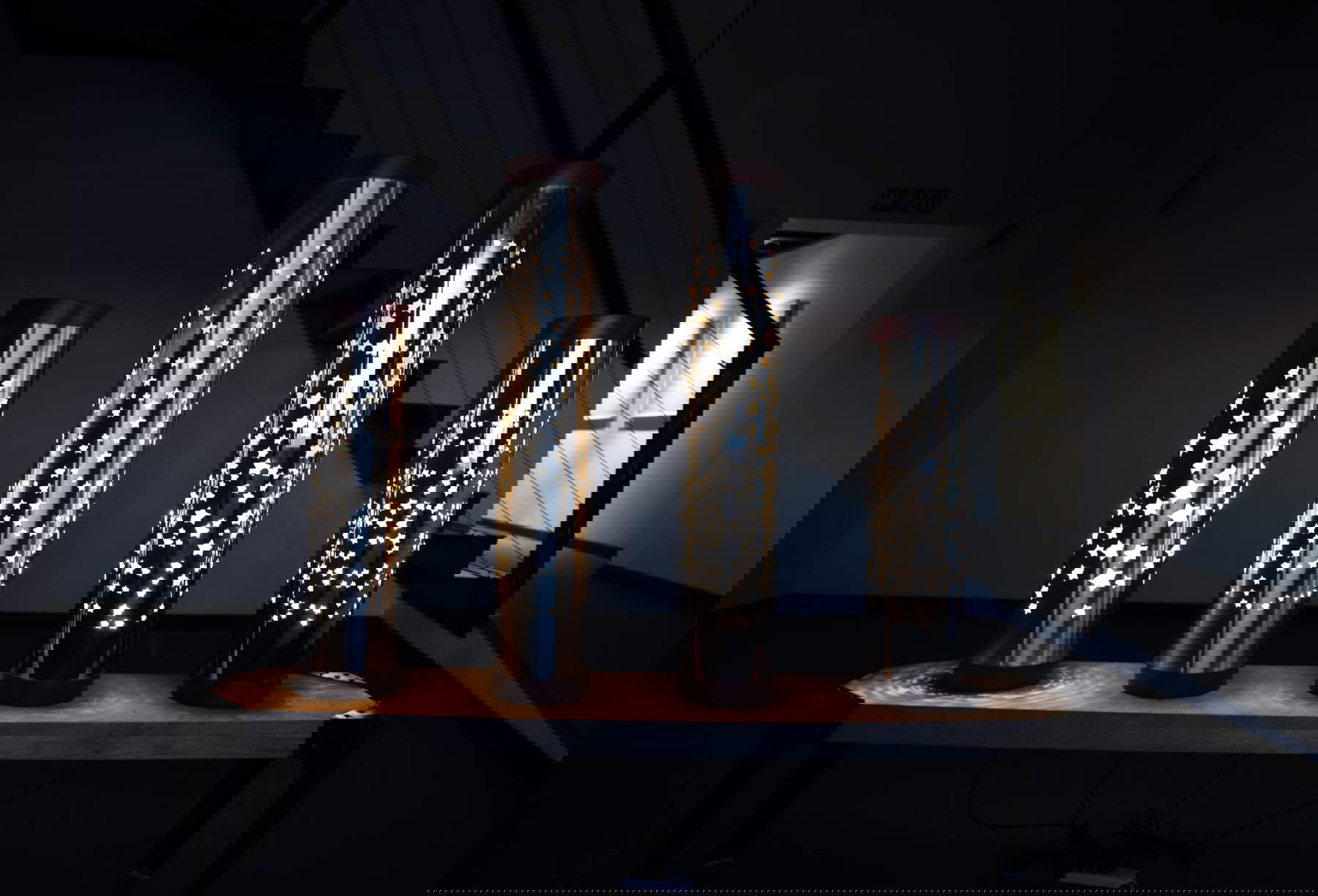
With the Braillight cycle, light is transformed into matter: a series of light sculptures in steel and amaranth wood that use Braille as a light source. First presented in 2024 in Engadine, the works are now reunited in Cortina di Stelle as a complete cycle, enriched by new creations from the Eclipse series. In these works, light and metal chase and overlap, evoking the astronomical phenomenon to reflect on the relationship between shadow and illumination. At high altitudes, where light is more intense and grazing, Braillight does not blind but orients, like the North Star or like the guiding voice next to a visually impaired athlete: it is the three-dimensionality of braille that evolves from tactile constellation to luminous sculptural form.
Also on display within the exhibition are some memorabilia from the Republic of San Marino’s Museum of Sports and Olympics, a treasure chest of San Marino’s sports and Olympic memory. Among the objects on display at Lagazuoi Expo Dolomiti are the flashlight from the 1960 Summer Olympics in Rome, San Marino’s first historic participation, and the flashlight from the 2006 Winter Olympics in Turin.
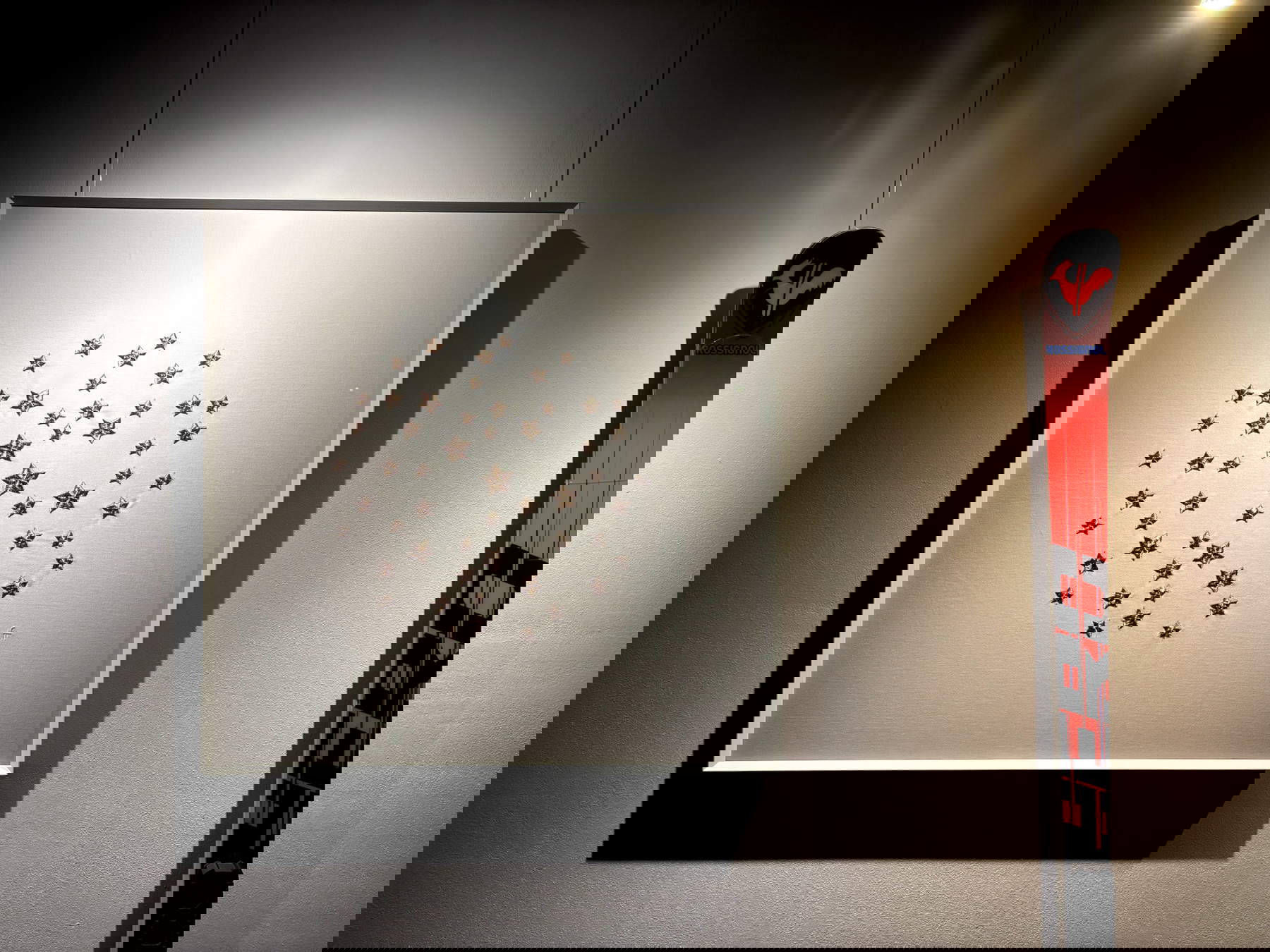
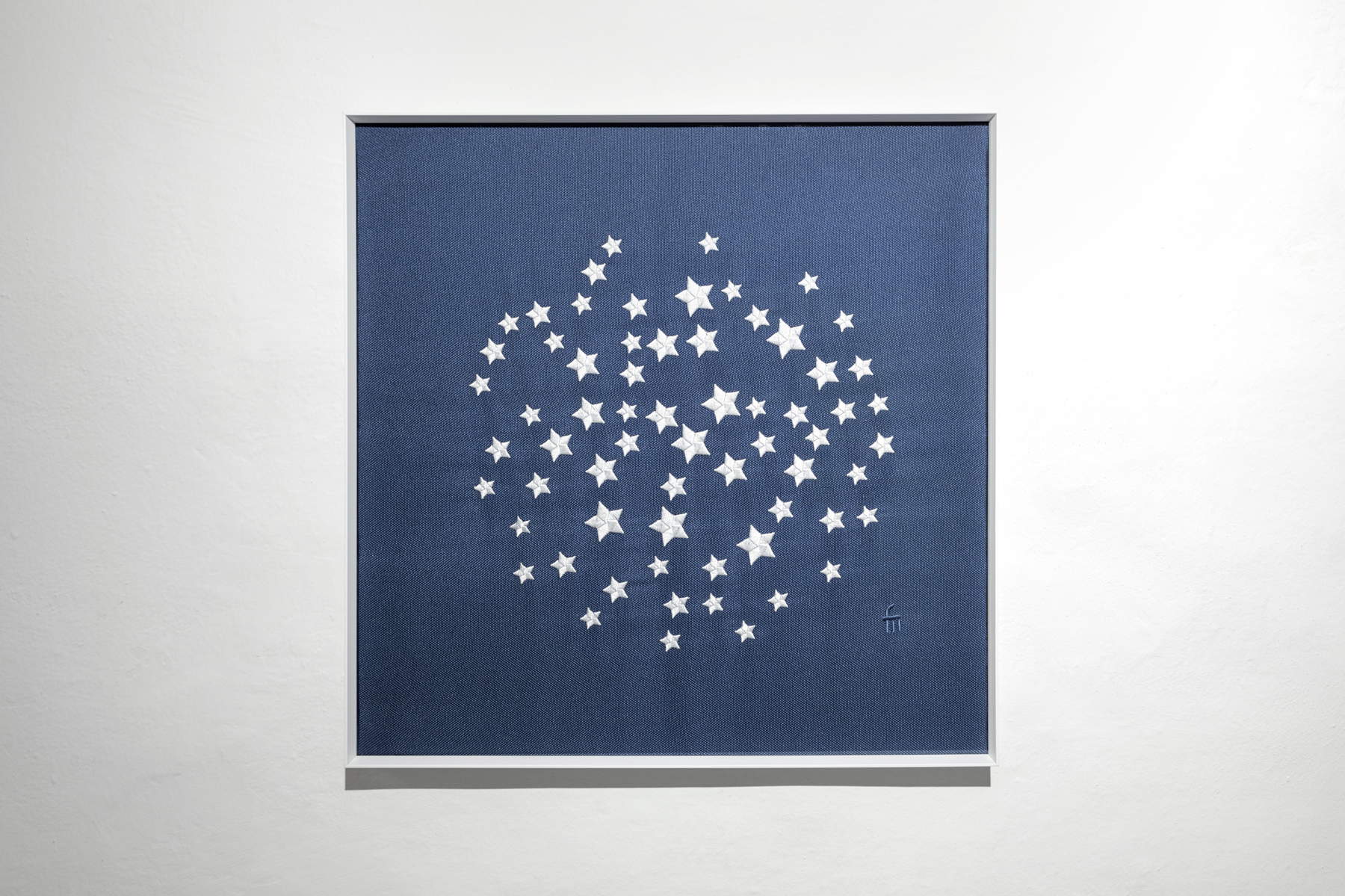
“What is a curtain?” asks curator Sabino Maria Frassà. “In Italian it is veil or curtain: it separates and protects, but it can also hide. Cortina d’Ampezzo also carries this ambivalence in its name: an inhabited basin, an Alpine ’court’ surrounded by peaks open to the sky. The exhibition chooses to be here to lift the veil and accompany the gaze up to ’brush against the stars.’” “Cortina di Stelle shows that the infinite outside, which human beings have always yearned for, coincides with the infinite inside when the community accepts to be a reciprocal instrument: art stops being an image to be contemplated and becomes a common language, sport stops being an individual performance and becomes a choral enterprise again. Here, truly, limits do not exist: there are curtains to be lifted.”
“We are honored to welcome in our spaces the art of Fulvio Morella, an art project that combines art, sport and inclusion and that invites us to overcome the limits we set for ourselves, just like those who face a mountain,” says Stefano Illing, creator of Lagazuoi Expo Dolomiti. “By bringing art to a height of 2,732 meters we want to transform natural beauty into a stage, with this goal we fully embrace the vision of universality that Fulvio Morella’s art suggests.”
|
| At 2,732 meters above sea level, at Lagazuoi, Fulvio Morella's art, inclusion and sports project |
Warning: the translation into English of the original Italian article was created using automatic tools. We undertake to review all articles, but we do not guarantee the total absence of inaccuracies in the translation due to the program. You can find the original by clicking on the ITA button. If you find any mistake,please contact us.