





... and the knight saved the princess from the terrible dragon. It sounds like thehappy ending of one of those fairy tales we used to read to each other as children, already under the blankets, before falling asleep, but in fact the story of St. George and the dragon has very ancient origins and waswidely spread throughout Europe thanks to Iacopo da Varazze, at the time archbishop of Genoa, with his Legenda Aurea written around 1260. It is no coincidence, therefore, that the Ligurian capital wanted to dedicate an entire exhibition (the first Genoese one on the subject) to the figure of the knight saint, who belongs to the history and collective memory of the Genoese, and to his fortune in the artistic sphere, given also that St. George was protector of the Republic of Genoa and today is one of the four patron saints of the city. A link, therefore, between the city and the saint that starts in antiquity, crosses the centuries and continues to this day in the depictions of St. George that one encounters simply strolling through the historic center, on the portals of palaces carved in stone, in the frescoes of the palace of the same name near the Old Port, in the city’s gonfalon, and even in contemporary street art.
Staged in the Falcone Theater of the Royal Palace, St. George. The Journey of a Knightly Saint from the East to Genoa, curated by Alessandra Guerrini and Luca Leoncini, Anna Manzitti, Gianluca Zanelli with Michele Bacci, Clario Di Fabio, Michel Huynh, and Anna Melograni and on view until March 1, 2026, is a delightful little exhibition that is easy for everyone to understand, including children, as it focuses solely on the depiction of St. George, with his attributes (the knight’s robe, the shield with sword and lance, the horse), and the dragon in the period between the final phase of the Middle Ages and the early Renaissance, but has managed to obtain for the occasion important national and international loans (Paris, Brussels, Hamburg, Cologne, Seneffe). The pleasantness that characterizes the exhibition in its entire narrative path, divided by sections, lies in having selected works and objects known and less known, but especially of the most diverse materials: illuminated paper, chiseled silver, paintings on canvas and panel, armor, reliquaries, carved wood, sculpted marble, cast bronze, terracotta, alabaster, and plaster, so that the gaze is lost in the most refined and curious details, testifying moreover to how the various artists, in the most diverse techniques, depicted one of the most identifiable characters for Genoa and its citizens.
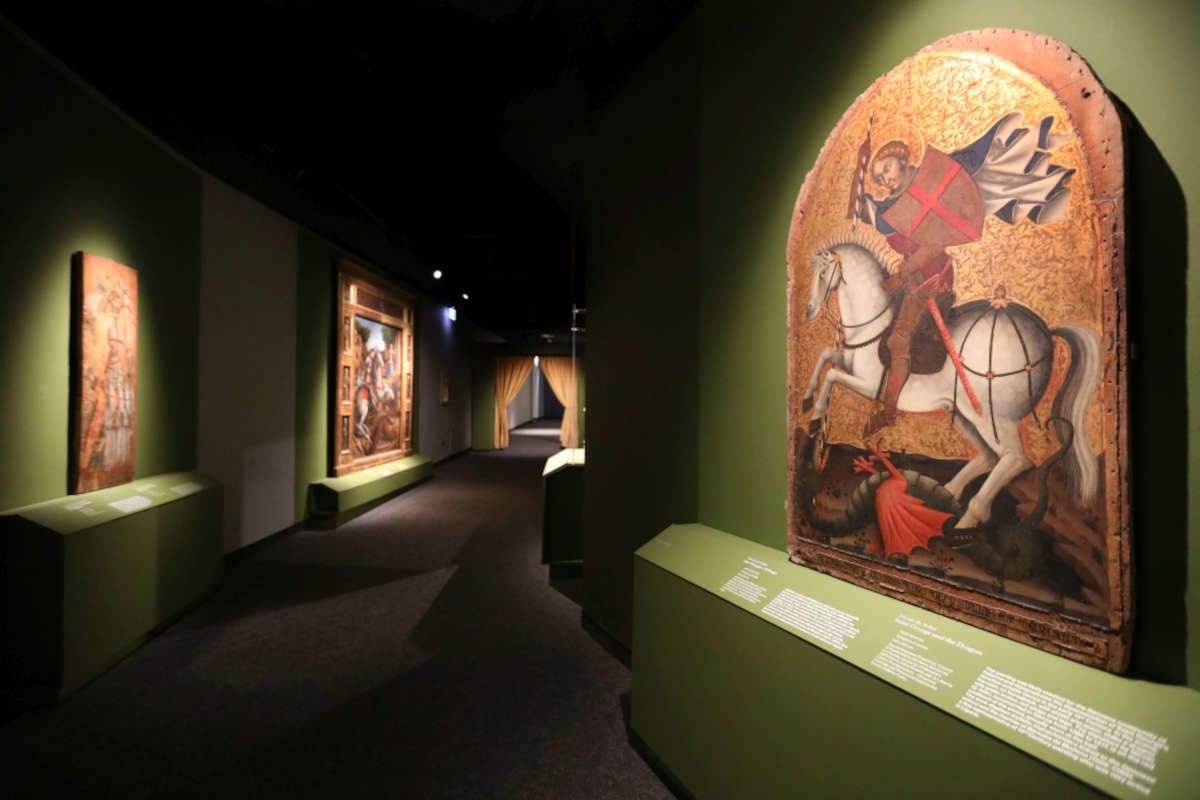
The story of St. George begins in Cappadocia, in present-day Turkey, where early sources from the fifth to seventh centuries describe him as an almost invincible Christian martyr who challenges the emperor Diocletian. Initially he is not the warrior who pierces the dragon, but a soldier who endures cruel torture, raises the dead, and confronts the devil by the sheer force of his unwavering faith. His death by beheading around 303 CE definitively established him as a universal symbol of spiritual purity and courage. The saint’s iconography then underwent a slow but steady evolution that transformed the martyr into the legendary knight we all recognize today. It was not until the 12th century, in fact, that the princess entered the scene, while it was from the 13th century in Byzantine circles that he was depicted in the form of a horseman on horseback piercing the monster, the iconography that spread to the East by means of gold-backed panels and frescoes and later reached the West, eventually establishing its most famous image here. The final transformation from soldier of the faith to knight armed with sword and lance is fueled by the Crusades in the Holy Land, a period when his figure takes on a marked military significance and spreads as a universal model for Christian soldiers. The sword, shield and armor that accompany George as protector of combatants become symbols themselves of his chivalrous character. The geography itself reflects the devotion to him, so much so that the Bosphorus Strait was anciently called brachium sancti Georgii (the arm of St. George), evoking not only the shape of the place but also the defensive strength of the saint believed to be the protector of sailors.
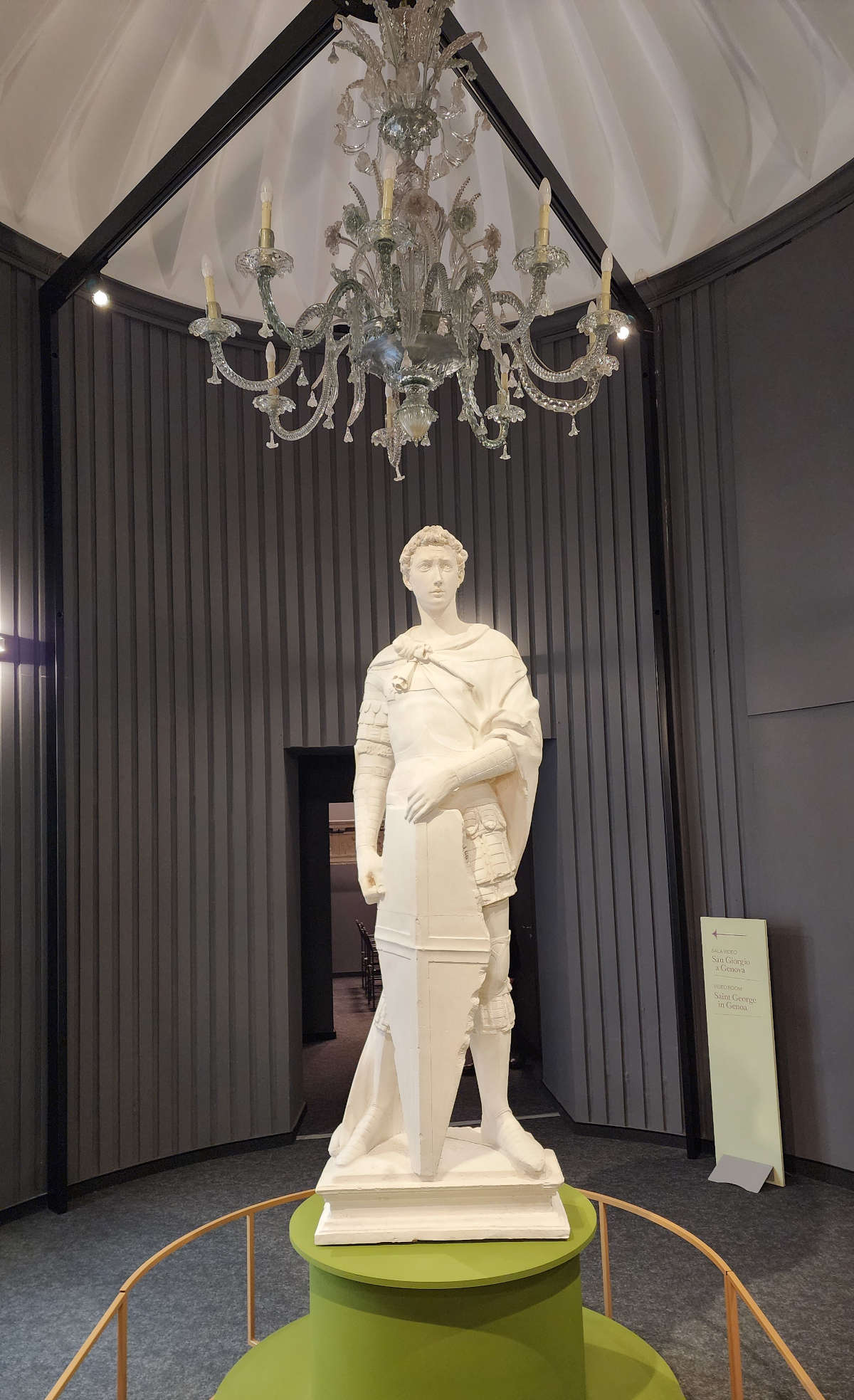
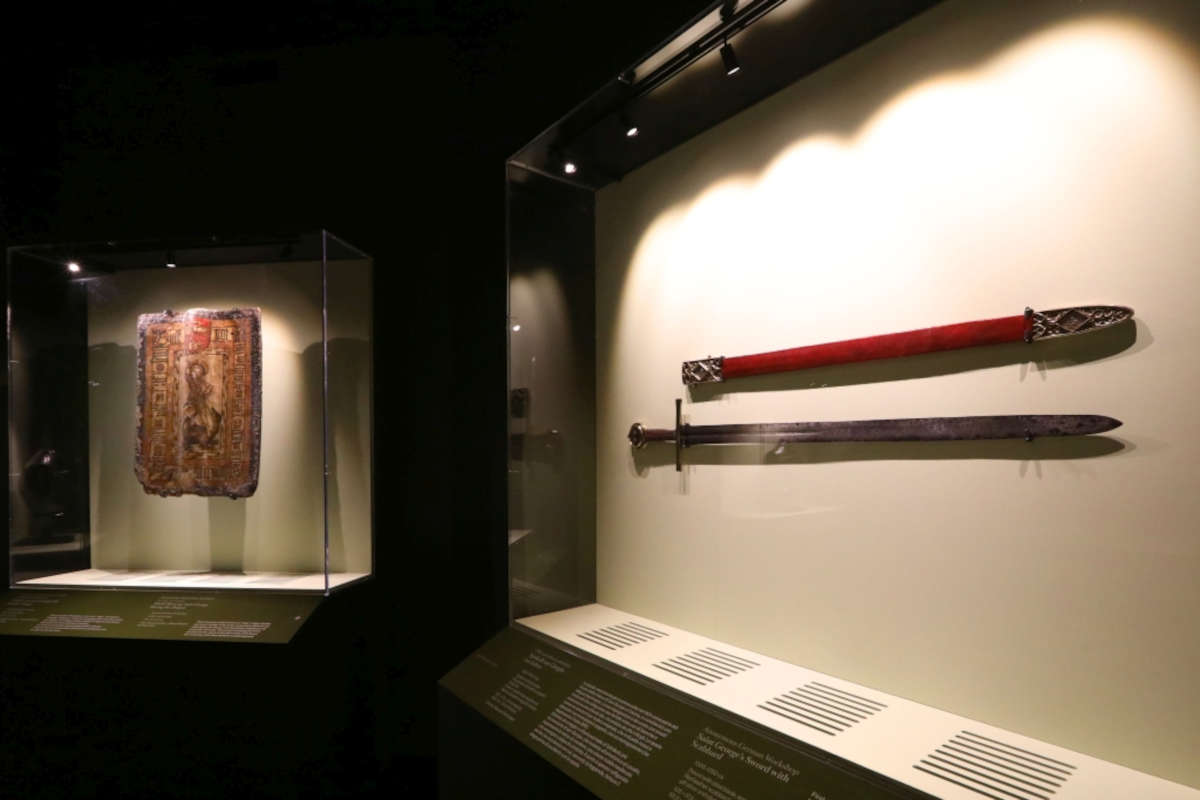
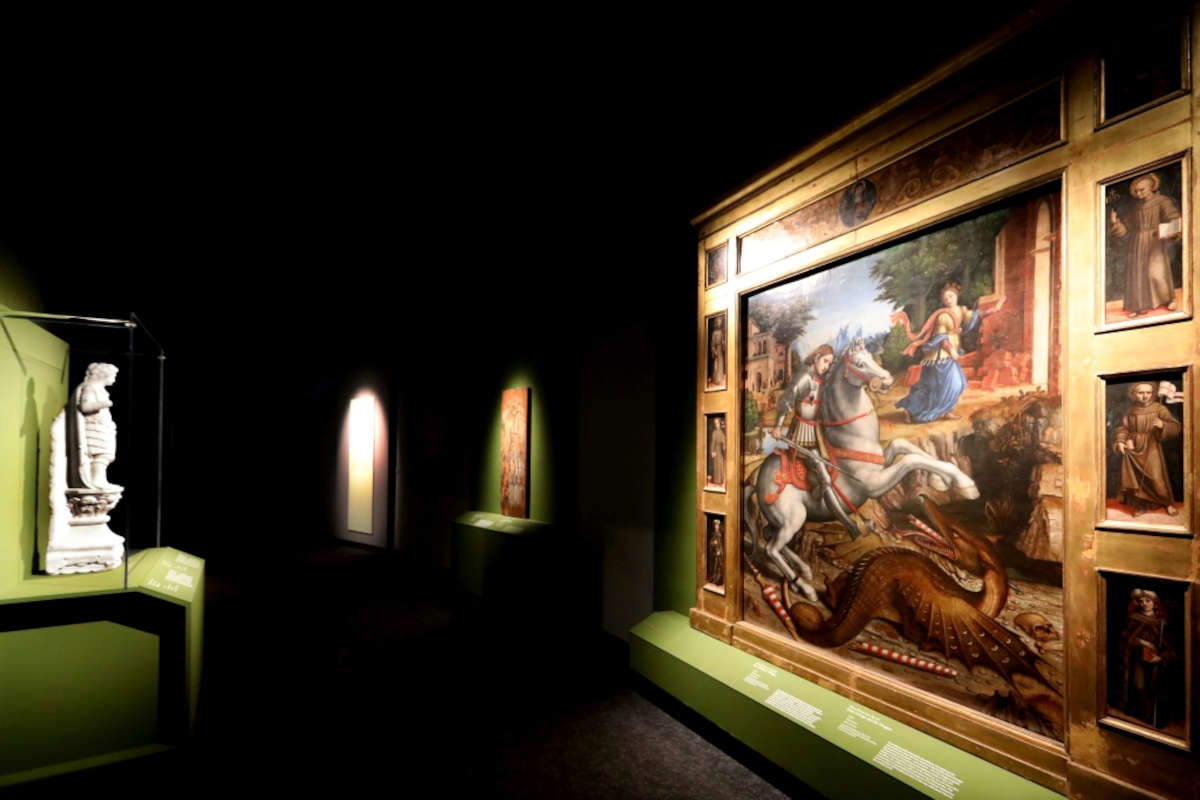
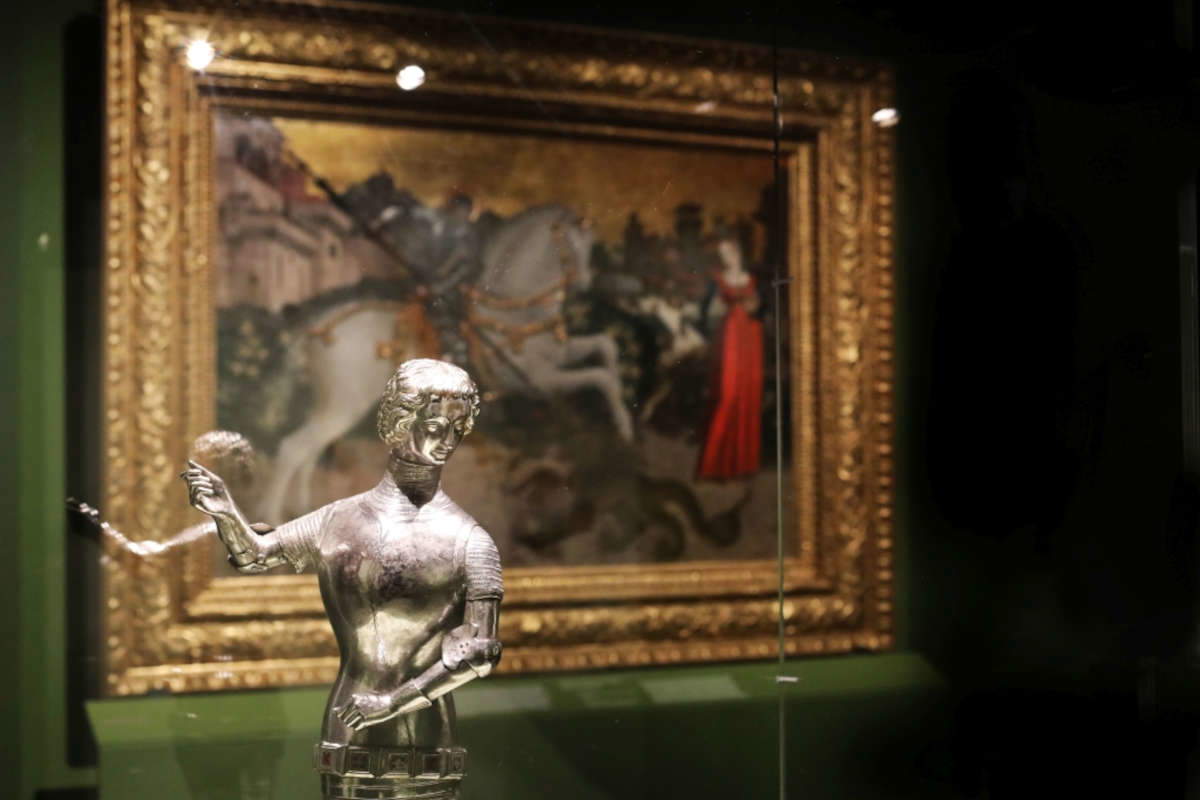
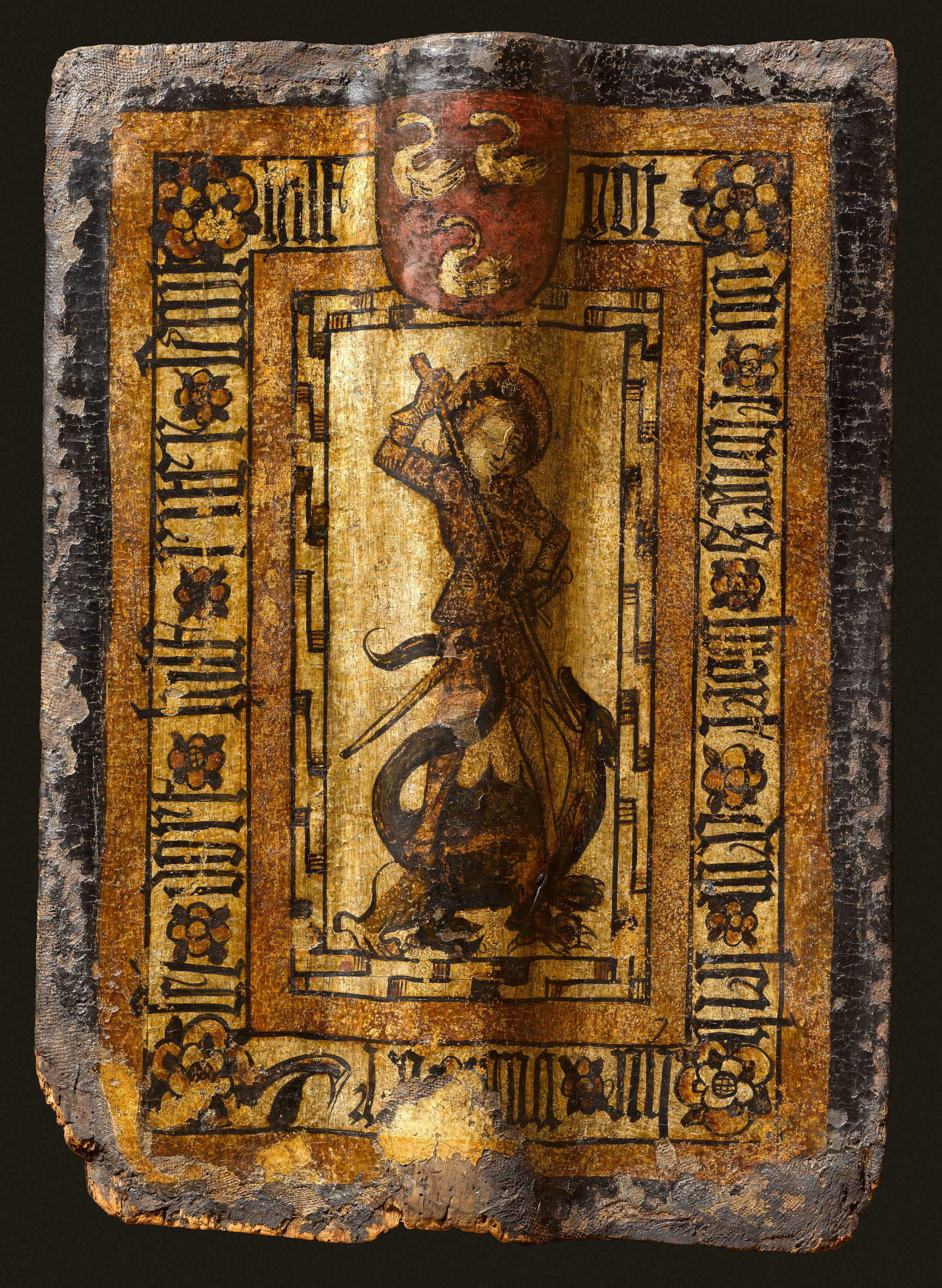
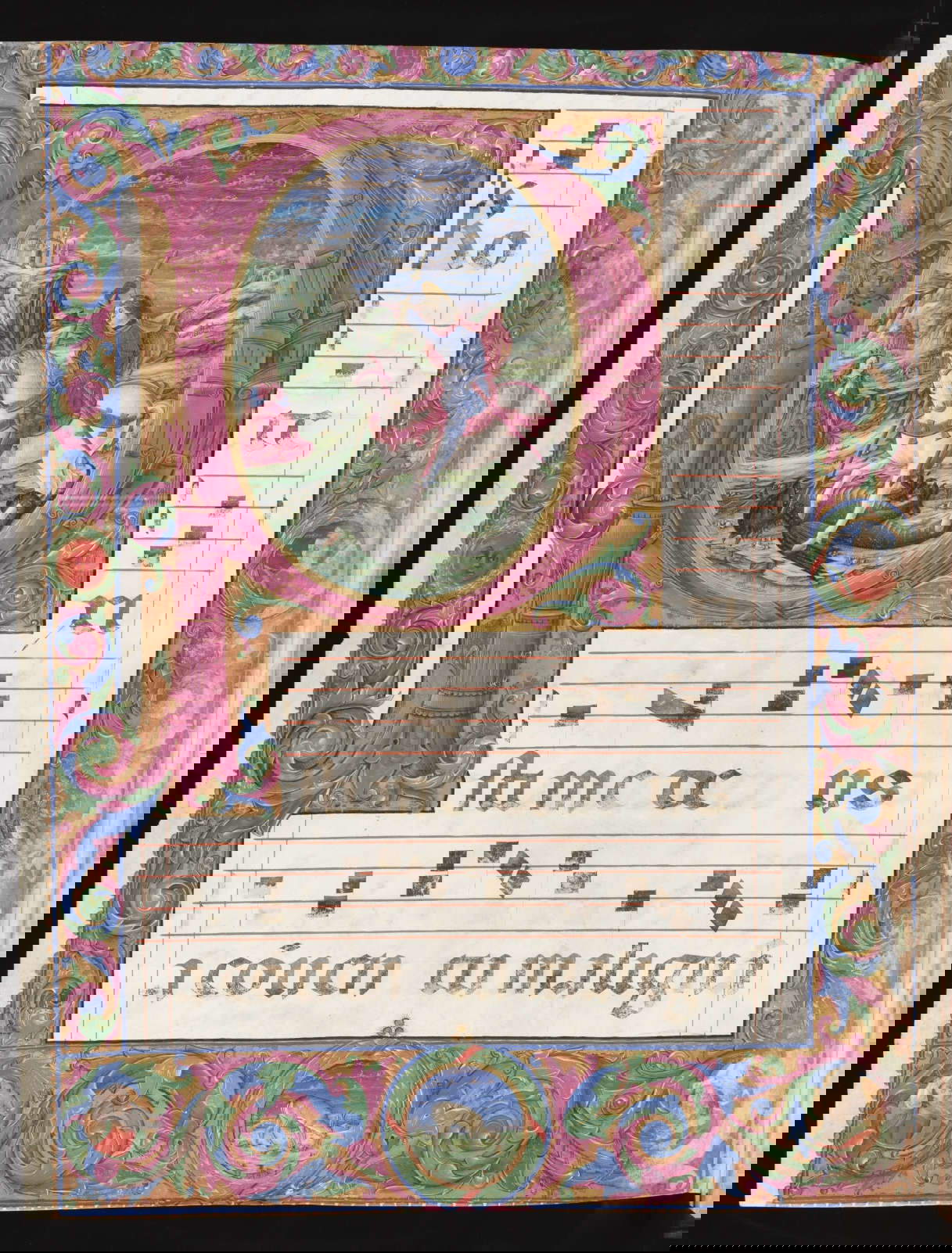
Welcoming visitors to the exhibition then is a plaster cast from the workshop of Oronzio Lelli that faithfully reproduces Donatello ’s St. George as a young classical hero, a masterpiece of 15th-century Italy and evidence of one of the most important Renaissance sculptures dedicated to the warrior saint with shield. The first room is also dedicated to the warrior saint, where a shield painted on leather with St. George piercing the dragon with a sword on loan from the Musée de Cluny, an early 14th-century sword considered in Cologne to be a relic of the saint, an early 16th-century suit of armor kept at the Stibbert Museum in Florence, and Vittore Carpaccio’s Saint George Slaying the Dragon , a 1516 painting on canvas from the Abbey of San Giorgio Maggiore in Venice in which the duel between the knight saint and the dragon is depicted, with the princess hiding behind a tree to escape. In the corridor that follows, the illuminated Kyriale from the Abbey of San Giorgio Maggiore in Venice and Giorgio Stella’s Annales Genuenses from the Franzoniana Library in Genoa: two 15th-century evidences of the presence of the image of St. George both in manuscripts with a liturgical function, as in the former case, and in civic texts, as in the latter case.
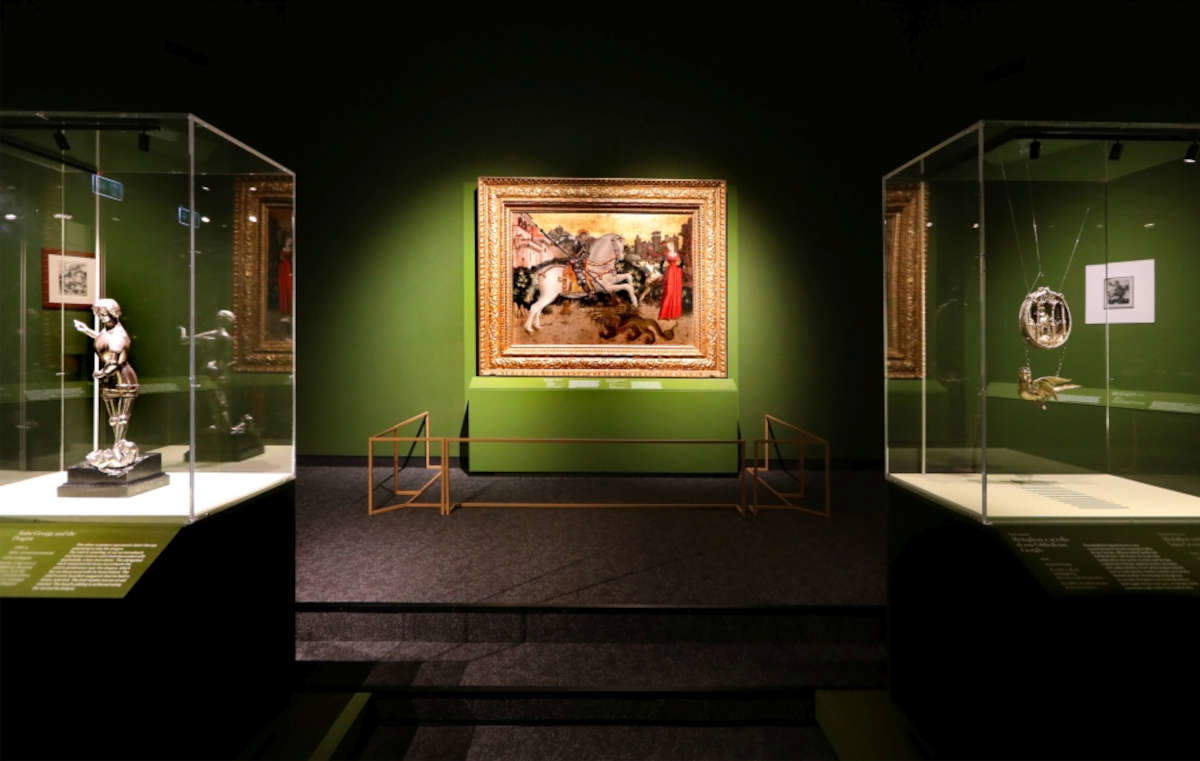
The next room is dedicated to the dragon, which for the medieval Christian did not represent a mere fantastic creature, but rather the personification of evil in all its forms: Satan, the Antichrist, heresy; the sin and temptation that undermine and corrupt man and against which one must fight daily. Thus it is that the image of George defeating the dragon becomes a visual parable against the dark forces. Curious and fascinating objects are on display here, such as the medieval chiseled cast bronze dragon-shaped aquamanile from Hamburg (note the figures climbing and clinging to the dragon’s torso, neck, and mouth, and the warrior on horseback depicted embossed on a wing), the Bargello aquamanile, also in bronze, where the greatly shrunken dragon is clinging to one of the horse’s hind legs, arousing the horse’s curiosity of the latter; the Candoglia marble gargoyle in the shape of a monstrous dog once gargoyled in Milan Cathedral; the unique 16th-century silver-gilt medallion, on loan from Brussels, that belonged to the Guild of St. George, a guild of archers that had spread through Flanders since the Middle Ages, from which is hangs a bird that originally constituted one of the targets that the archers had to hit during the annual Guild feast, and on the wall the St. George, the Dragon and the Princess by an anonymous Brescian painter from the Pinacoteca Tosio Martinengo, in which all the elements of the legend appear, including the liberated city in the background and the dragon with large bat wings of extreme finesse.
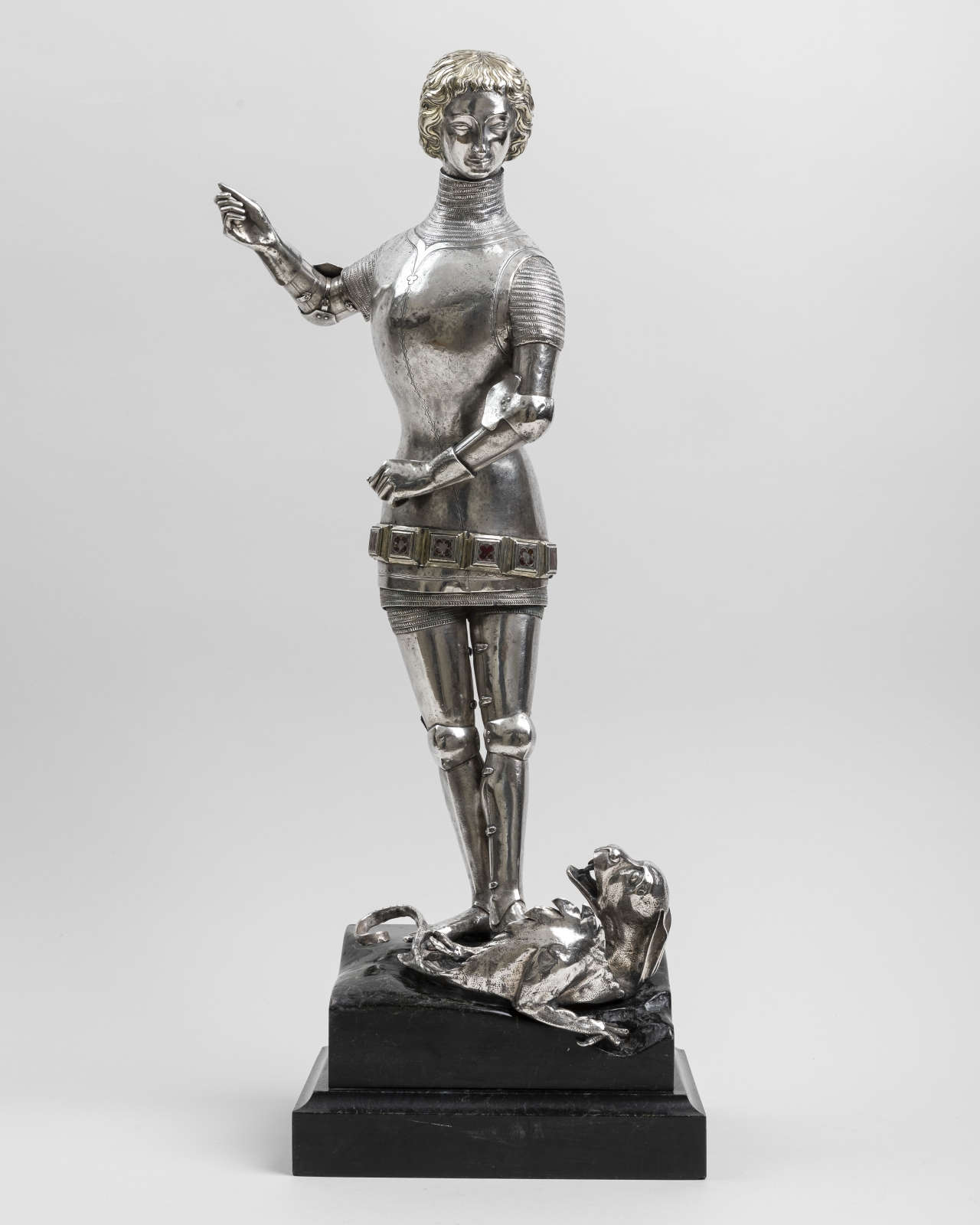
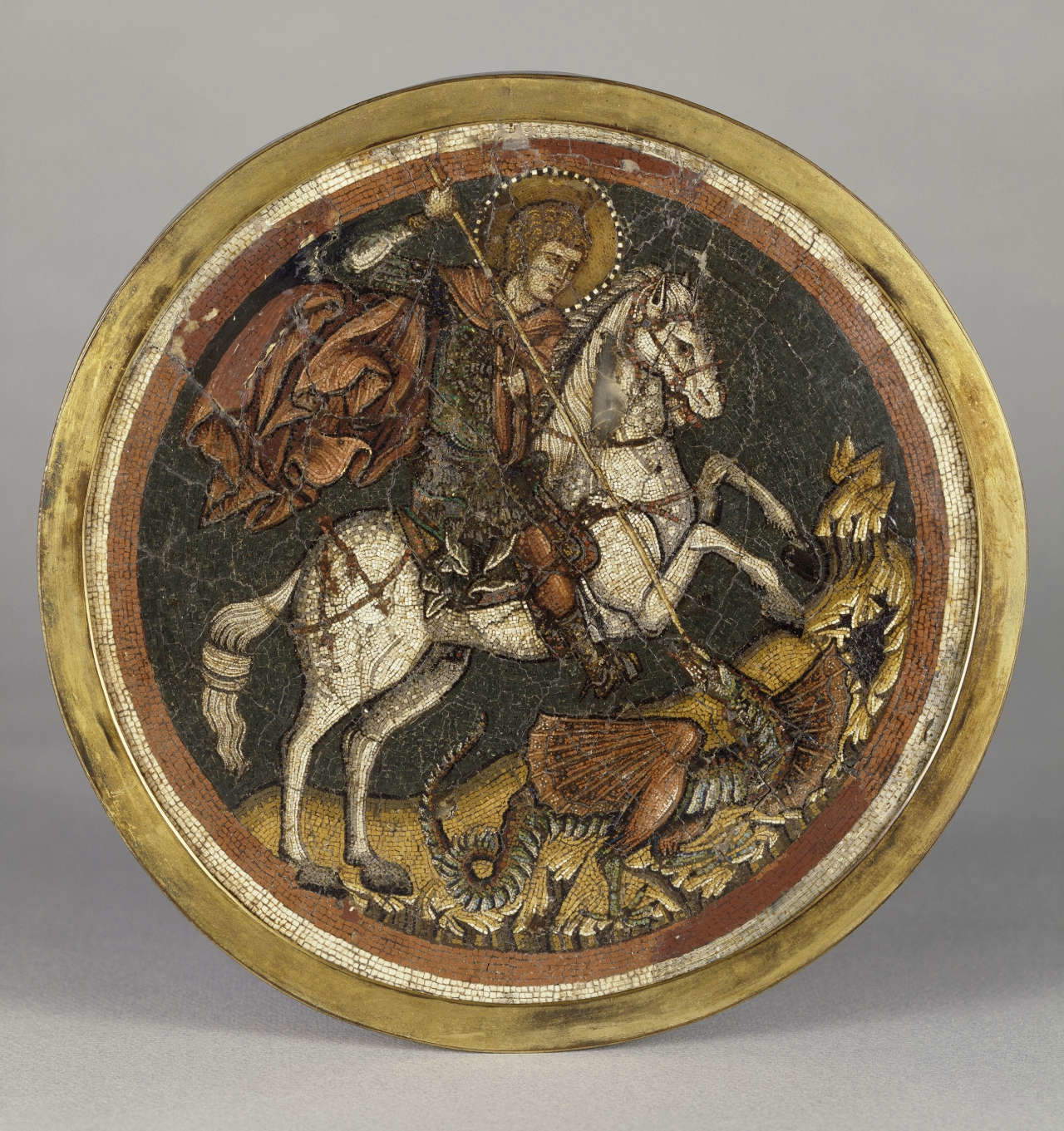
Also among the treasures on display is the sumptuous reliquary of the saint’s arm from the Treasure of St. Mark’s in Venice, which testifies to the intertwining of Byzantine and Venetian art, while the 14th-century Byzantine micromosaic from the Louvre with George Slaying the Dragon shows the power of myth in reduced size for private devotion.
In the Genoese context, St. George becomes an indissoluble identity icon. Since the 12th century, the Genoese have fought under two flags: one with a red cross on a white field, the other with the image of the saint. The cry “For Zena and Saint Zorzo!” handed down by popular memory resounded in fleets and squares, marking the saint’s transition from a sacred figure to a civil protector of the community invoked even during the plague.
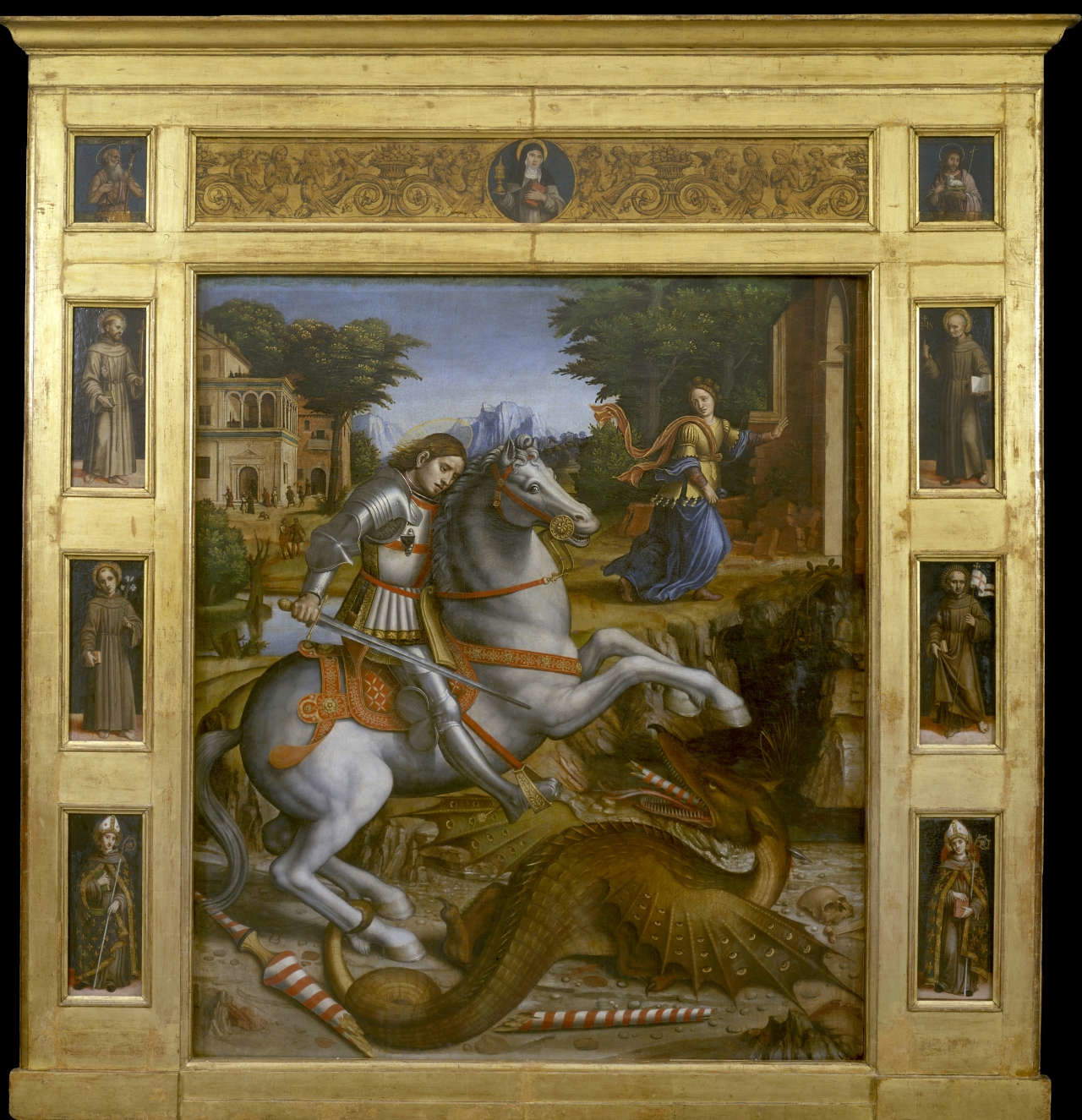
This symbolic force led in 1407 to the birth of the Banco di San Giorgio, apublic financial institution, one of the oldest in Europe, that administered debt, granted loans and governed territories; a true economic engine of Genoa that made the effigy of the saint a mark of prestige and economic soundness. Noble Genoese families, such as the Dorias, Giustiniani and Grillo, even had the image of George depicted above the portals of their palaces, and next to their own coat of arms, as a sign of power and safe protection for their business and home. The exhibition itinerary here therefore gives space to a selection of Genoese works or works of Genoese origin such as Luchino da Milano ’s San Giorgio from Palazzo San Giorgio in Genoa, seat of the eponymous Bank from the 15th century until the fall of the Republic: because of its monumental dimensions (180 by 330 centimeters), the care taken over the framing and the artist’s emphasis on the flag, it may originally have been a gonfalon. Returning instead to Genoa from Sicily for the occasion was the 15th-century Saint George and the Dragon by Nicolò da Voltri, commissioned by the Genoese community living in Palermo, which underscores the spread of the cult of the saint outside the city’s borders. Also on display is the large panel painting made for the church of Santissima Annunziata in Levanto by the Pavia-based painter documented in Genoa Pietro Francesco Sacchi, probably commissioned by Bernardo Giustiniani. The work in the center is framed on the sides by six figures of Franciscan saints and in the upper border by a medallion with St. Clare.
The exhibition also disproves the legend that Richard the Lionheart, passing through Genoa in 1190, asked the Genoese to adopt the flag with a red cross on a white field for his fleet in exchange for an annual tribute to the city. Historically, the red cross on a white field was already a widespread military emblem in medieval Europe, even appearing in the Bayeux Tapestry of 1066, well before the alleged agreements with the English king. Medieval sources mention neither flags nor agreements, but only trade, so the eighteenth-century hypothesis advanced by historian Francesco Maria Accinelli regarding a link between Richard the Lionheart and the Genoese flag has no basis. The spread of the cult of St. George in fact knows no boundaries: we find him in Georgia, where he gives his name to the nation and is celebrated on the national feast of Giorgoba (November 23), in England as the patron saint of the Order of the Garter mentioned even by Shakespeare in Richard III, in Russia, where he appears in the coat of arms of the city of Moscow, and in Catalonia where roses and books are given as gifts on April 23, the feast of Sant Jordi. Roma communities in the Balkans also honor him with a spring festival called Ederlezi, while in Ethiopia Coptic icons celebrate his white horse as a symbol of eternal victory of good over evil.
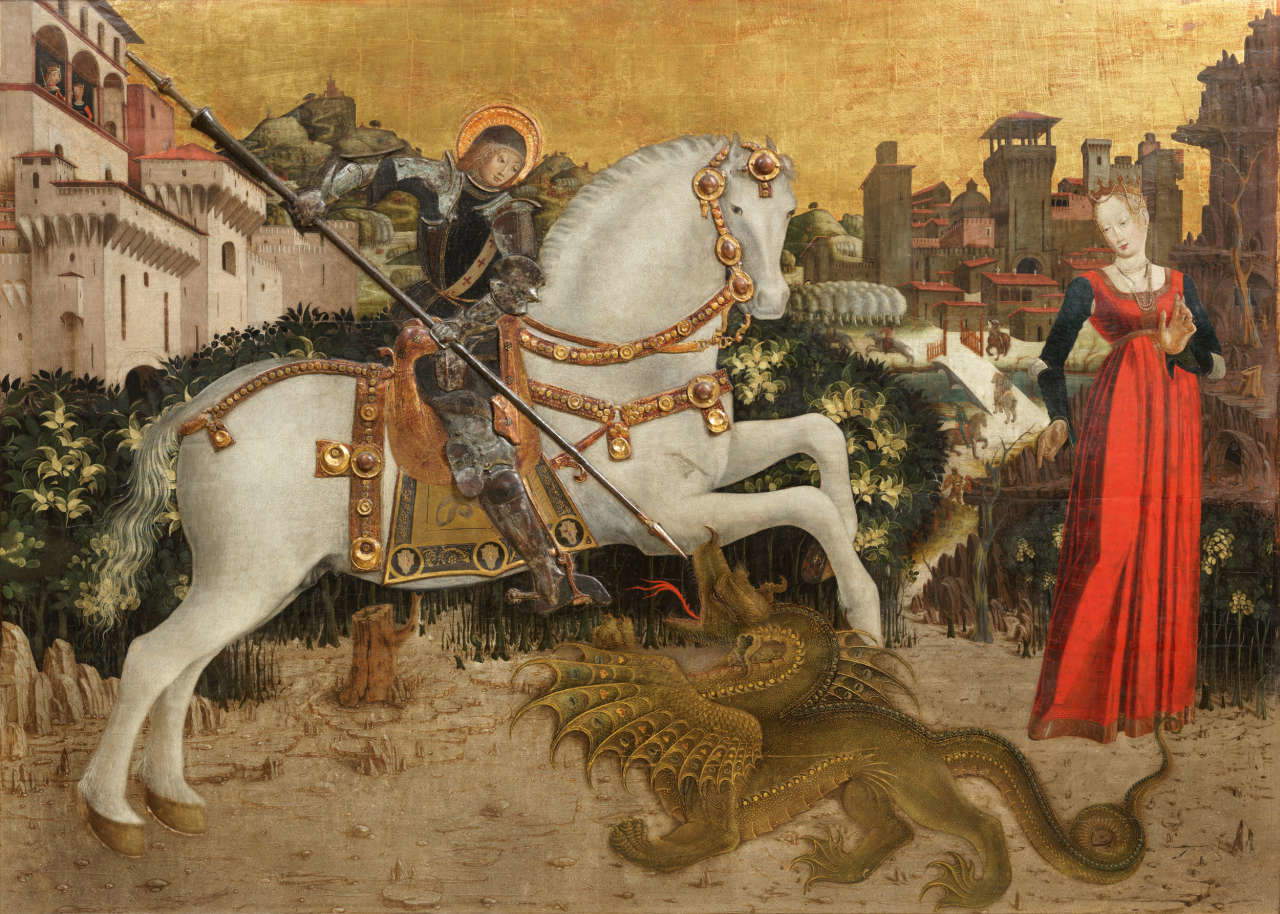
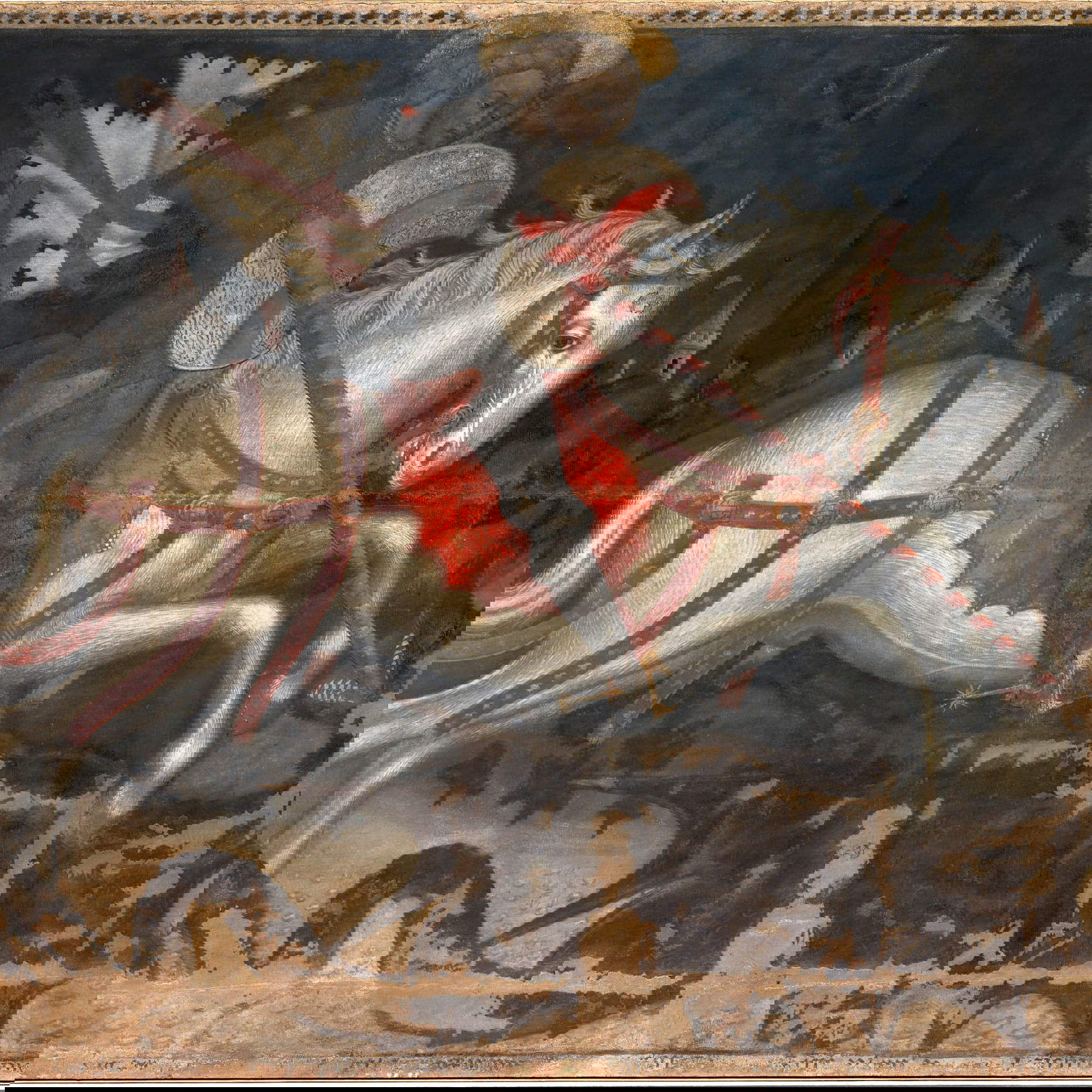
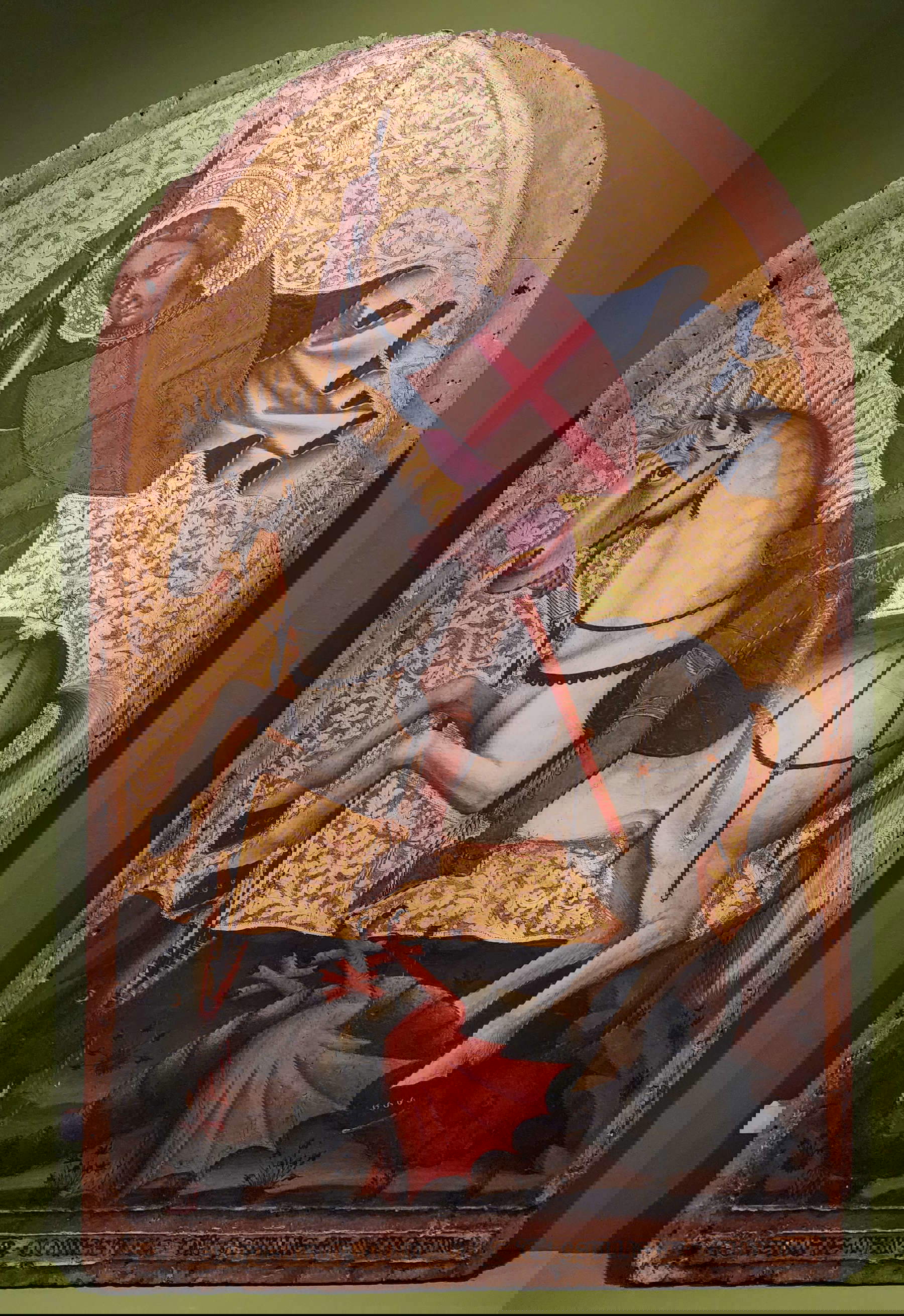
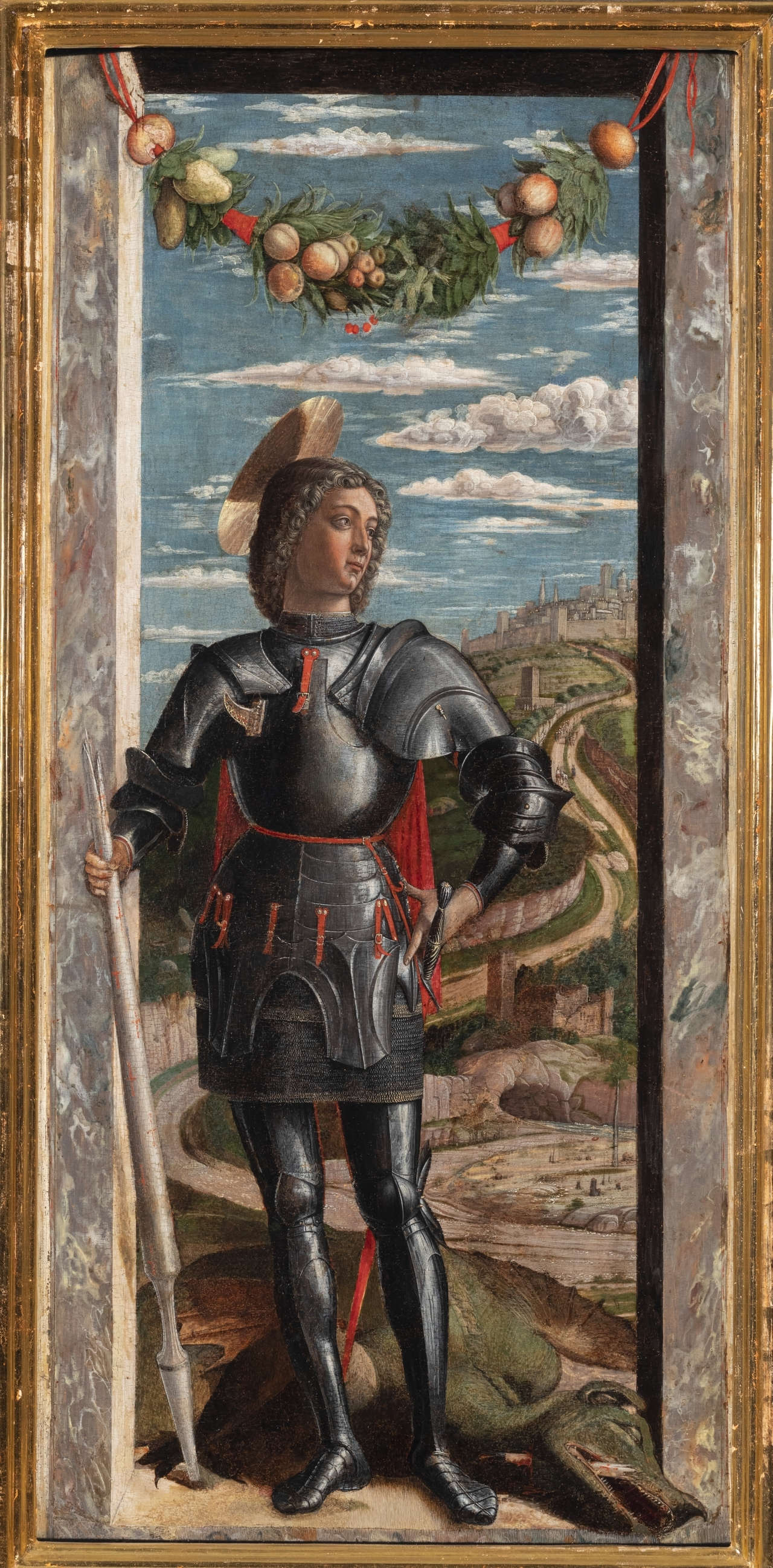
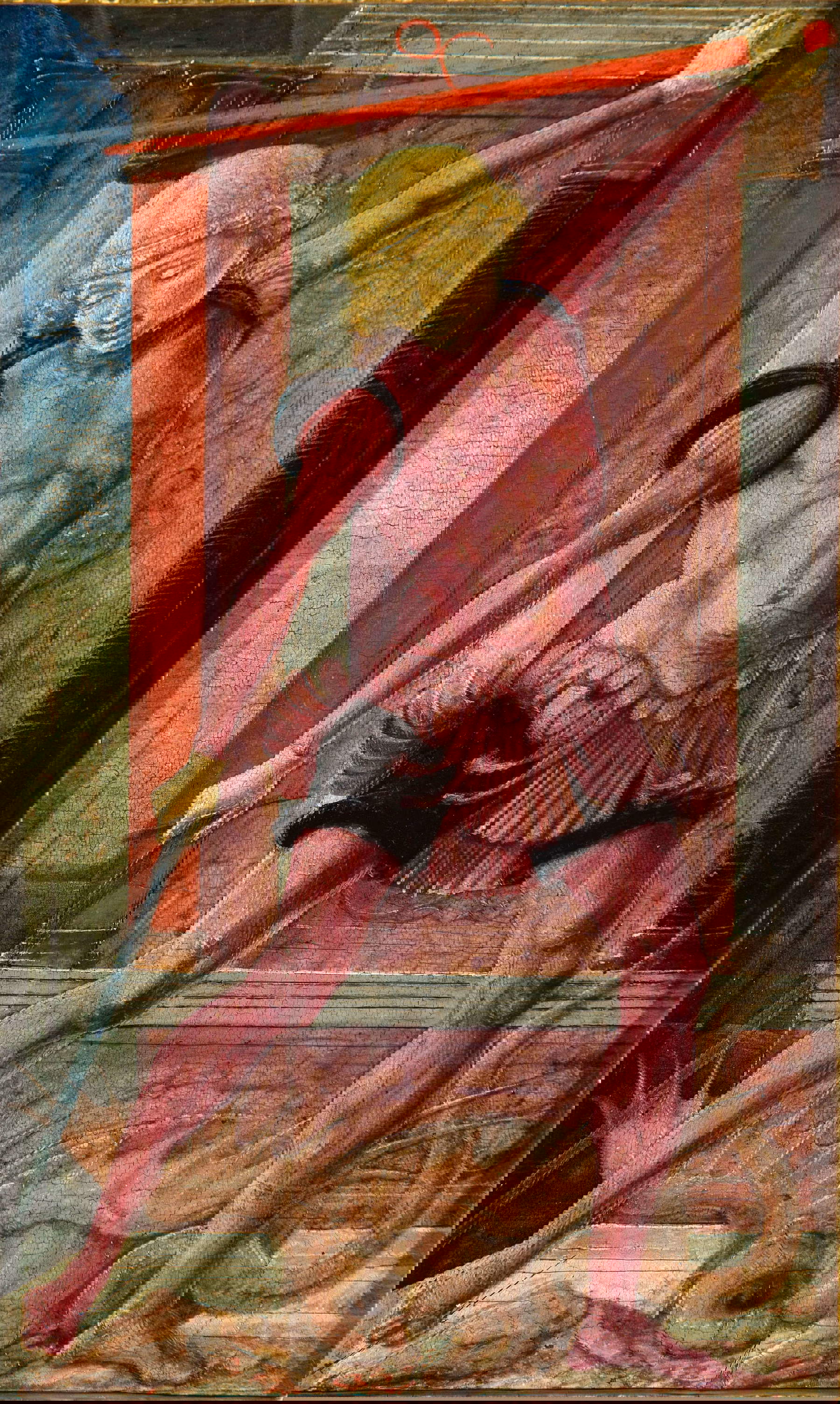
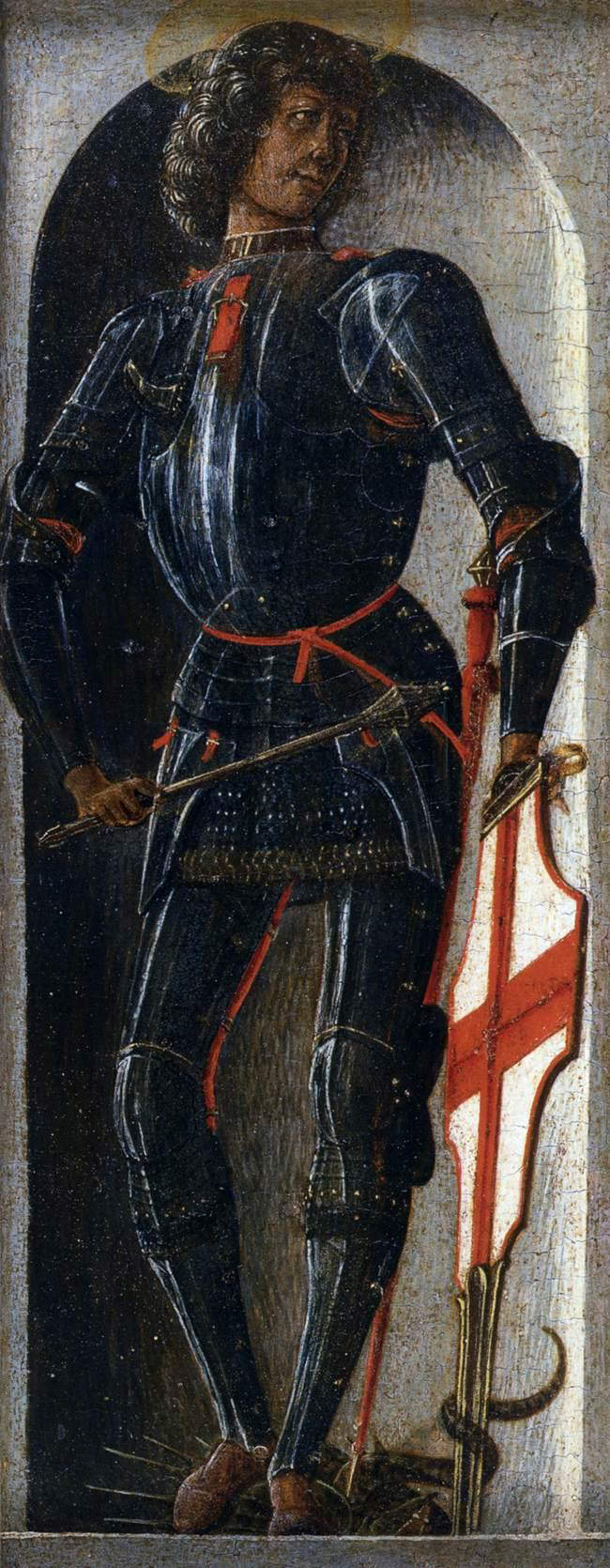
The exhibition finally culminates in the last room with Andrea Mantegna’s Saint George, exhibited for the first time in Genoa, in which the saint is portrayed victorious after slaying the dragon, surmounted by a festoon of leaves and fruit. A masterpiece rediscovered in 1834 when it reappeared in theinventory of the Manfrin collection in Venice. Disputed at the death of Marquis Pietro Manfrin among major European museums, including the National Gallery in London, in 1856 Pietro Selvatico, director of the Gallerie dell’Accademia, managed to obtain it for Venice with the permission of Franz Joseph of Austria. Finally rescued from Austrian aims, which had other plans for the work instead (at the Belvedere in Vienna), thanks to the proud protest of the Venetian people who prevented its final transfer, the painting has been housed in the Gallerie dell’Accademia in Venice ever since. Characterized by classical rigor, monumentality, and virtuosity such as the reflection of the nape of the saint’s neck in the halo, Mantegna’s San Giorgio became a landmark for the Ferrarese school, influencing artists such as Cosmè Tura, who interpreted the saint (on display here from the Cini Foundation in Venice) with a dynamic and dramatic tension, far removed from the latter’s solemnity, and Ercole de’ Roberti, who in the Griffoni Polyptych (the panel depicting the saint on loan from the Cini Foundation is on display here) fused Mantegna’s solidity with a supple and modern energy.
It is also noteworthy that, for greater understanding of the sections, the tour is accompanied by short videos by scholars that help provide more keys to understanding the figure of St. George and his widespread image. Special attention is also paid to children, for whom a notebook with activity-games and a downloadable audio guide with QR codes suitable for understanding the themes of the exhibition and the works on display have been created. Finally, the catalog published by Dario Cimorelli Editore includes in-depth essays and dedicated reflections as well as fact sheets of the works on display. My only note is that the works in the catalog do not follow the order in which they are displayed in the exhibition, making the sections unclear.
Nevertheless, this is a well-edited and enjoyable review that has the merit of having investigated for the first time in an exhibition awidely diffused iconography, including through unusual and curious objects that go beyond the usual pictorial depiction of the knightly saint, and of having contributed to perpetuating thatcollective identity that links Saint George to Genoa. The invitation, also stated through a map at the end of the tour route, is indeed to go out and have fun unearthing all the Saint Georges scattered around the city. A challenge aimed at young and old alike: who knows who will find the most.


The author of this article: Ilaria Baratta
Giornalista, è co-fondatrice di Finestre sull'Arte con Federico Giannini. È nata a Carrara nel 1987 e si è laureata a Pisa. È responsabile della redazione di Finestre sull'Arte.
Warning: the translation into English of the original Italian article was created using automatic tools. We undertake to review all articles, but we do not guarantee the total absence of inaccuracies in the translation due to the program. You can find the original by clicking on the ITA button. If you find any mistake,please contact us.

























 IT
IT FR
FR DE
DE ES
ES CN
CN


