



by Redazione 24/12/2025



Categories: Exhibitions / Disclaimer
With the exhibition dedicated to the restoration of Mirella Bentivoglio's work Hyper Ovum, Castello Gamba in Châtillon, Aosta Valley, launches the Contemporary Restoration project, a new initiative that combines the protection of artistic heritage with historical-critical research.
The exhibition spaces of the Gamba Castle-Museum of Modern and Contemporary Art of the Aosta Valley in Châtillon welcome from December 20, 2025 to February 22, 2026 an event that is much more than a simple exhibition: it is in fact a rediscovery and a deep philosophical reflection on matter and language. In fact, with the exhibition dedicated to the restoration of Mirella Bentivoglio’s work Hyper Ovum, Castello Gamba launches the Contemporary Restoration project, a new initiative that combines the protection of artistic heritage with historical-critical research. The initiative stems from the close link between the ordinary activity of protection and conservation of the works of art in the museum’s collection by the Historic-Artistic Heritage and Cultural Sites Management Structure of the Regional Superintendency and the constant commitment to study the works in the museum’s permanent collection. The aim is to show the public not only the work of art in its newfound beauty, but also the “behind the scenes” of theconservation intervention, accompanied by a careful historical insight curated by Davide Dall’Ombra. The focus of this first appointment isHyper Ovum, a monumental sculpture in linden wood from 1987, considered a cornerstone in the production of one of the most influential and multifaceted figures of the Italian neo-avant-garde: Mirella Bentivoglio.
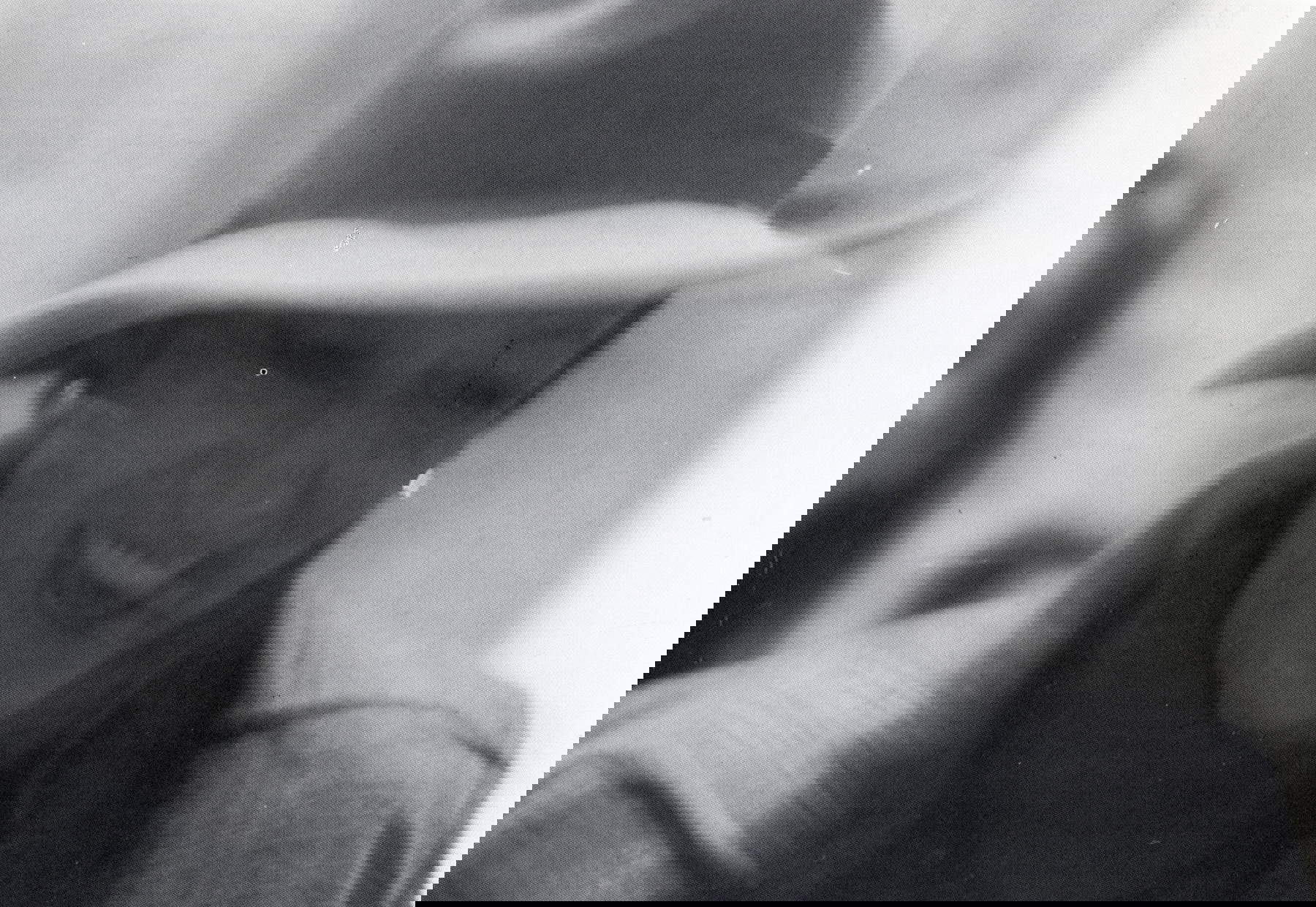
Born in Klagenfurt in 1922 and passed away in Rome in 2017, Mirella Bentivoglio was a poet, verbovisual artist and curator. Growing up in a multilingual environment between German-speaking Switzerland, England and Italy, she devoted her life to exploring the fine line where word becomes image and image becomes poetic substance.
From concrete poetry to visual poetry and visual writing to performance, action-poetry and poetry-environment to large symbolic structures of linguistic matrix on public land such as the famous Ovo in Gubbio, Bentivoglio has always claimed a “feminine” creative space. She has remained famous for her curatorship of the exhibition Materialization of Language for the 1978 Venice Biennale at the Magazzini del Sale, an event that exclusively welcomed works by women artists, marking a fundamental moment for art in the second half of the 20th century.


The Hyper Ovum
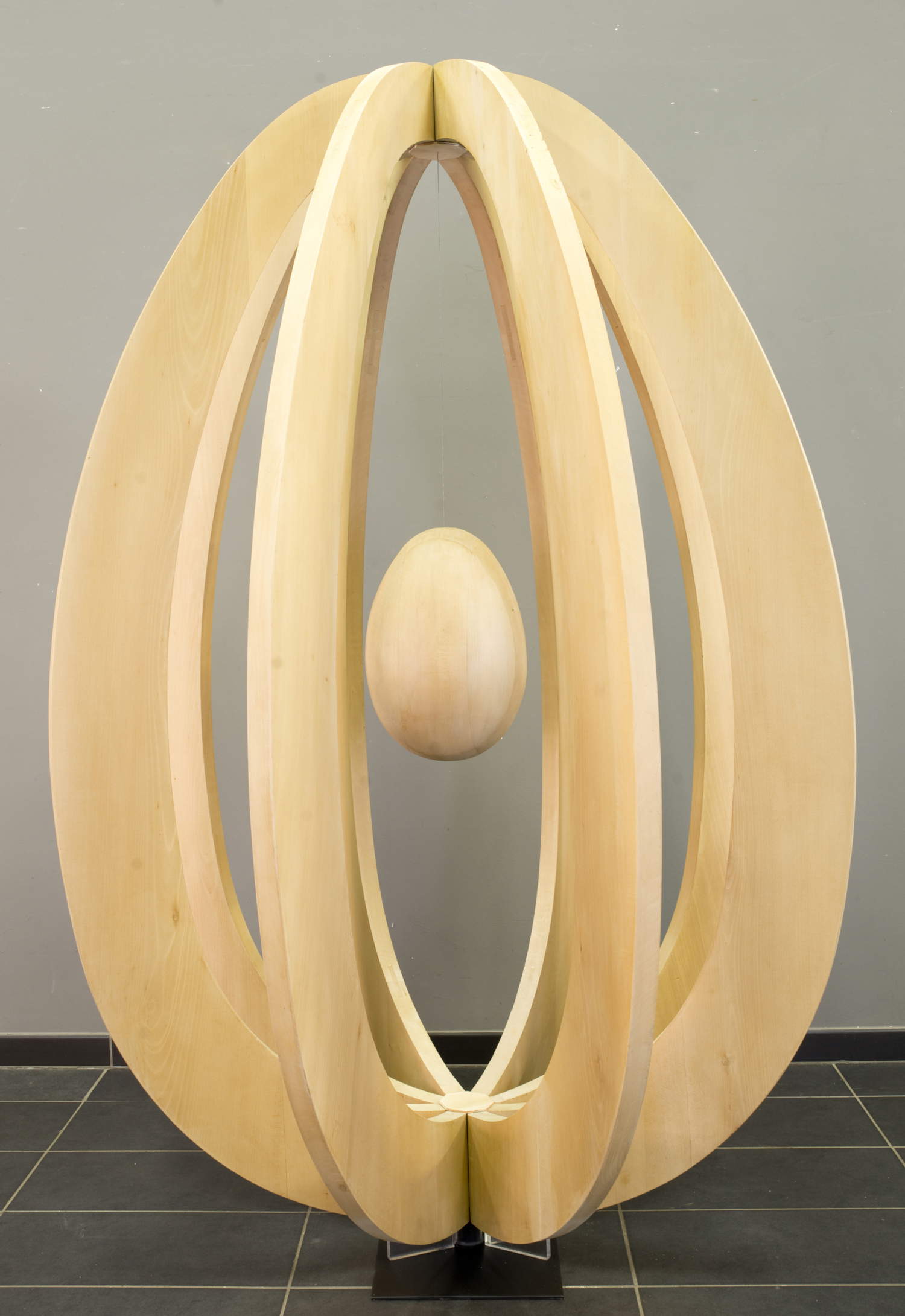
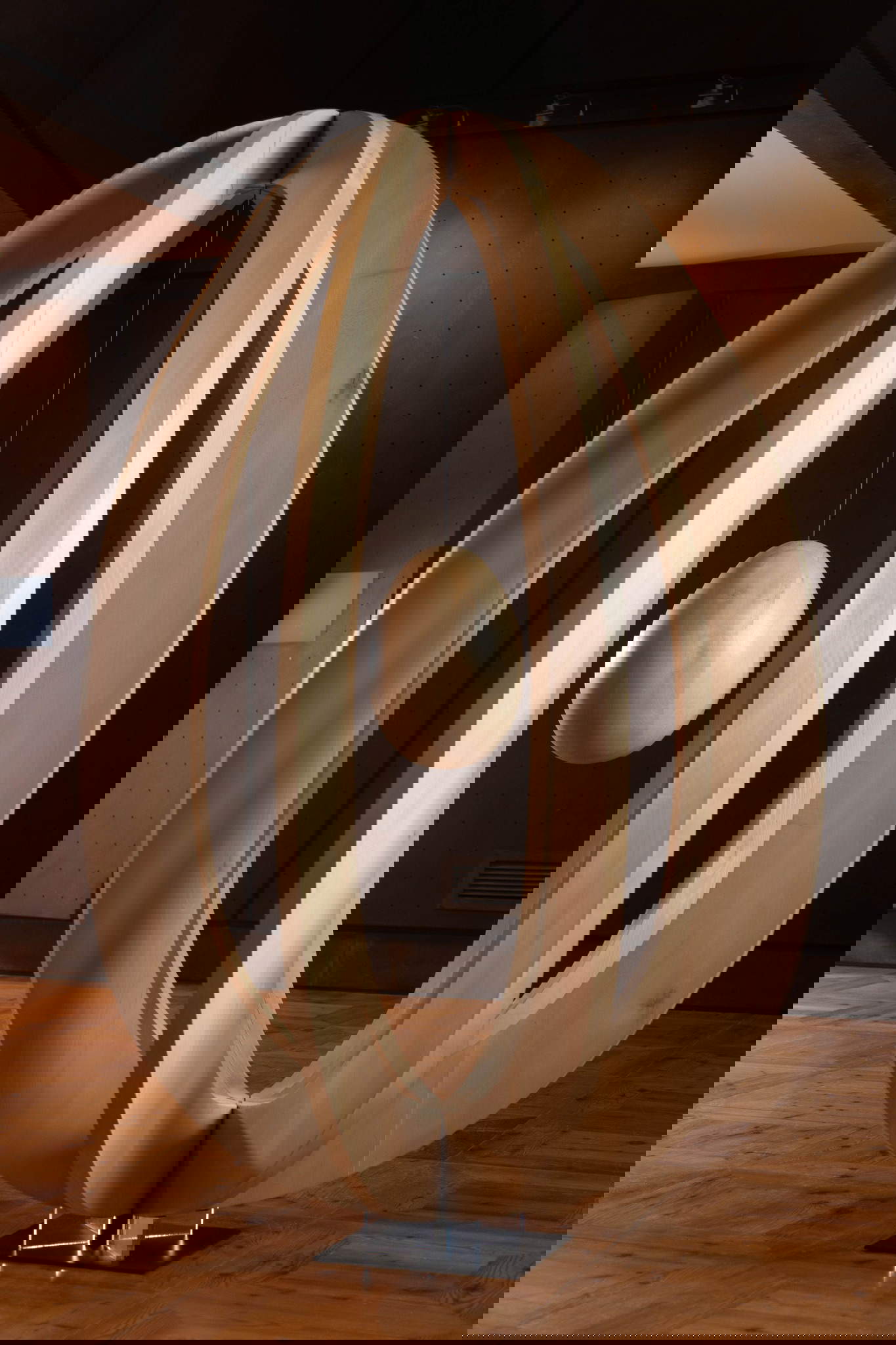
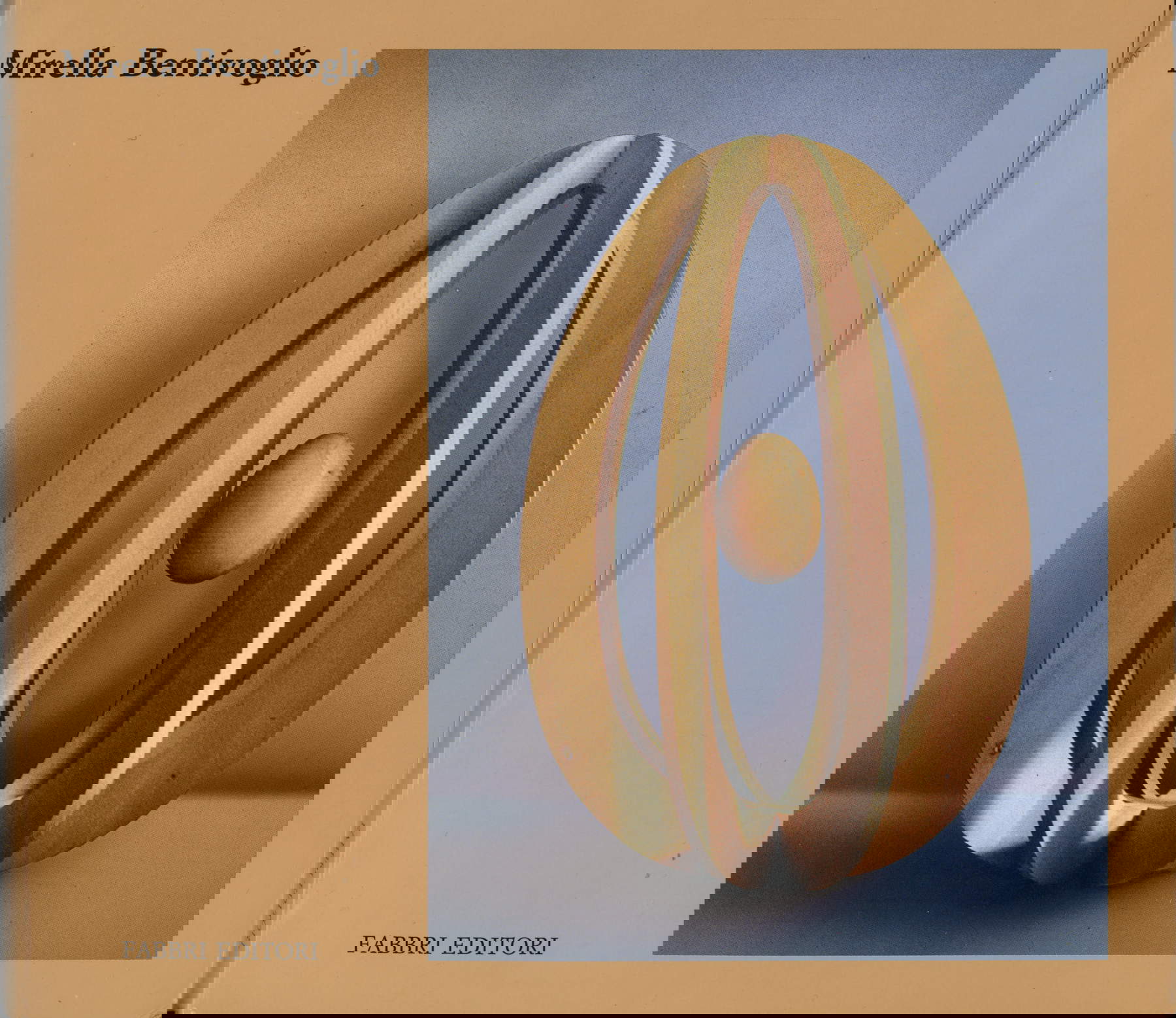
The work at the center of the exhibition, the Hyper Ovum, is an imposing structure (210 x 150 x 150 cm) that represents the synthesis of the artist’s research on the theme of the egg, a cosmic symbol of origin and perpetuity. Donated to the Region of Valle d’Aosta in 1988, after a historic exhibition at the Leper Tower staged between 1987 and 1988, the work has remained in museum storage for nearly four decades, waiting to be able to speak to the public again,.
For Bentivoglio, the egg, a recurring symbolic figure in his art, is not just a perfect form, but a cell of meaning. If her famous Ovo di Gubbio (1976) was a stone shell, a “cage” enclosing space, the Valdostan Hyper Ovum is her “wooden skeleton,” an egg freed of its interior, defined by the artist herself as an “egg of air, of soul, a zero.” Inside it hangs a smaller egg made of turned wood, a citation of the divine perfection of Piero della Francesca’s Montefeltro Altarpiece.
The power of letters
Mirella Bentivoglio’s poetics is intrinsically linked to the alphabet. In the title Hyper Ovum (large, magnificent, overflowing egg), the initials become philosophical symbols: the “H” of Hyper represents abstraction, separation and organization, while the “O” of Ovum is the secret of universal manifestation, but also the mathematical sign of zero, understood as infinite potential and “original nothingness.” Hyper Ovum “takes up, in the initials of the name, one of my first works of concrete poetry, dedicated to the word ”Ho,“ first person of the verb to have, which more than twenty years ago I had visualized as a cage,” the artist explained. “A text that in its dryness intended to propose the game of alternatives, highlighting, in the muteness and form of the letter ”H,“ the sign of abstraction and separation, of repeatability and organization, and in the elusive, physical, sonorous, unique ”O,“ the secret of universal manifestation. A pattern, and a dialectic, implied at various levels in many of my later works (precisely also in the inner armor of my Euguban egg); patterns that I have gradually compared with works of the piVoric tradition. As if to extract, and ideograph, aVer the archetype buried in the human unconscious, the symbolic energy lost (in some cases only hidden) in secular representational mimesis.”
Interestingly, the artist traces the origin of this symbology to a visceral connection with the Aosta Valley, dating back to World War II. Bentivoglio attributes to this land and its history a foundational role in his own poetics, starting with the two initials of Hyper Ovum. In fact, Bentivoglio was struck by an Aosta Valley legend: that of a thief who, in an attempt to reach the moon with a very tall ladder, jumped onto the moon, but the ladder fell causing the glaciers to crack. In this legend, the artist saw the broken ladder turn into the letter “H” and the moon into the letter “O,” rooting his poetics forever among the peaks of Mont Blanc.
The Restoration
The exhibition of Hyper Ovum at the Gamba Castle is also an opportunity to celebrate a complex structural restoration and cleaning operation, carried out by Cesare Pagliero under the scientific direction of Alessandra Vallet - Historic-Artistic Heritage Structure and Cultural Sites Management and Antonia Alessi - Historic-Artistic Heritage Restoration Office.
The work, composed of eight curvilinear linden wood elements arranged in a radial pattern, presented serious criticalities due to the very nature of the material. In fact, the wood had suffered cracks along the grain due to the rigidity of the original joints. The intervention required a deep cleaning from the layers of dust and paraffin wax accumulated over time, as well as the reconstruction of some triangular points of the wooden “wedges.”
The main challenge was to ensure stability of the work without compromising its reversibility: beechwood dowels and new asterisk-shaped metal fittings were inserted, designed to facilitate disassembly and future handling of the piece. Finally, a water-based hydro-oil protection with “zero effect” beeswax, characterized by the absence of color and color saturation of the fiber, restored the wood to its natural, opaque appearance, just as the artist envisioned it. The restoration will allow its permanent placement in the museum’s itinerary at Castello Gamba.
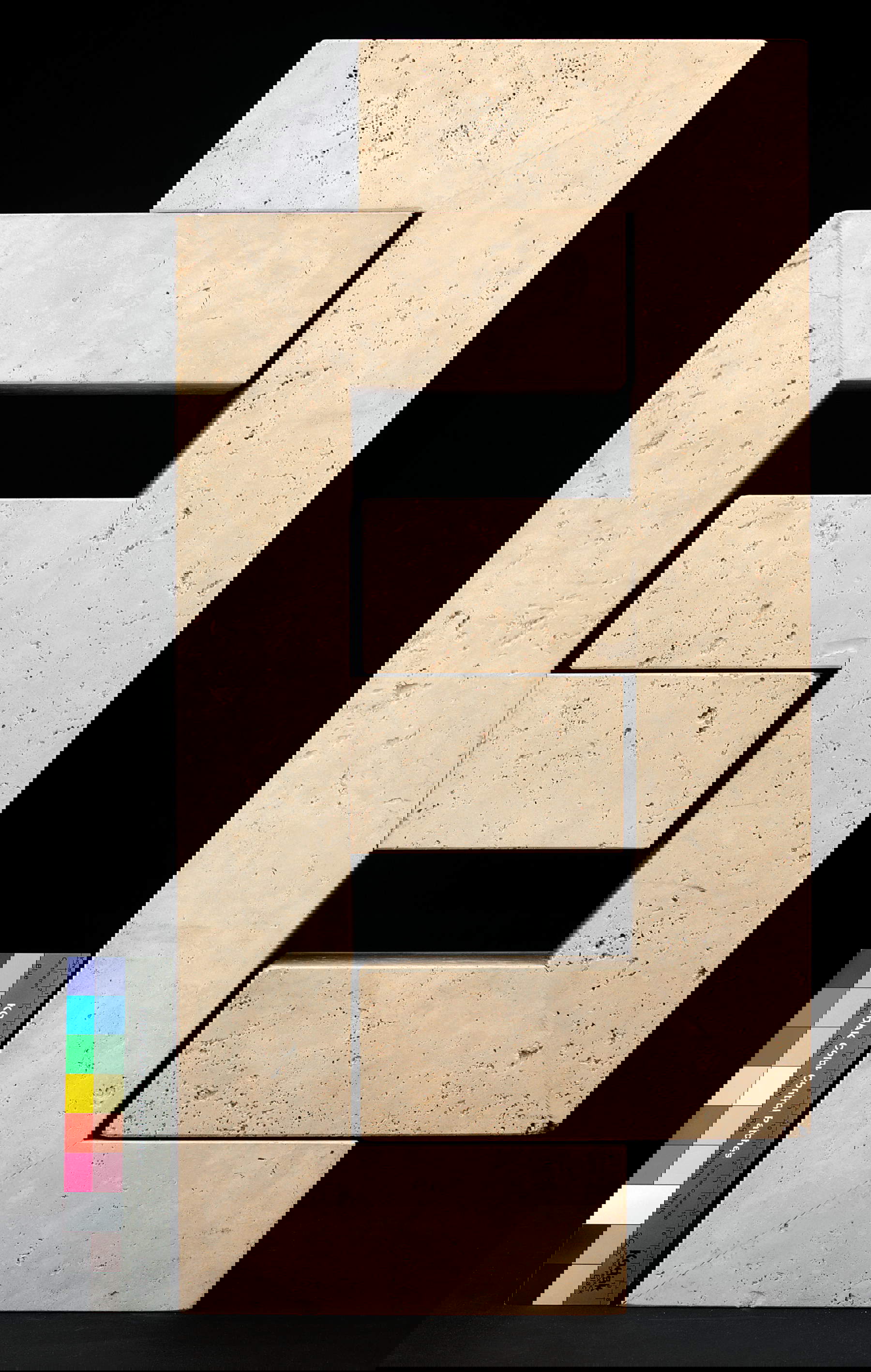
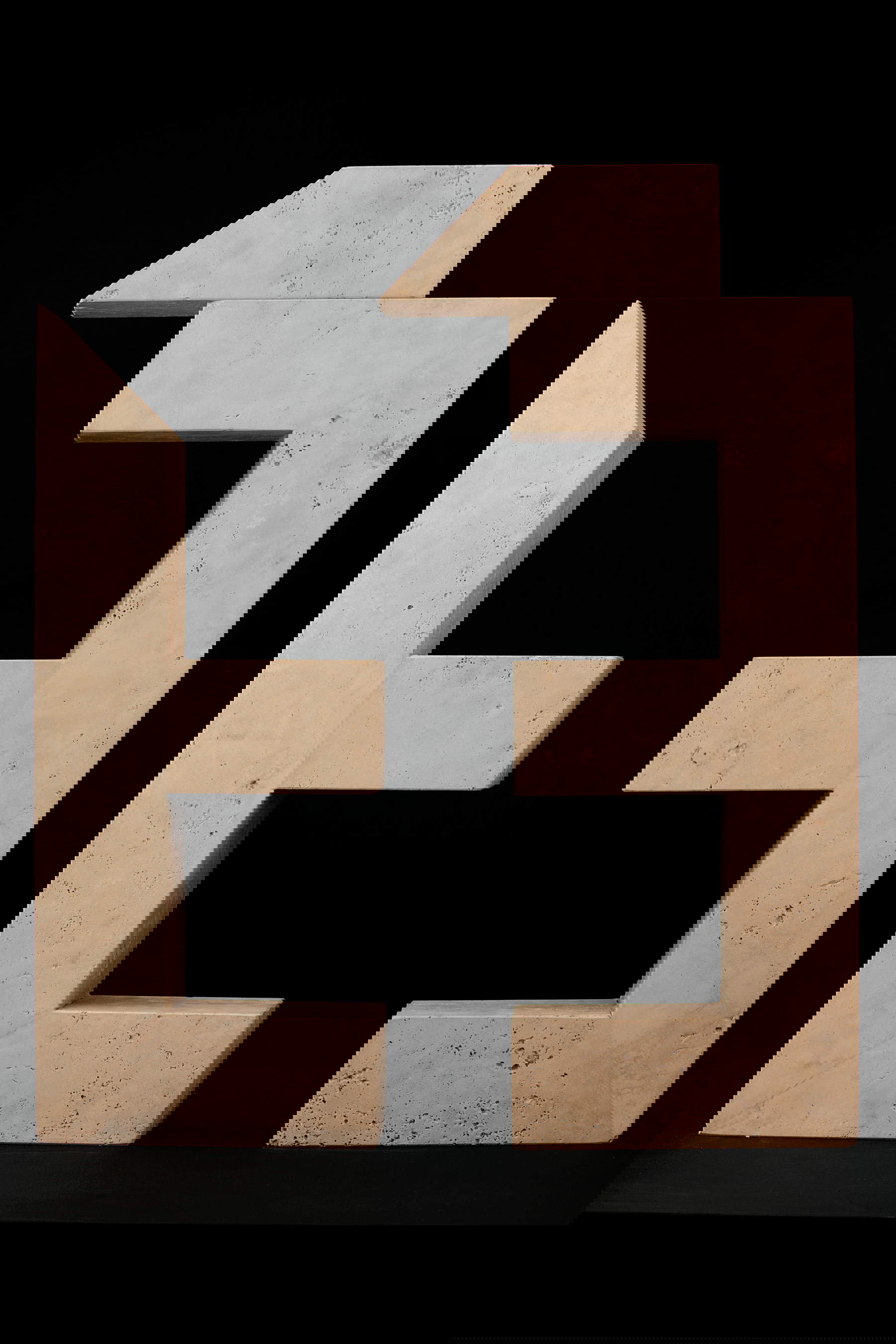
The exhibition does not end with the Hyper Ovum. The exhibition itinerary invites visitors to discover two other capital works by Mirella Bentivoglio kept in Room 12 of the museum: Lapide alla congiunzione and La Porta dell’Essere, both created in travertine in 1977. In these sculptures, the artist explores the power of the letter “E,” which for her generates the “H” of Hyper. The “E” is not just a grammatical conjunction, but the symbol of the bond between men. If in The Door of Being an accent “frees” the letter by making it a verb and existence, in Tombstone to the Conjunction the two “E’s” are stretched out, knocked down, albeit embraced to represent the highest possible unity.
To visit the exhibition at Castello Gamba is to immerse oneself in a universe where matter becomes language and emptiness becomes form. Mirella Bentivoglio’s work challenges us to look beyond the surface of things, to search for the symbolic energy hidden in the archetypes of the human unconscious.
|
| Aosta Valley: the return of Mirella Bentivoglio's Hyper Hovum for the "Contemporary Restoration" of Castello Gamba |
Warning: the translation into English of the original Italian article was created using automatic tools. We undertake to review all articles, but we do not guarantee the total absence of inaccuracies in the translation due to the program. You can find the original by clicking on the ITA button. If you find any mistake,please contact us.