




by Redazione 23/02/2026



Categories: Exhibitions / Disclaimer
From February 24 to May 11, 2026, the Galleria dell'Accademia in Florence presents Spinello Aretino's 1391 triptych after a restoration that began in 2024 and was accompanied by a comprehensive diagnostic campaign.

From Feb. 24 to May 11, 2026, the Galleria dell’Accademia in Florence will host a temporary exhibition dedicated to Spinello Aretino’s triptych depicting the Madonna and Child Enthroned and Four Angels among Saints Paulinus Bishop, John the Baptist, Andrew, and Matthew, with the Prophets Jeremiah and Moses in the upper roundels. The work, signed and dated 1391, returns to public view after a restoration project that began in November 2024 and has just been completed, accompanied by a campaign of diagnostic investigations that delved into its structure, materials and state of preservation.
The exhibition, set up in the rooms on the second floor reserved for Florentine painting of the late 14th century, aims to present both the painting and the results of the intervention. The curatorship is entrusted to the officials of the Galleria dell’Accademia in Florence and the Bargello Museums, Elvira Altiero, art historian, and Eleonora Pucci, restorer. Within the itinerary is a video that traces the conservation history of the triptych and documents the different phases of the restoration, supported by in-depth texts and images. The exhibition design was developed by architects Claudia Gerola, Barbara Francalanci and Roberto Lembo.


“The installation created for the return of Spinello Aretino’s triptych to the halls of the Galleria dell’Accademia in Florence,” stresses director general Andreina Contessa, “was born from the idea of enhancing not only the quality extraordinary nature of the work and its importance in the evolution of Tuscan painting at the turn of the 14th and early 15th centuries, but above all to highlight the invisible work that takes place daily behind the scenes of a museum and that we want to share with the public. A work made up of collaboration and study, aimed at caring for the heritage of our collections, which is one of the goals I have set for myself at the helm of this new museum institution. With this exhibition, which documents the various stages of the restoration work, we want to involve visitors more and more, trying to raise awareness toward a more conscious tourism.”
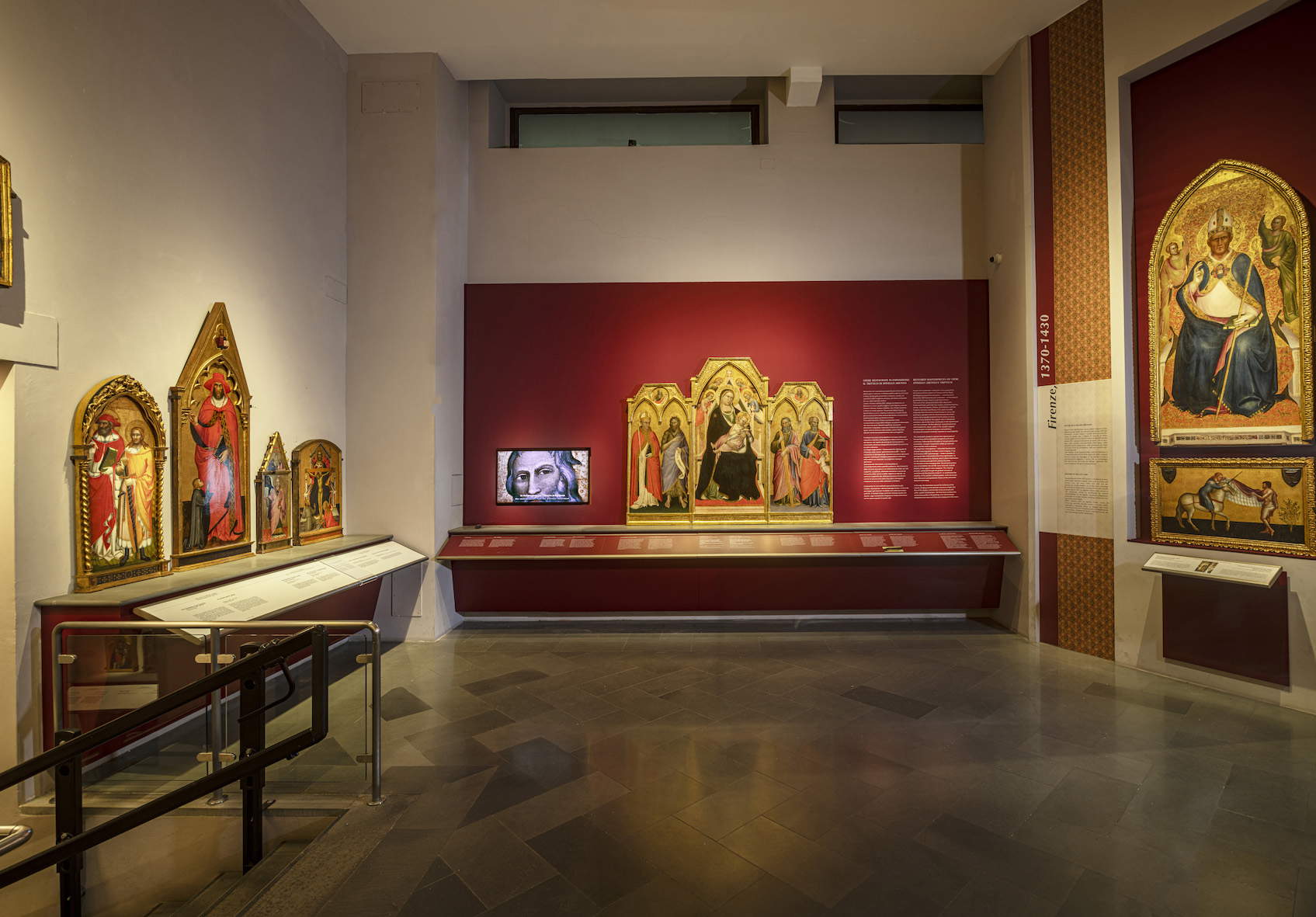
The restoration was carried out by Andrea and Lucia Dori, while the work on the wooden support was supervised by Roberto Buda. The diagnostic investigations were carried out by Ottaviano Caruso. All operations were carried out under the direction of Elvira Altiero and Eleonora Pucci, who coordinated the work in its various technical and scientific articulations. Spinello di Luca, known as Spinello Aretino as a native of Arezzo, figured among the protagonists of Tuscan painting in the late 14th and early 15th centuries. The author of altar panels and major fresco cycles, he contributed to the renewal of the figurative language of his time. The triptych now presented constitutes a point of reference for the reconstruction of his career, also in relation to the movements that in those years led him to work between Lucca, Pisa and Florence. The painting, executed on panel with a gold background, was commissioned by Lucchese merchant Paolino di Simonino di Bonagiunta for the oratory of Sant’Andrea in Lucca. The choice of the saints depicted in the side panels responds to a specific celebratory intention: Andrew, the titular of the church, and the figures recalling the names of the donor and his brothers. The presence of the Prophets Jeremiah and Moses in the upper roundels completes the iconographic program, placing the Marian scene within a theological framework.
In 1850 the triptych was in danger of being exported abroad following an illicit sale. The transaction was promptly blocked by the Tuscan government, which sanctioned its final assignment to the Galleria dell’Accademia in Florence. Since then the work has been part of the museum’s collections, although it has gone through complex conservation vicissitudes over time. Before the current intervention, the painting presented a profoundly altered appearance. Surface deposits, overflowing and degraded plasterwork, deficiencies, cracks in the wooden support, layers of varnish and oxidized glues, as well as extensive repainting, compromised the legibility of the whole. Preliminary diagnostic investigations made it possible to distinguish later interventions from the original parts, to identify the preparatory drawing, and to obtain precise information on the materials and pigments used by the artist.
The goal of the restoration was to recover the original parts and restore the balance and visual continuity of the triptych, with an improvement in aesthetic perception and overall enjoyment. The intervention adhered to the principles of reversibility and recognizability, with additions distinguishable at close range but not invasive in the overall view. The most delicate phase involved cleaning. The operations were carried out in a progressive manner, identifying from time to time the most appropriate level of intervention. After the removal of dust and surface particulates, oxidized glues and paints were solubilized. The removal of altered repainting, which interfered with the reading of the image, made it possible to bring to light the original blue of the Madonna’s mantle, made with azurite and natural ultramarine.
On the wooden support, the old crossbeams, the result of a previous restoration, were removed, with the subsequent realignment of the planks and the application of new chestnut wood crossbeams on each panel. The new structures were anchored using elastic mechanisms with conical springs, a solution that allows for better adaptation to the natural variations of the material. The intervention restored brilliance to the colors and brought out the light passages, the rhythm of the draperies and the rendering of the flesh tones, shaped with subtle brushstrokes of a graphic nature. The work now has a renewed legibility that allows us to appreciate its quality of execution and to recognize more clearly the role of the triptych in Spinello Aretino’s activity in Lucca.
 |
| Spinello Aretino's restored triptych returns to the Academy of Florence |
Warning: the translation into English of the original Italian article was created using automatic tools. We undertake to review all articles, but we do not guarantee the total absence of inaccuracies in the translation due to the program. You can find the original by clicking on the ITA button. If you find any mistake,please contact us.