





From March 5 to April 11, 2026, Galleria Giovanni Bonelli in Milan presents Ecce Homo, a solo exhibition by Liu Ke (Ning Xiang, 1976) curated by Fabio Cavallucci that marks his first direct confrontation with the Italian context. The title, laden with historical and philosophical resonances, becomes in his hands a contemporary statement on the identity and responsibility of the individual. Far from any figuration, Liu Ke investigates the human through abstraction, transforming lines, geometries and color fields into fields of tension between stasis and movement. His painting emerges from a process in which the initial accumulation gives way to an increasingly rigorous and precise synthesis. It is not a matter of reducing to subtract, but of concentrating: making the essential a place of maximum perceptual intensity. In his works, fluid energy and constructive discipline, impulse and limit, gesture and measure coexist. Nature, more than subject, is plane of resonance: a counterfield that activates and verifies the tightness of abstraction. At the same time, philosophy, from Kierkegaard to Nietzsche, acts as a subsequent echo, clarifying in the title what the vision has already set in motion. In this interview with Fabio Cavallucci, the artist reflects on his own path, the relationship between teaching and practice, and the dialogue with Western art history.
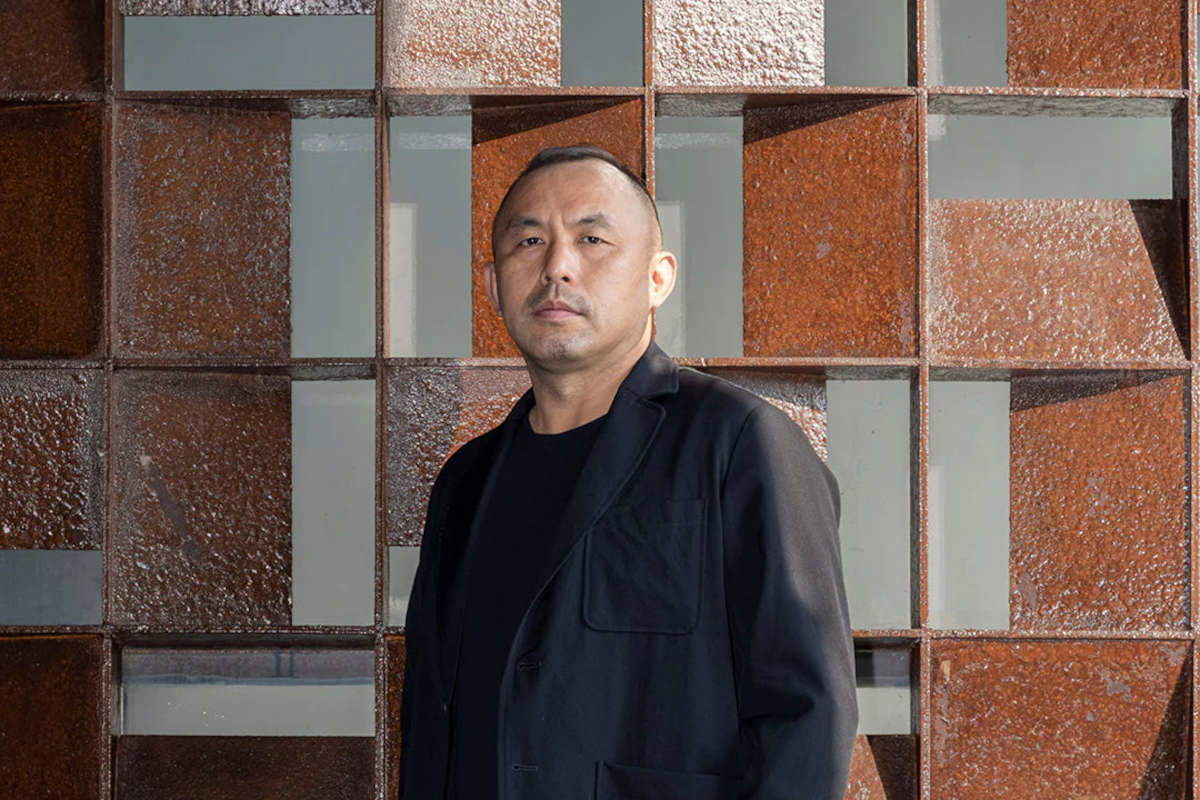
FC. Ecce Homo: If you had to describe yourself in two lines, who are you?
LK: I feel a bit like a sculptor who never stops “shaping” himself: through continuous work of creation and reflection, I shape my inner structure. This “self-plasming” happens mainly on two planes - that of thought structure and that of social relations: it does not have much to do with outward appearance or a visible form, but rather with my social life that extends outward and with the network of relationships that I continuously build and recalibrate between artistic practice and teaching. It is the interweaving of these elements that has helped make me who I am today.
If we follow the development of your work from the early 2000s to the present, we can see that over time it has become more and more essential: from the figures of the early works, to calligraphic signs, to vertical lines, to more recent geometric forms. Was it a search for simplification and precision, as if to say that you can communicate the same things more accurately if you reduce the signs?
For me, this tendency toward simplicity is not a “turning point” that came later; rather, it is a goal that I have sought from the beginning, that is, to arrive at a more essential expression. The works of the early years, which were more subtle, with more defined forms and rich details, were not so much a point of arrival where I wanted to stop, but a necessary process of accumulation: at that stage I needed to layer and “compress” experience and language, until at a certain moment it was possible to “jump out” and return to a more concise and focused form of expression. At first I also feared that geometrization might make the work too conceptual, as if it were already decided in advance by an idea. But then I realized that the key lies in the movement of the process: when simplification is not a rigid formal strategy, but arises within a path of continuous advancement, adjustment and generation, then it succeeds in dissolving that risk of conceptualization and makes the essential a more effective and more precise way of expression.
Although abstract, your painting always seems to derive from natural sensations, from physical experiences of the world. What role does nature play in your work today?
I believe that abstraction is not a system that can close in on itself: it rather resembles an “accidental encounter,” a moment when my subjective idea collides and at the same time resonates with the relationship I have with external nature. Therefore, for me, nature is not a background, but the plane of feedback of my abstract language: if this interweaving, this contact and intersection with nature is missing, my minimal abstraction loses its foundation and cannot stand up in isolation. Nature is both a kind of counterfield and an encounter that keeps happening: it is in these encounters that abstraction is really activated and, in a sense, confirmed.
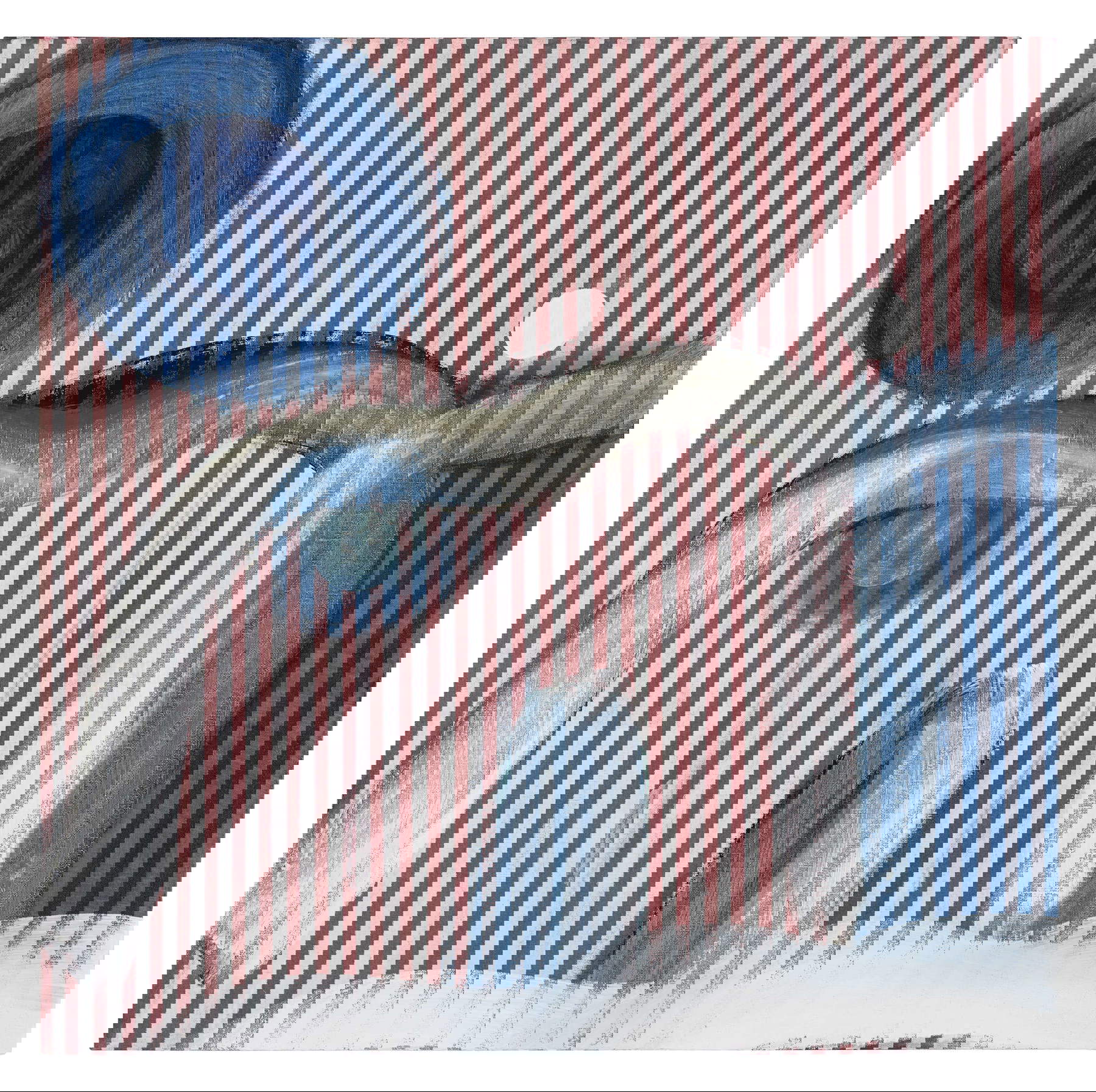
Two opposing principles seem to meet in your work: on the one hand, energy as flow, and on the other hand, the need to impose very rigid rules, including through the adoption of strict geometric forms and technical means such as tape. Do you think this is actually the case?
I agree: this tension (energy?) exists. For me, “flow” is not an arbitrary emotional outburst, but rather resembles a movement on the plane of ideas, a dynamic relationship. The “stasis” of geometry, on the other hand, is the counterfield of that flow: it is not an aut-aut, but two poles constituting themselves in their mutual mirroring. When I stand before a square canvas, the frame itself is already a geometric structure: all my movement takes place within that form. In other words, geometry does not serve to erase movement, but to give it a boundary and a measure, and to make it emerge precisely in the counterpoint between “stasis” and “motion.” I went through several transitions and turning points, but in the end I realized that it is precisely this continuous transformation, this confrontation almost “of friction,” that made me mature a firmer relationship with the force of the flow: a sense of control that is born within the boundary and built through opposition.
When you start a painting, do you start from an already outlined project, do you already have a clear idea of the structure, or do you discover it as you go along?
At the beginning I usually only have an outline structure, not a complete and defined project from start to finish. In the course of the work I constantly move between “subversion” and “new confirmation”: the structure is questioned, corrected, and at some point even reaffirmed.
Therefore, for me the initial idea looks more like a starting point - a gap, a breaking point, or a kind of preset “overall feeling.” Then, on that basis, I look for a key point and proceed in layers, advancing the work step by step until the work takes shape through continuous transformations and transitions. And this is also why my works are rarely born “out of the blue”: they are almost always the result of a processual genesis.
You experiment with many techniques, from video to sculpture to installation, but in the end you always remain faithful to painting. Do you believe that painting has extra possibilities for communication (such as speed and greater ease of execution) than other mediums?
I actually started studying art from painting, and for many years an important part of my basic training was, in a way, “drawing sculpture”-I drew a lot of plaster casts and studies from life of sculptures. Because of this, the sense of space and volume that sculpture imparted to me, along with the three-dimensional awareness implicit in line, became internalized until it became a sensibility for the spatial structure of the painting-the starting point of my understanding of space and construction. But if I eventually turned more and more toward painting, especially in recent years, it is because I perceived more clearly the specific power of color: color naturally possesses a strong two-dimensionality, yet it manages to create a kind of “transition” between plane and three-dimensionality, bringing out a sharper sense of movement and transformation in the painting. Compared to pure sculpture, painting makes it easier to really make structure, rhythm and perception flow in the visual plane. In addition, the “transformability” of painting materials gives me greater freedom: unlike sculpture or installation, it does not require a fully defined overall plan from the beginning. An object, once made, makes many decisions difficult to question; painting, on the other hand, allows one to return, to correct, cover, reorganize - and this can also be a limitation, but it is also its most open part. From the point of view of working method, it can be said that in painting I always retain a “constructive” thought: I treat the surface of the painting as a conscious intervention, with an almost architectural quality. This feeling of construction perhaps derives precisely from the sculptural experience - only in the end it is accomplished within the support of painting.
Sometimes references to international art, including Italian art, for example to Michelangelo Pistoletto or Lucio Fontana, emerge in your work. Are these pure homages to great masters, or do you find that there is something in their work that can help you better understand your own work?
Rather, I tend to interpret this relationship as a process of inspiration and transformation. For me, the works of some artists offer first and foremost a trigger point: I can take an image, a structure or a trace of method as material, and transpose it within my own system of work. Often, the beginning of a work needs an “entrance,” an opening. Whether it is Fontana, some Arte Povera artists, or Duchamp-whom I also use frequently-are like channels for me through which to enter the work. When the entrance, thanks to a clear reference, becomes “tighter,” more concrete, paradoxically I am able to open up within the work a “wider” space of development: the more specific the access, the more what unfolds within tends to be free and rich. This helps me to enter the state of the work immediately and prevents me, in the initial stage, from becoming entangled in the endless possibilities of an “original” composition. Taking Duchamp as an example, I mainly use two lines. The first is Fountain: I turned the photograph of the work upside down, causing its form to be transformed in the painting into a structural image similar to a “tabernacle” or “cave.” The second is Nude Descending the Stairs: starting from the “step” rhythm present in the work, I developed several variations in my works. In addition, I also use some images and spatial experiences from Italian art history as a starting point - for example, the figure of an “angel” in Masaccio, or Bernini’s The Ecstasy of Saint Theresa, and so on.
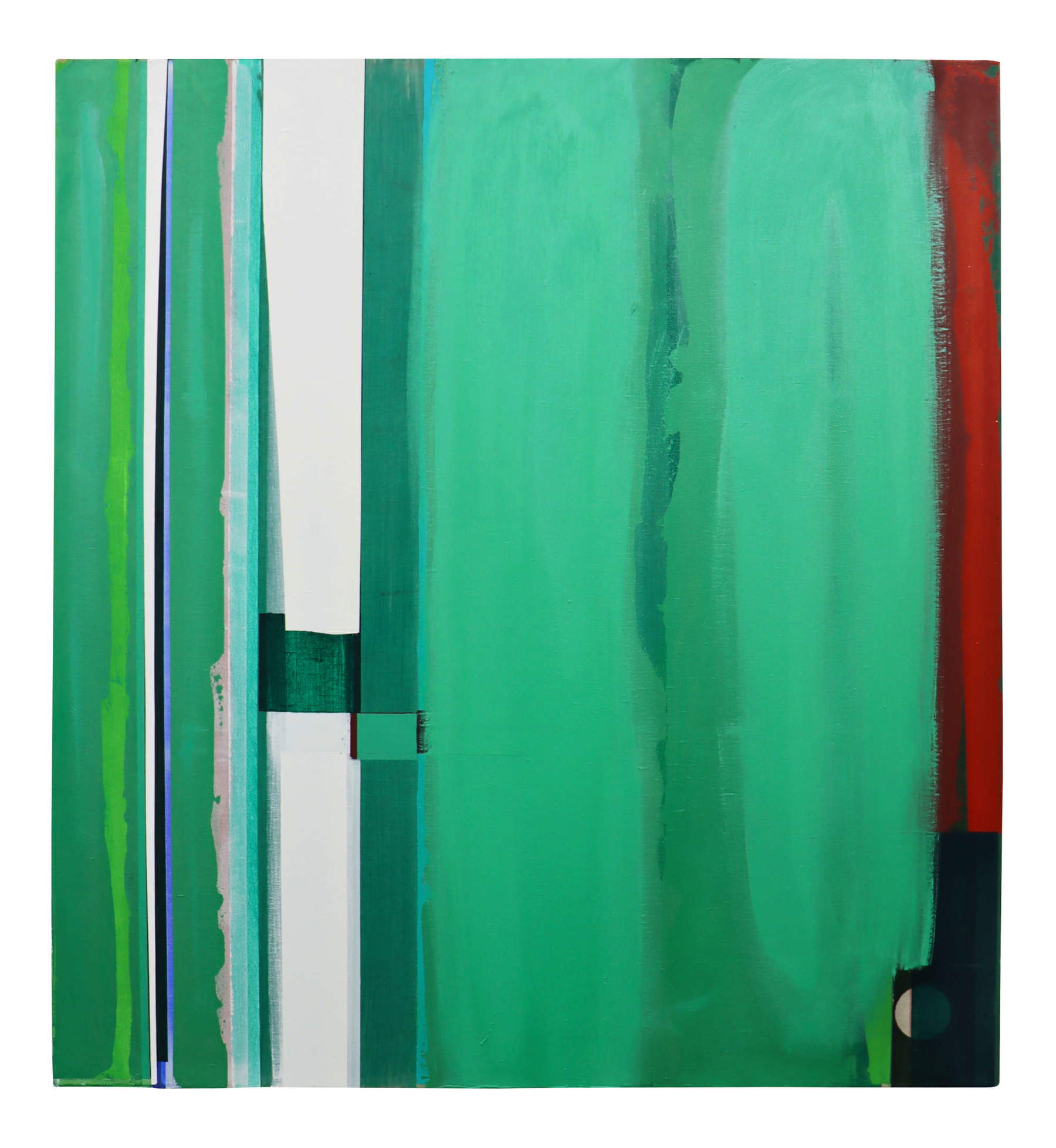
You have a very conscious relationship with Western philosophy, from Kierkegaard to Foucault. Which philosophers do you feel closest to and why?
My interest in philosophy actually started very early. Already during my student years I happened to browse through books on philosophy; at first I approached mainly classical German philosophy, for example Hegel’s Little Logic, and in a more piecemeal way I also read several fundamental texts related to that tradition. In recent times, the author who has influenced me most directly is Kierkegaard. I find his Aut-Aut to have a special force: many issues, in him, do not remain in an intermediate, vague zone, but force you to confront choice, to take a stand. Some of his perspectives make me perceive with greater intensity the uniqueness of the individual: how a person really becomes “himself” is often clarified precisely through distinction from the other, and even - in a sense - through a form of separation. This idea struck me deeply. When I then read Nietzsche, his Ecce Homo brought this feeling even more to the fore. It made me see more clearly that the “individual” is not something that is there in an abstract way: it is continually constructed through a web of relationships. Everything you do comes into correspondence with the world around you; and what you do today stands in difference and comparison with what you did in the past. This is precisely why I chose Ecce Homo as the title: it indicates “this man” as such, and the way a person defines himself within relationships and differences.
At what point do these philosophical thoughts enter the work? Are they a creative cue that intervenes along with the perception of an image or are they the consequence, the interpretation that you yourself give once the painting is made or at least started?
For me, philosophical reflections rarely enter directly into the creative process; more often they come later, when the work is already finished-especially at the moment when I give it a title. Usually, first the work is born, first there is the visual experience; then, if I happen to be thinking about a philosophical issue during that time as well, I end up making it part of the title or my interpretation, so that the meaning of the work becomes more focused and stronger. For example, I recently made an exhibition titled Kierkegaard’s The Line of Escape: the idea came out of a study exchange with a lecturer who deals with horizon and perspective. I began to reflect on the “horizon”-a point that continually recedes, that in a sense always disappears, and at the same time is the boundary line where heaven and earth meet and “fold” into each other. From there, I related this visual experience to Kierkegaard’sAut-Aut: philosophy does not replace seeing, but strengthens my visual concept on the level of title and understanding. In general, this still applies to me: first comes the seeing, then comes the title.
Ecce Homo is a title loaded with history and figurative images in the West. What does it mean to you to talk about the human through abstraction?
For me, Ecce Homo is first and foremost an affirmation. But this affirmation is not a neutralized expression, designed to “agree” or reconcile; nor is it a judgment, in the religious sense, between “good and evil.” Rather, it is a statement by correspondence: when you stand in front of something, you must have a clear attitude, a thought that measures itself with that object in a direct, almost one-to-one way. I would like that, in front of my works, the audience can feel this atmosphere of “clarity”: not a motionless clarity, but a clarity that becomes sharper within change, within movement. In other words, what interests me is that, even in a state of continuous transformation, one can still grasp a sharp direction. Therefore, to speak of “man” through abstraction, for me, is not to paint a recognizable portrait, but to bring out a condition of existence: how, within complex, split and often opposing relationships, a person manages to make a clear statement.
When viewers stand before one of your paintings, what do you hope will happen: that they understand something or that they feel something?
Personally, I prefer that, first of all, they feel. Because “understanding” is often a more individual operation: everyone has their own structure of knowledge and background of experience, and the paths of understanding end up diverging a lot. If, on the other hand, one can first sense an emotion, an atmosphere, then it becomes easier for a certain common resonance to be created. I have also noticed a rather interesting fact: there is a strong constructive component and a marked sense of space in my works, which is why architects seem to enter the work with particular ease - and “feel” it right away. In fact, many of my most important collectors are architects, and proportionally they are very many. This, in a way, confirms that my painting tends perhaps to get a perception across first, through space, structure and rhythm.
As a lecturer and course director at the Guangzhou Academy, what would you like your students to learn from your teaching, without them becoming slavish imitators of your style?
I prefer students to see themselves as autonomous individuals working within the art system. After all, we are all in the same system, just at different stages: I may have more experience, they have more energy, more momentum. Therefore, in the classroom I do not impose the relationship according to the traditional “teacher explains, student learns” model, but rather understand it as a collaborative relationship: we work together, with mutual correspondences and connections, in a dynamic of common advancement. In a way, I would like us to be more like colleagues - in the same field, each engaged in his or her own work, but also able to stimulate and push each other. Inside such a relationship, students do not put the focus on “copying my style,” but more naturally develop their own method and direction.
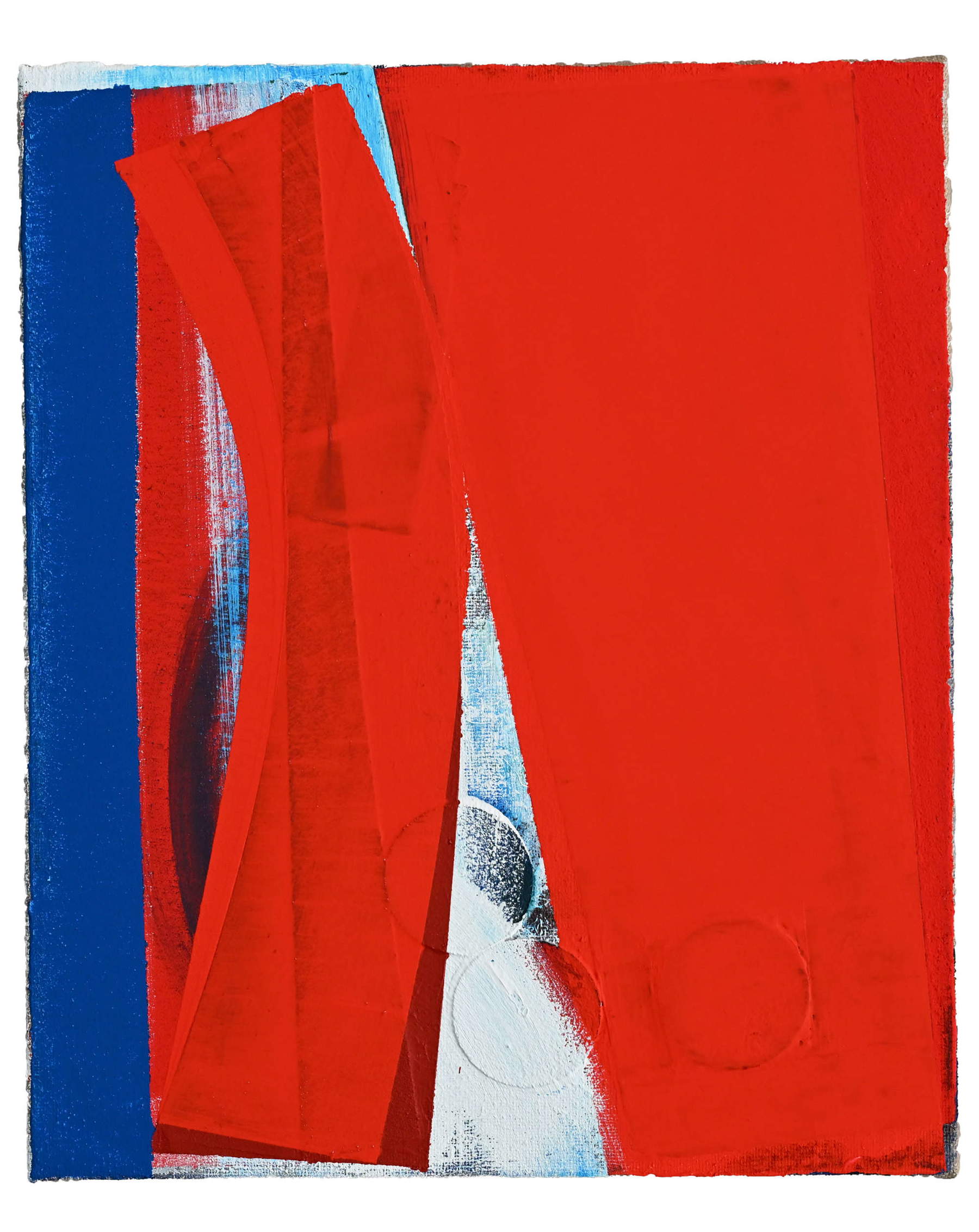
You have also always worked assiduously on the creation of exhibition spaces-Sabaku, the Boxes Museum in Shunfeng Mountain Park, the Songshan Lake Boxes Museum, the art center being built in Ningxiang Hunan. How does your institutional and curatorial activity fit into your path? Do you find it a necessary expansion of your work as an artist? How do you manage to dialogue with artists whose aims and means are very different from yours?
As a museum/institution manager, I impose a very strict discipline on myself: I cannot organize a solo show of my own in the museum and I do not participate in group shows with more than six artists. In the course of this work, I try to keep myself in as lucid, calm and objective a state as possible. And it is in this condition that I perceive most clearly how artists who are completely different from me can bring me, on the level of “logic,” a change. And this change, when it falls on me, ends up making my life richer and my way of thinking richer. Therefore, I often turn every “accidental” encounter -- meeting different people, with different ways of working -- into a path: something that feeds my perception and my thinking. And, in turn, all this acts back on my creation and my life; that is why I consider these practices a necessary extension of my artistic making. Consequently, I prefer to work precisely with artists who are different from me: to enter the “state” of the museum together, to initiate collaborations, and to really let that difference happen.
What are you really interested in getting out of this Italian exhibition, aside from the fair eventual financial reward for selling the works? What would you like to take back with you to China?
For me, first of all, this is my first solo exhibition in Italy, and so what I’m really interested in is to put my works really inside the city of Milan - to make them stay, together with the museums around, the local art scene and the works of other artists, in the same fabric of relationships and in the same context. In this way it is not simply a matter of “bringing the works to exhibit,” but of getting them inside that world in a more real way. What I insist on is precisely this sense of “relationship” in the Italian context. Because here, on the one hand, there is a very strong classical background; on the other hand, there is also a very defined contemporary system-for example, that of the Venice Biennale, but also the structure of looking constructed by museums and different exhibitions. I hope that my works, in this context, can become a presence: in an environment where classical and contemporary stand side by side, they can be seen, placed and compared. At the same time, I would like to be able to observe more objectively where my work stands in relation to the works with which it relates and in relation to the different contexts involved. This “objective situation” is very important to me, because then it comes back to affect my future work: it makes me understand what happens when works enter more fully into a network of relationships of this kind-what transformations take place and what kind of resonance they bring back.
Well, I would say that’s it. Is there anything else you’d like to add in conclusion?
Actually a lot of things really happen by accident. You know, as I’m talking to you now, I’m basically talking while staring at a military jet. Look at that for a moment: my car is parked right here, exactly in front of that plane. Basically, for the whole interview I was talking while looking there - and it makes me smile, because I find it quite curious: I couldn’t even say why, but it just happened that way.

Warning: the translation into English of the original Italian article was created using automatic tools. We undertake to review all articles, but we do not guarantee the total absence of inaccuracies in the translation due to the program. You can find the original by clicking on the ITA button. If you find any mistake,please contact us.















 IT
IT FR
FR DE
DE ES
ES CN
CN


