





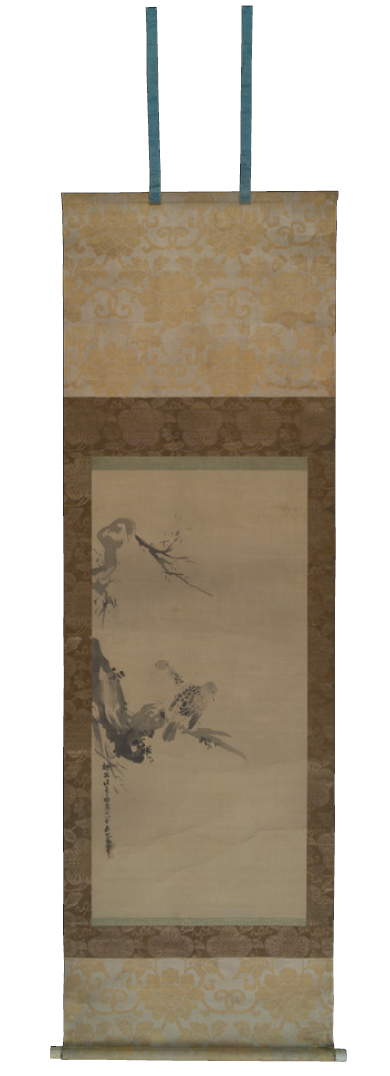
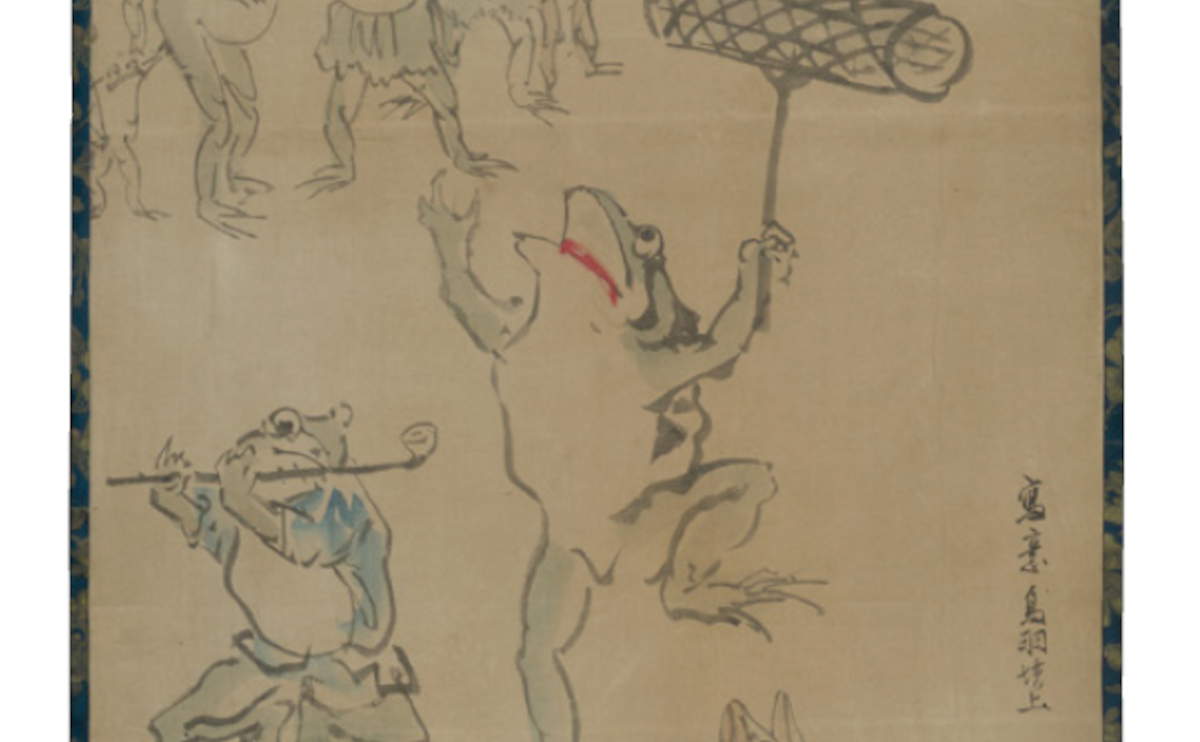
From December 13, 2025, the Castle of Agliè (Turin), part of the Royal Residences of Savoy, will present to the public a rare and valuable nucleus of twenty-one Japanese paintings from the 19th century, restored to their original expressive intensity after a major restoration. The works come from the collection of Duke Tomaso of Savoy-Genoa and were acquired in Japan during the voyage made between 1879 and 1881 under the command of the corvette Vettor Pisani. Musician frogs intent on playing drums, ravens, parasol-wearing courtesans, women in mirrors, and men suspended in flight on a hot air balloon are now back on view thanks to a new display, distributed between the antechamber of the Chinese Room and the Chinese Room.
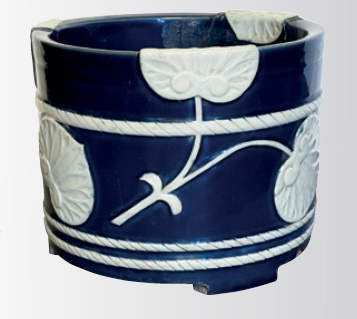
The itinerary offers a renewed reading of the presence of the Orient in the Savoy residence and enhances the kakemono on silk, placed in dialogue with the 17th-century samurai armor that arrived in Agliè through the same expedition. Memories of Travel. Paintings from Japan at Agliè Castle is a project that interweaves research, conservation and enhancement, offering for the first time the opportunity to admire the entire collection after restoration. Completing the exhibition are twenty-eight Japanese blue and white ceramic garden pots, purchased in Yokohama in 1880: ancient bonsai containers, mainly originating from Seto, Owari province, already documented in the Castello’s historical inventories.
The works underwent a complex conservation intervention by the Fondazione Centro Conservazione e Restauro “La Venaria Reale,” with the support of the Fondazione CRT through the Cantieri Diffusi call, provided through Art Bonus, and with the contribution of the Ministry of Culture.
The restoration addressed the typical problems of Eastern mounts adapted to Western mounts, restoring structural stability, legibility and aesthetic quality to a core of paintings that had long remained rolled up and kept in storage. The collection is already attested in the inventory of 1908, when a corridor on the second floor was named the “Gallery known as the Japan Gallery,” testifying to the rootedness of these works in the history of the Castle.
Most of the paintings (ink drawings and watercolors on paper) bear the signature of the celebrated painter Kawanabe Kyōsai (1831-1889), known for his satirical animal-animated sketches, caricatures, and depictions of everyday life, populated by Japanese and Western characters executed with extraordinary speed. Some kakemono and paintings are four-handed works (gassaku), which originated during seki-ga convivals, “sitting painting” performances popular in Japan in the late 19th and early 20th centuries.
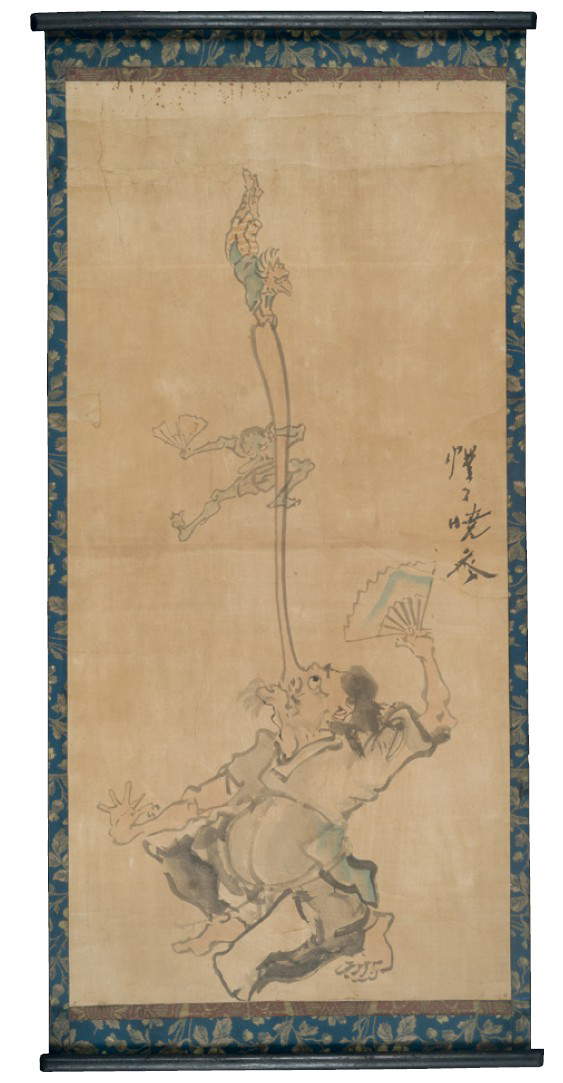
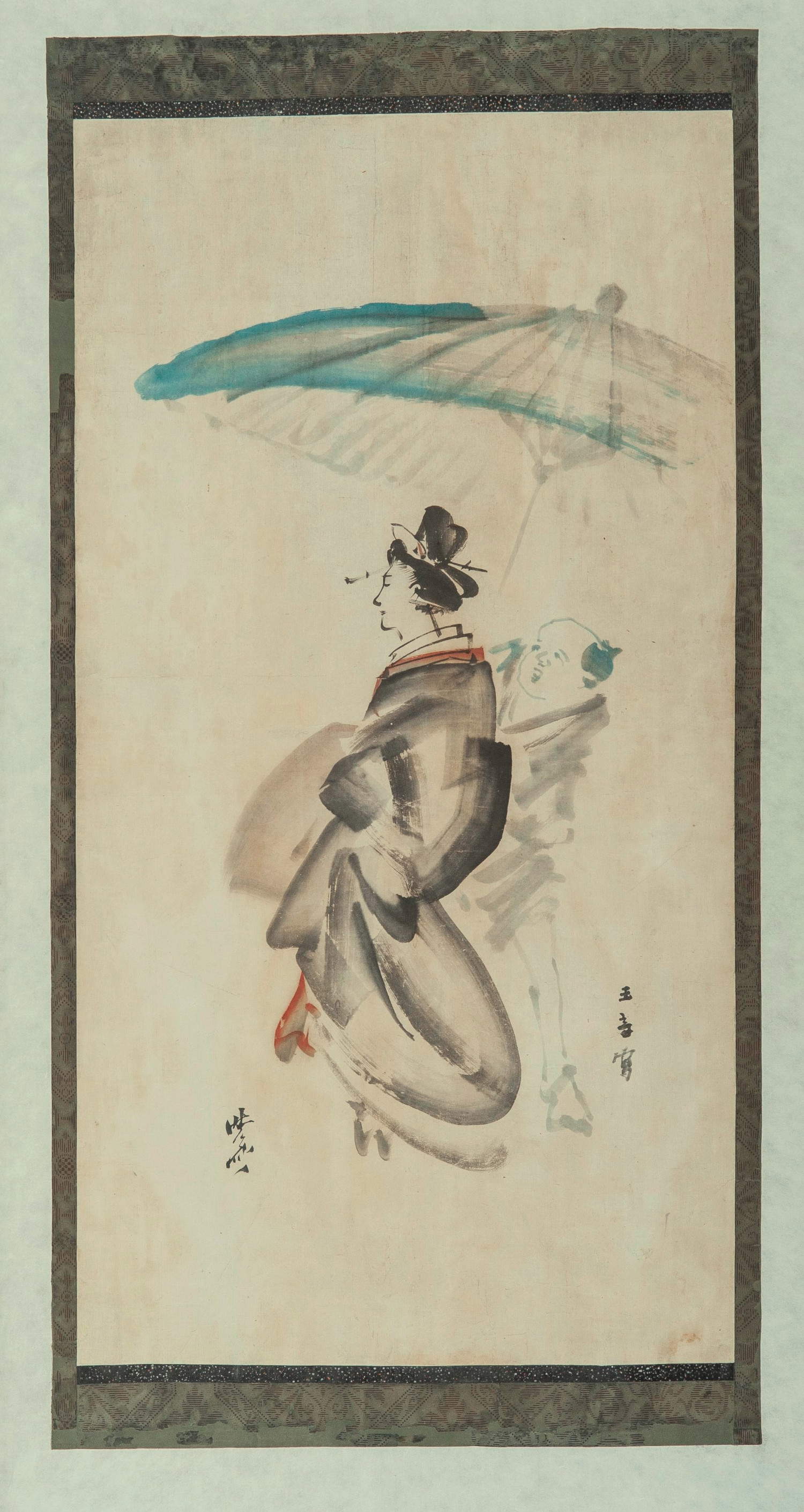
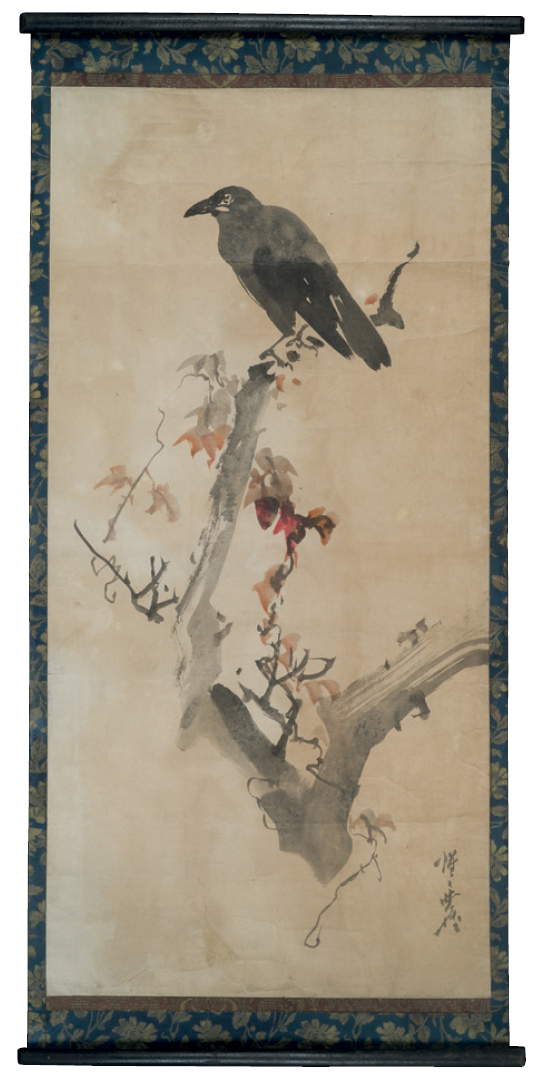
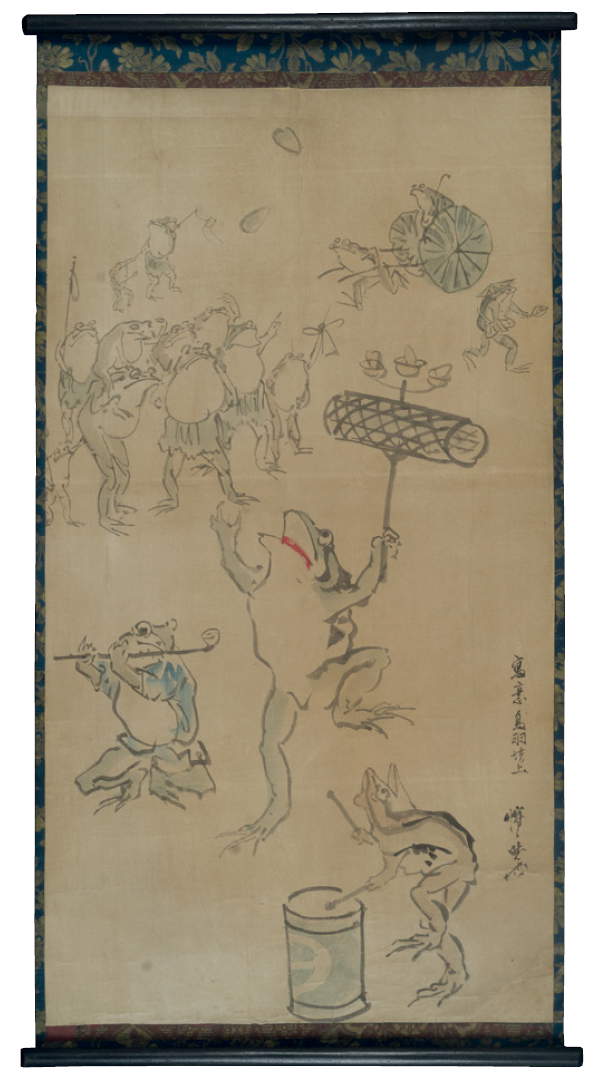
Kyōsai is remembered for his talent and tireless activity, which led him to paint for hours nonstop; the scrolls in the collection fully reflect this production, characterized by a quick, light brushstroke and a sometimes irreverent tone. Prominent among the recurring subjects is the raven, the symbol of his fame, alongside musician frogs playing drums, jumping with other instruments or mocking a snake, becoming an ironic metaphor for society. In other works, the artist resorts to caricature to depict human figures: noses stretching out of proportion, wafer-thin legs stretched toward khaki fruit, Western-clad dakyu players intent on vying for the ball. There is also no shortage of subjects related to the natural and botanical world, following a tradition deeply rooted in Japanese culture, with bamboos, reeds and orchids, as well as genre scenes ranging from a woman at a mirror to a courtesan with a parasol, from fishermen to men curiously observing hot air balloon flight.
The vases are distinguished by brilliant deep blue glazing (ruri), achieved by adding cobalt oxide to the transparent glaze. Geometric decorations and figurative reliefs, such as medallions, fans, and plant motifs, such as chrysanthemum corollas, pine branches, lotus or fern leaves, as well as depictions of birds, develop on the blue background. More elaborate decorations were molded separately and applied to the ceramic surface before firing, using the haritsuke technique. Strongly three-dimensional and often white in color, these applications create striking visual effects, simulating the flight of cranes and fukura sparrows among bamboo groves against a deep blue background. Alongside this type, the collection also includes a single large vase painted with a landscape and cranes in shades of blue and azure.
The new exhibition is accompanied by the publication Memories of Travel. Paintings from Japan at Agliè Castle, edited by Laura Gallo and Giuseppe Milazzo. The volume, published by Editris, offers insights into the collections and restoration and is available for purchase directly from the publisher’s website.
In addition to the presentation of the paintings, Saturday, Dec. 13, also marks the opening of the renovated New Hall, redesigned as an introductory space to the museum tour. The design includes a new lighting system, graphic panels with a timeline tracing key junctures in the history of the Castle and Park, and a three-dimensional tactile model of the building that facilitates visitor orientation. In the 19th century, the New Hall was used for administrative functions as the Intendancy Hall and still retains its original vault, fireplace and a historic door, which are enhanced by the new layout.
“The display of the 21 paintings and 28 Japanese vases,” says Filippo Masino, director of the Royal Residences of Savoy, “for us is much more than just an exhibition. We are returning to the public works that for years have remained invisible in storage, and of which we can now grasp the delicacy, irony and expressive power, revealing how much their images have dialogued over time with the very history of the Castle. It is the first step in a renewal that aims to bring the Castle of Agliè back to tell its story through its collections and an invitation to rediscover a more intimate and more conscious look at the heritage that inhabits it.”
“The restoration of the Castello di Agliè’s core of paintings and Japanese objects represents a gesture of care toward a heritage that speaks of encounters, travel and shared culture,” says Fondazione CRT President Anna Maria Poggi. “Restoring the original beauty of these assets to the Castle means offering the public not only extraordinary works, but also a new chance to understand how the dialogue between distant worlds has marked our history. Supporting interventions that combine research, conservation and enhancement is for us an ongoing commitment to the protection of heritage and its transmission to the communities of today and tomorrow.”
“The restoration intervention,” points out Alfonso Frugis, President of the Conservation Restoration Center “La Venaria Reale,” “has seen a multidisciplinary involvement between our Restoration Laboratories of the Paper and Photography and Textile Artifacts areas together with the Scientific Laboratories and testifies to an ongoing commitment and a shared path between the Center and the Savoy Royal Residences promoters of a museological and museographic renewal of the historic dynastic residence.”
 |
| At the Castle of Agliè (Turin) Japanese paintings and vases restored in a new dedicated display |

Warning: the translation into English of the original Italian article was created using automatic tools. We undertake to review all articles, but we do not guarantee the total absence of inaccuracies in the translation due to the program. You can find the original by clicking on the ITA button. If you find any mistake,please contact us.

















 IT
IT FR
FR DE
DE ES
ES CN
CN


