





The Viareggio Carnival 2026 is tinged with futurist suggestions with Carnevale futurista. Homage to Depero, the second category float signed by Luciano Tomei. A project that interweaves the allegorical language of the great Viareggio tradition with the imagery of Fortunato Depero (Fondo, 1892 - Rovereto, 1960), a protagonist of Italian Futurism and interpreter ofan art capable of fusing movement, rhythm, color and playful spirit.
Indeed, Carnival and Depero’s work share many elements: dance, music, art understood as total spectacle, and a sense of play that becomes an expression of creative freedom. Depero loved to represent the dynamism of modern life, a world torn between order and madness, between geometric construction and irrepressible vitality. His figures seem to dance, animated by a continuous energy, as if immersed in an endless Carnival. From this affinity comes the idea of the allegorical float, conceived as an invitation to celebration, fantasy and expressive freedom.
The overall vision is strongly linked to theexaltation of color and geometric shapes. The language is deliberately stylized, with an overt reference to Futurism and a direct homage to Depero not only in the title of the float, but especially in the aesthetic choices. Color is the real protagonist of the entire construction. The hues are pure, sharp, devoid of shades. Yellow ochre, light red, dark red and blue dominate the scene. Each figure is constructed through well-defined backgrounds, without gradual transitions. Only in some cases are colors mixed to obtain different shades of the same hue, as is the case with blue, which is present in three variants that punctuate the volumes and create internal contrasts in the composition.
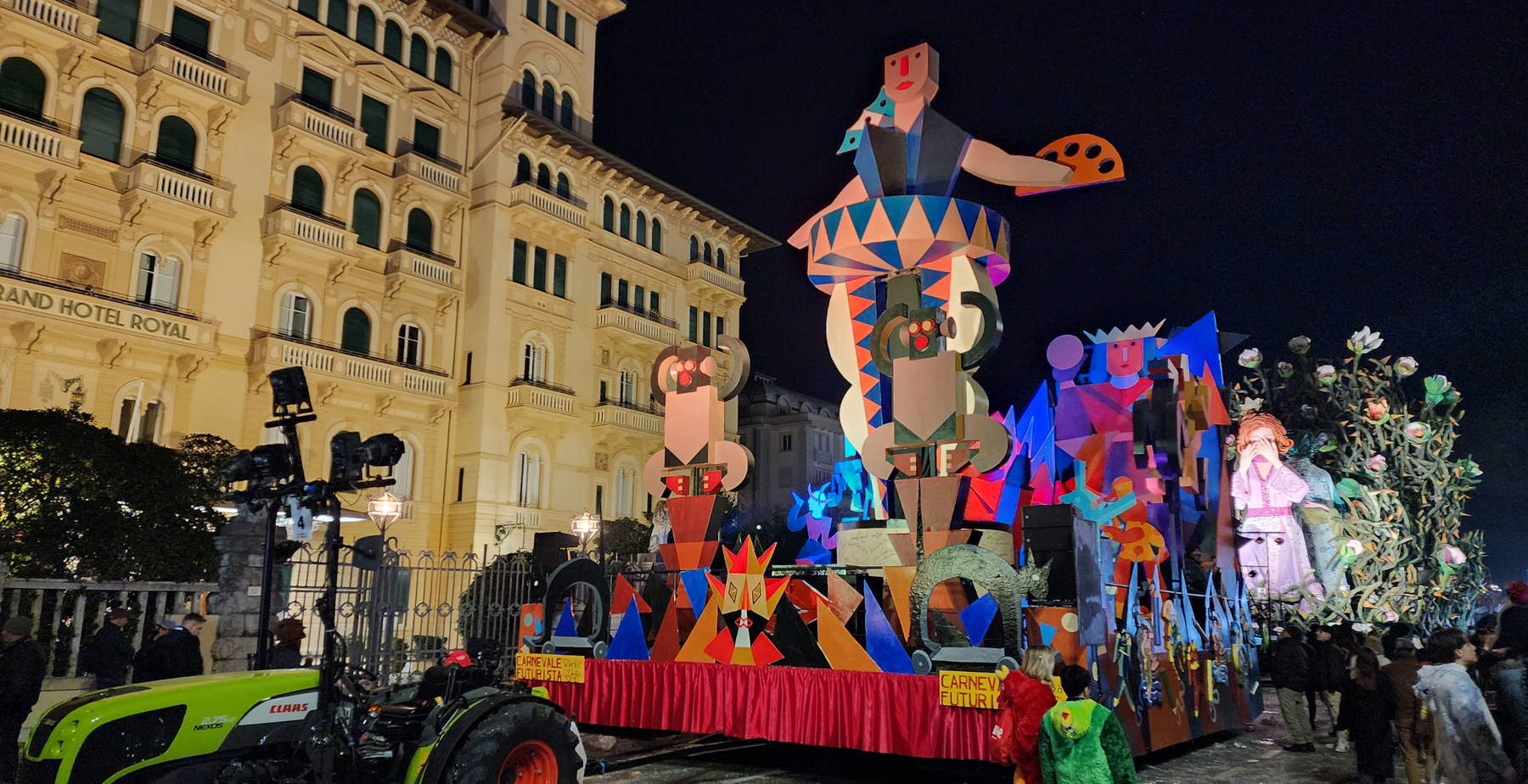
The figures seek stylization in coherence with Depero’s aesthetic. The structure of the wagon is frontal and has a canopy necessary to allow the movement of the rudder. A series of molded figures inspired directly by the futurist artist’s works are placed on the lower left and right sides. These figures were made with the cast-paper technique, after an initial modeling in clay, according to a craft process that combines tradition and formal research.
The float measures 10 meters long and 9 meters wide. The tallest element is a dancer reaching 8 meters and 40 centimeters, inspired by a drawing by Depero. She is the main character, the narrative and symbolic centerpiece of the entire allegory. The dancer represents the dancing Carnival: she is the one who gives rhythm, movement and meaning to the scenic construction. Her presence dominates the scene and guides the audience’s gaze along the geometric lines and color contrasts of the work.
In front, above the tartar, left and right, are two monkeys fixed rotate up to 180 degrees. They can make a complete turn or perform only half a turn. All their movements are manual, entrusted to operators who control their dynamics during the parade. Also on the top of the float appear other colorful silhouettes, two-dimensional drawings inspired by Depero, placed on plinths and conceived as graphic elements moving in space.
On the sides are two horses with their respective riders, one dark blue and one bright red. These elements can also rotate partially and, through a system of levers, simulate a swinging gallop similar to the movement of a swing. The overall effect is that of a stage machine in which each figure participates in a collective rhythm, in a balance between structural order and expressive vitality.
The figures are an integral part of the futurist aesthetic of the float. The costumes have been adapted to the human body while maintaining a strong geometric imprint. The men wear an asymmetrical futurist tunic paired with pants that start wide at the waist and narrow downward, forming a point. Women wear dresses with geometric skirts that resemble two overlapping triangles, one descending from top to bottom and one ascending from bottom to top. The skirts are wide at the legs, cinching at the waist and widening back toward the shoulders. Geometric headdresses, trapezoids, circles or triangles appear on the head, reinforcing the overall visual impact and translating the typical forms of Futurism into a performative key.
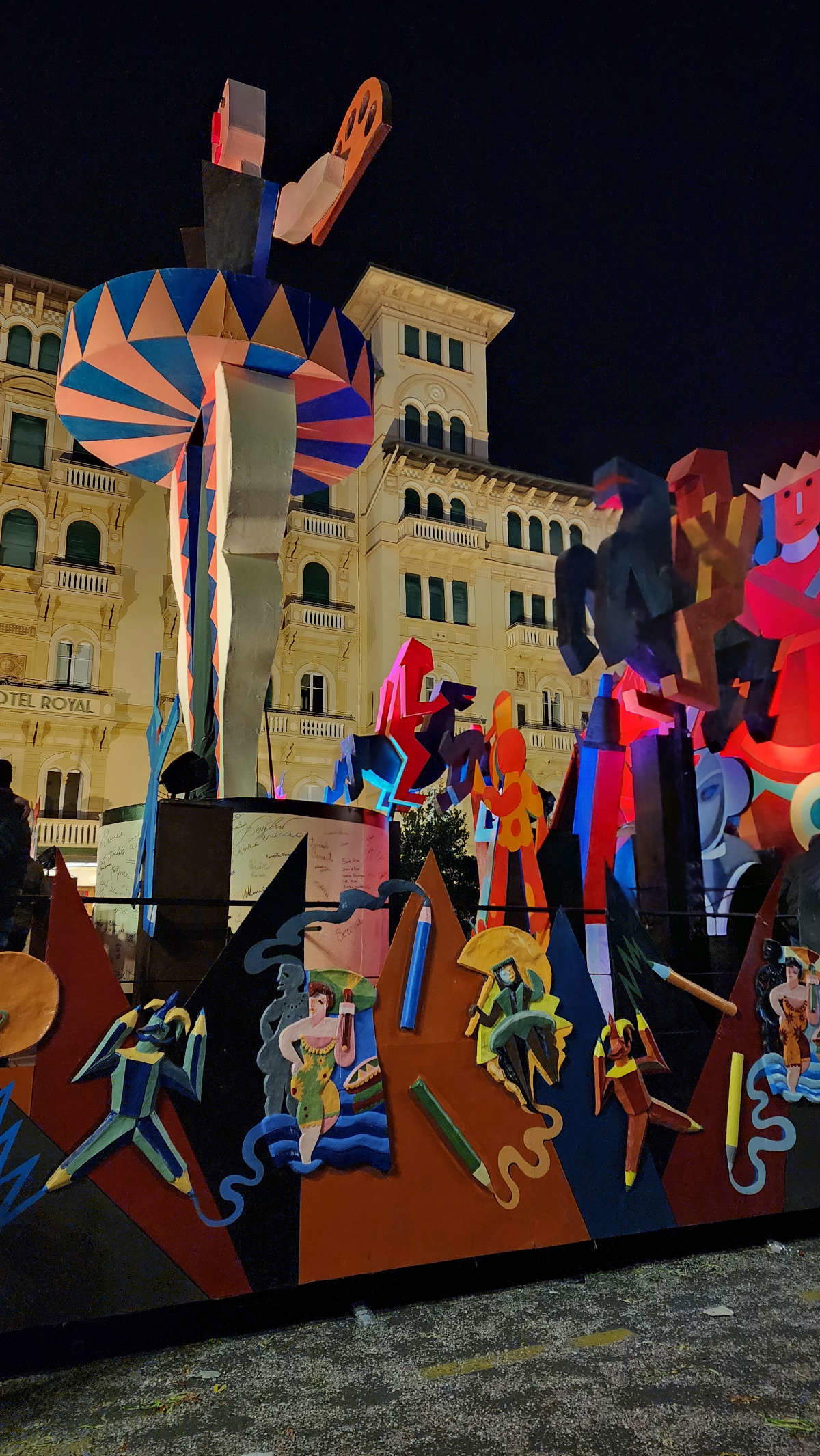
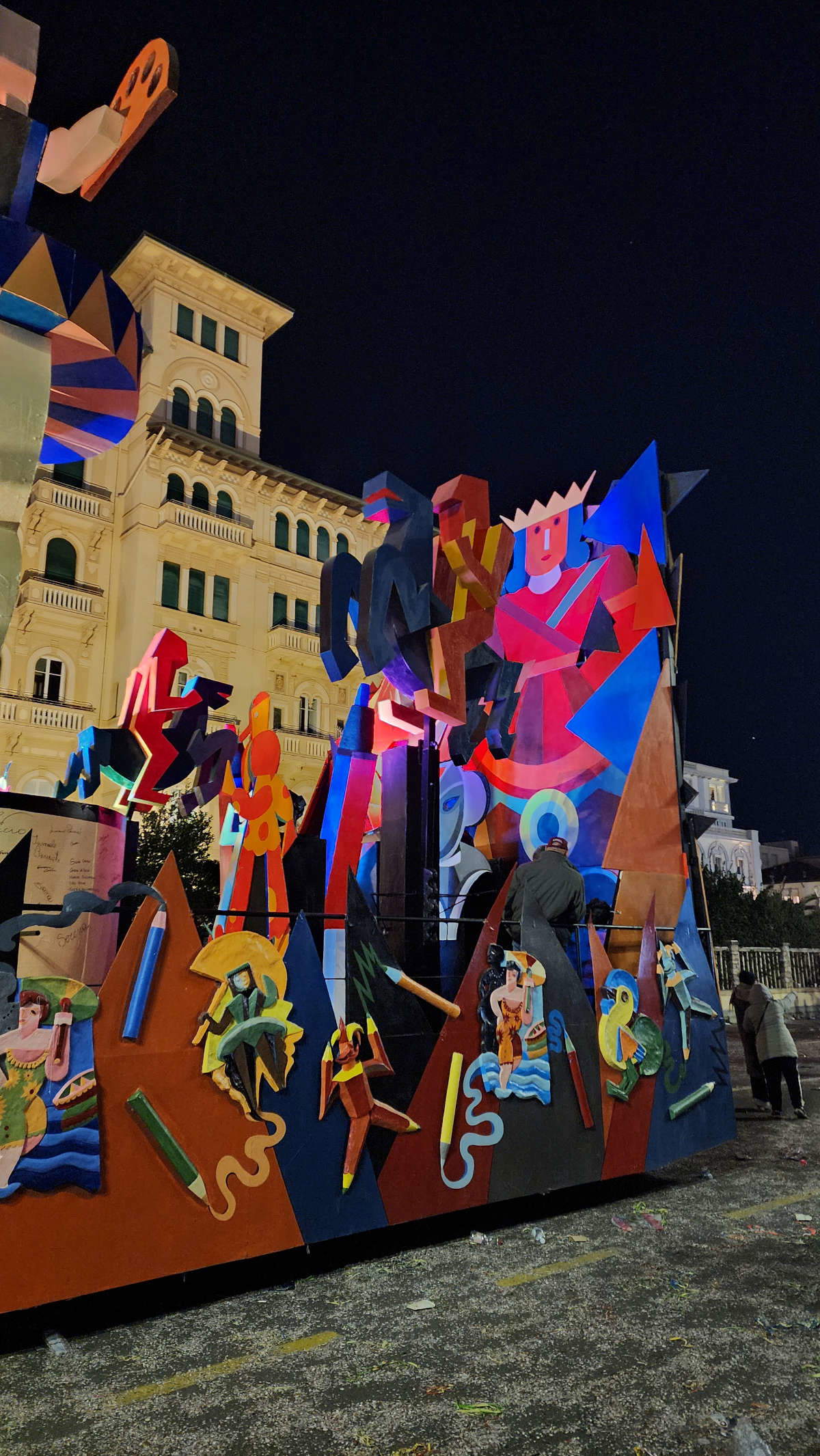
About 20 workers are employed for the technical aspect alone, including carpenters, electricians in charge of lighting and sound system. The same team that made the float, along with outside personnel, man the area around and in front of the structure during the parades to ensure surveillance and safety along the route. All the movements of the float are manual. There are several movers: some dedicated to the monkeys, others to the horses, and three operators exclusively for the dancer. Two of these rotate her, while a third, using a hoist, moves her arms in a wide, dancing gesture. A tractor driver, a DJ and technical assistants complete the team.
The back of the float is scenographically consistent with the front. A backdrop highlights the main figures, and in the center is a large king of deniers, about 4 meters tall and mounted 5 feet off the ground. Around him appear triangles of various sizes and thunderbolts, graphic elements that recall futurist dynamism. The back also features a second king of deniers, creating a 360-degree visual continuity and reinforcing the idea of a work designed to be viewed from all angles.
“I wish this to be a Carnival first of all of sunshine and beautiful days,” says Tomei. “And then we exalt with our works, imagination, creativity and we dedicate these works of ours to people who like to relax and come to enjoy a show made precisely of inspiration and imagination.”
Born in 1960, a graduate of the Academy of Fine Arts in Carrara in 1984, Tomei began his journey in the world of Carnival as an illustrator for CarnevalDarsena, and then officially landed at the event by collaborating for eight years with builder Piero Farnocchia. Over time he also worked with Arnaldo and Fabrizio Galli. He has made numerous isolated masks, group masquerades and second-category floats, achieving excellent rankings. In the three-year period 2021-2023 he signed first-category floats. Since 2022 he has been joined by Antonino Croci, after some experience with other carnival masters, and has co-authored the most recent projects with him. Since 2024 the two have competed together in the second category, consolidating a collaboration that in 2026 finds in the float dedicated to Depero a mature synthesis of artistic research and popular spectacle.
|
| At the Viareggio Carnival 2026, a float paying homage to Futurism and Depero |

Warning: the translation into English of the original Italian article was created using automatic tools. We undertake to review all articles, but we do not guarantee the total absence of inaccuracies in the translation due to the program. You can find the original by clicking on the ITA button. If you find any mistake,please contact us.






















 IT
IT FR
FR DE
DE ES
ES CN
CN


