





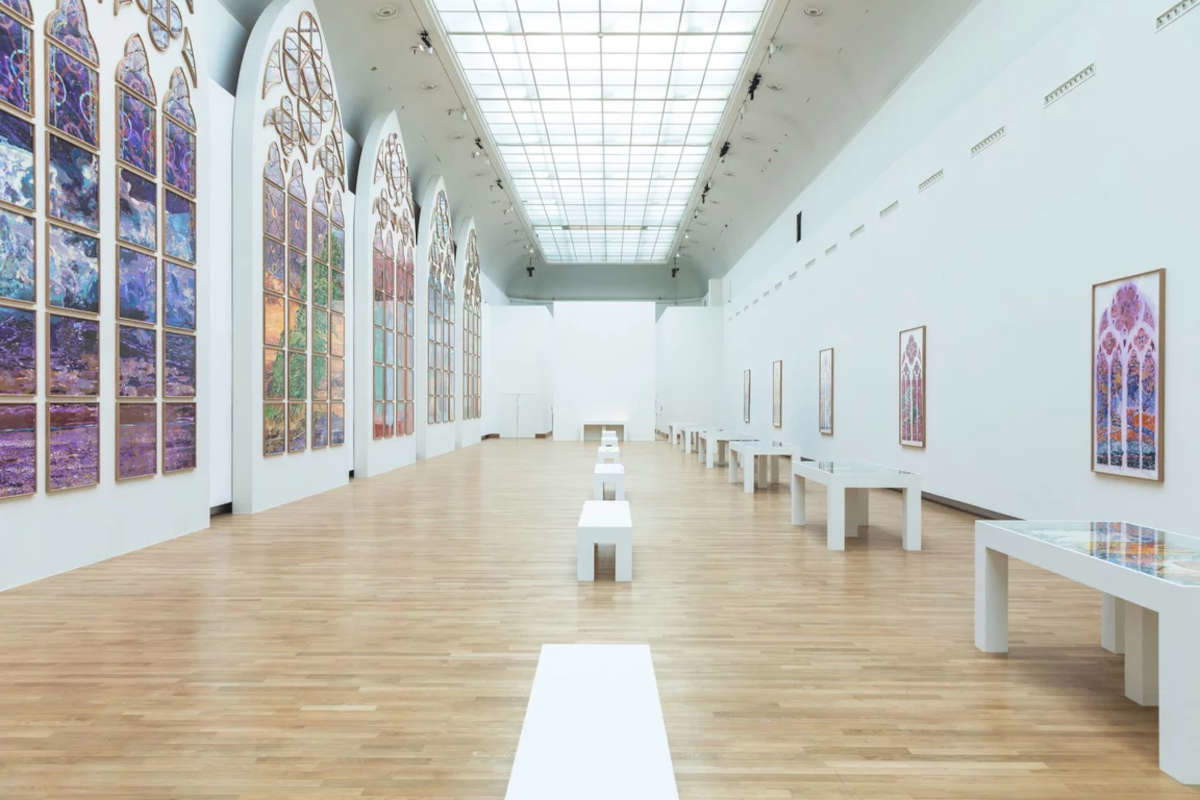
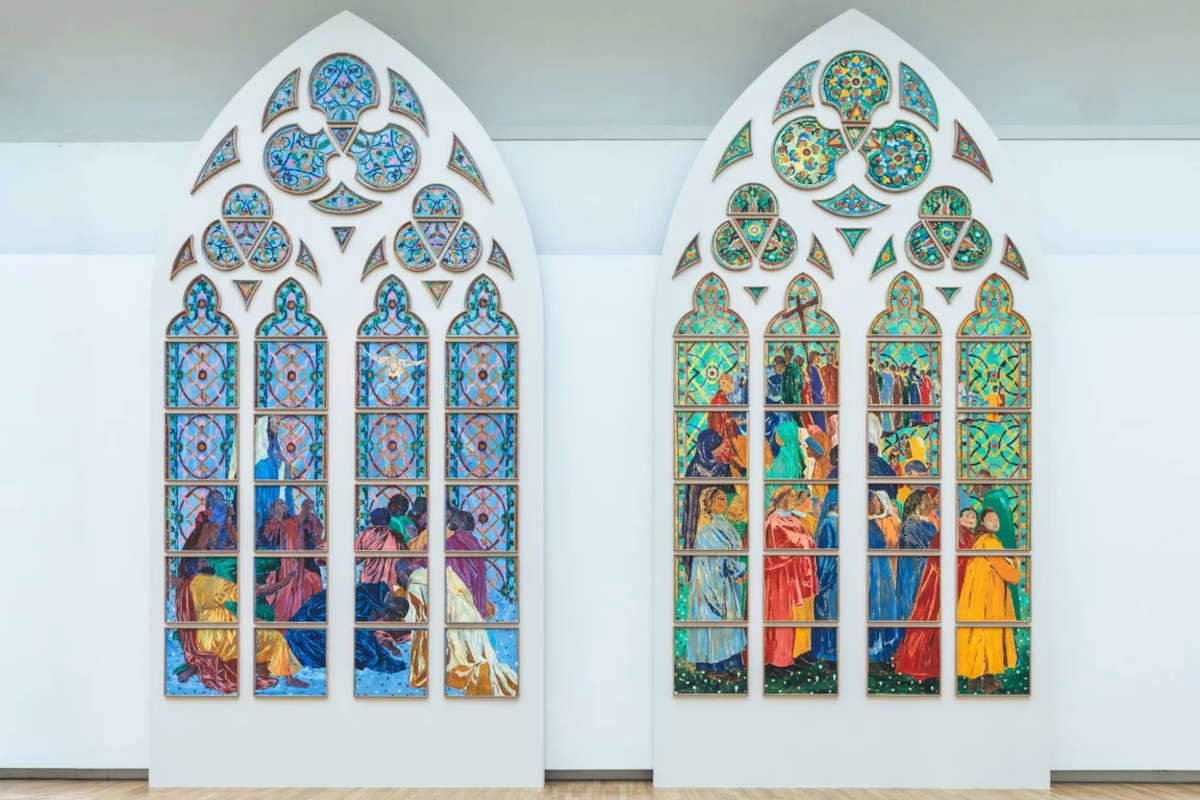
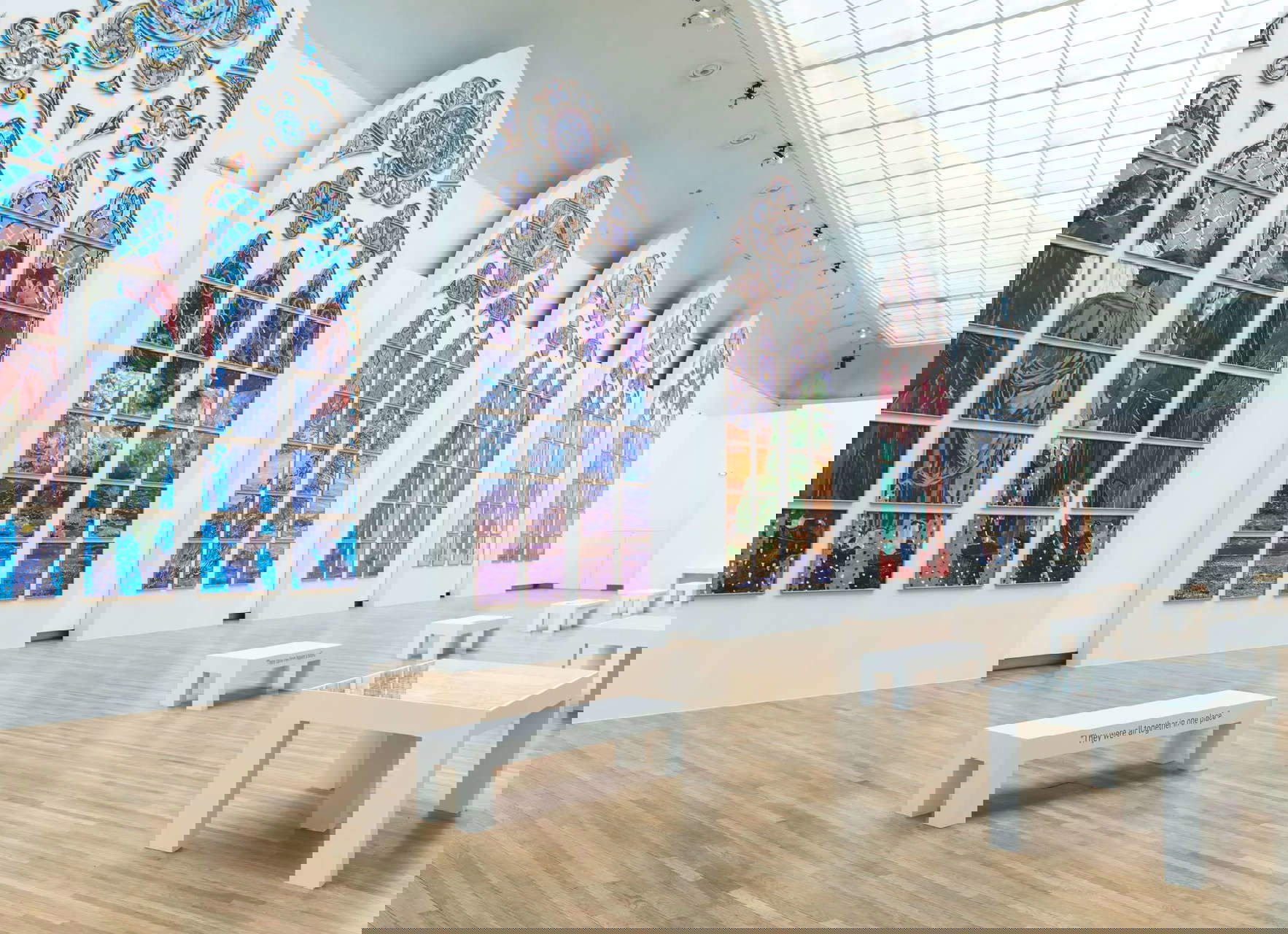
An exhibition entirely devoted to the new stained glass windows of Notre-Dame Cathedral, which were designed by French artist Claire Tabouret (Pertuis, 1981), opened last Dec. 10 and will run until March 15, 2026, at the Grand Palais in Paris. The exhibition is titled D’un seul souffle and shows the works of Tabouret, who is among the best voices of young French contemporary art, executed after the artist was selected in December 2024 as the winner of the consultation organized by the public institution Rebâtir Notre-Dame de Paris. The exhibition presents in the life-size models, sketches and preparatory work for the six future stained glass windows intended for the south side of the building’s nave. This exhibition stems from Tabouret’s desire to involve the public in a historic undertaking, offering a close-up view of the creative process while the final works are still being made at Atelier Simon-Marq.
The set design curated by Jean-Paul Camargo was conceived to transport visitors into the specific atmosphere of the workshop, allowing them to closely observe a moment of work still in the making. At the center of Claire Tabouret’s artistic investigation is the monotype technique, a printing process that the artist has practiced consistently for many years and which she found ideal for the nature of the project. Each of the six stained-glass windows, about seven meters high, was preceded by a complex operation of decomposition and recomposition. For each individual stained-glass window, Tabouret made about fifty pieces corresponding to the different sections of the stained-glass window and its rosettes, which were subsequently assembled to form the monumental models exhibited at the Grand Palais.
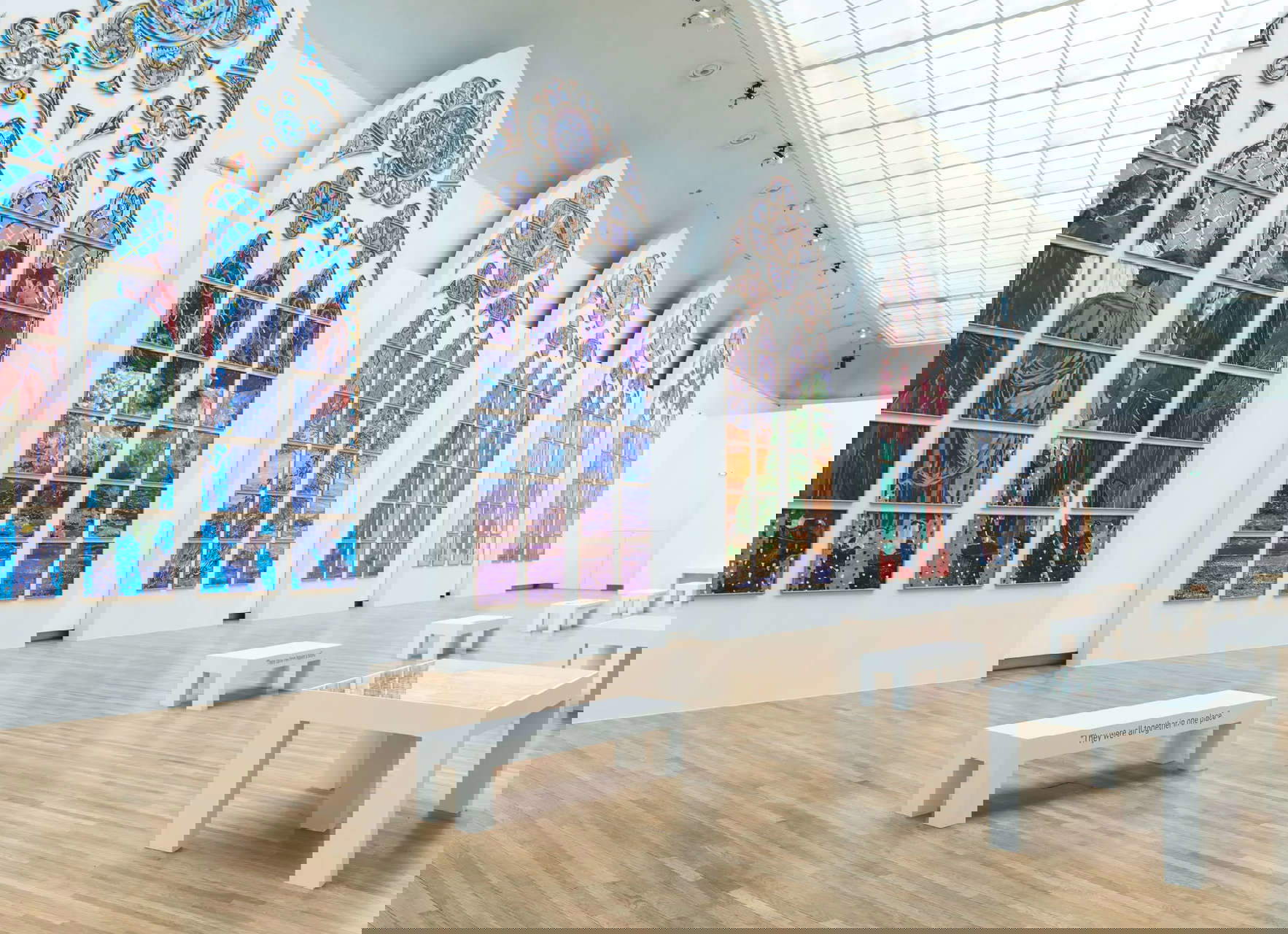
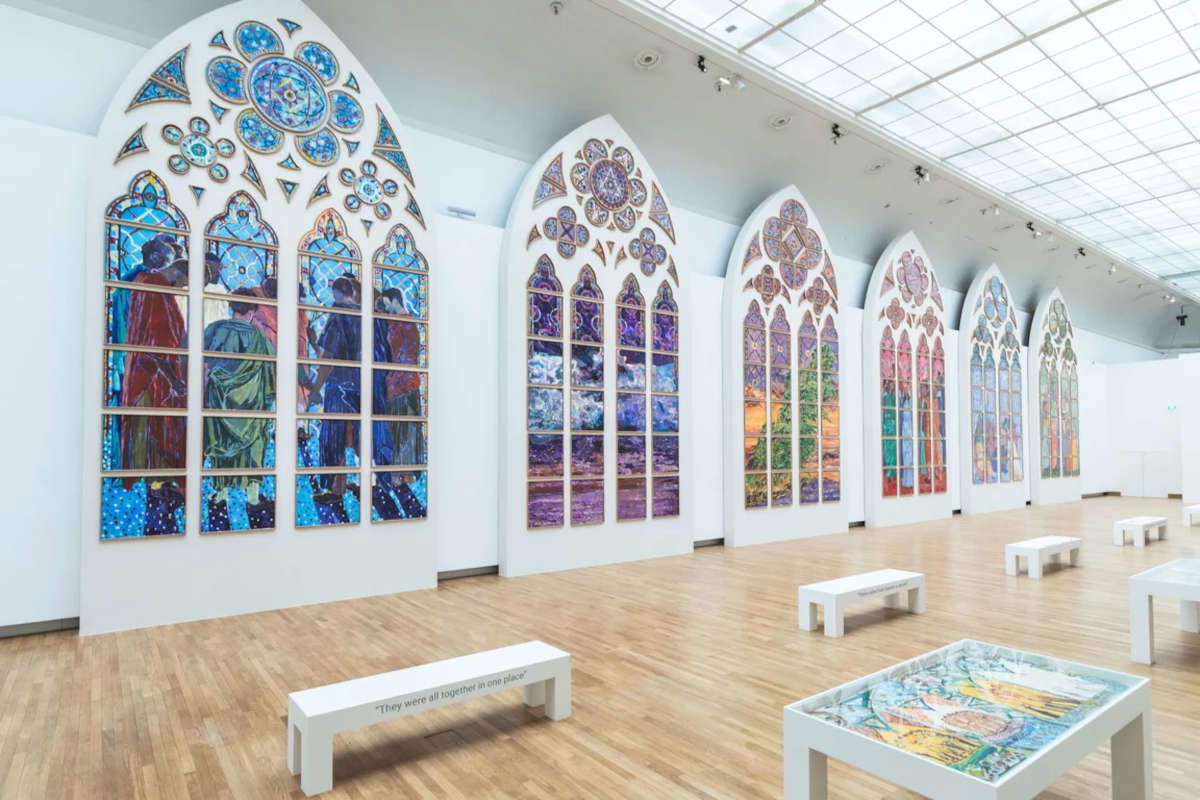
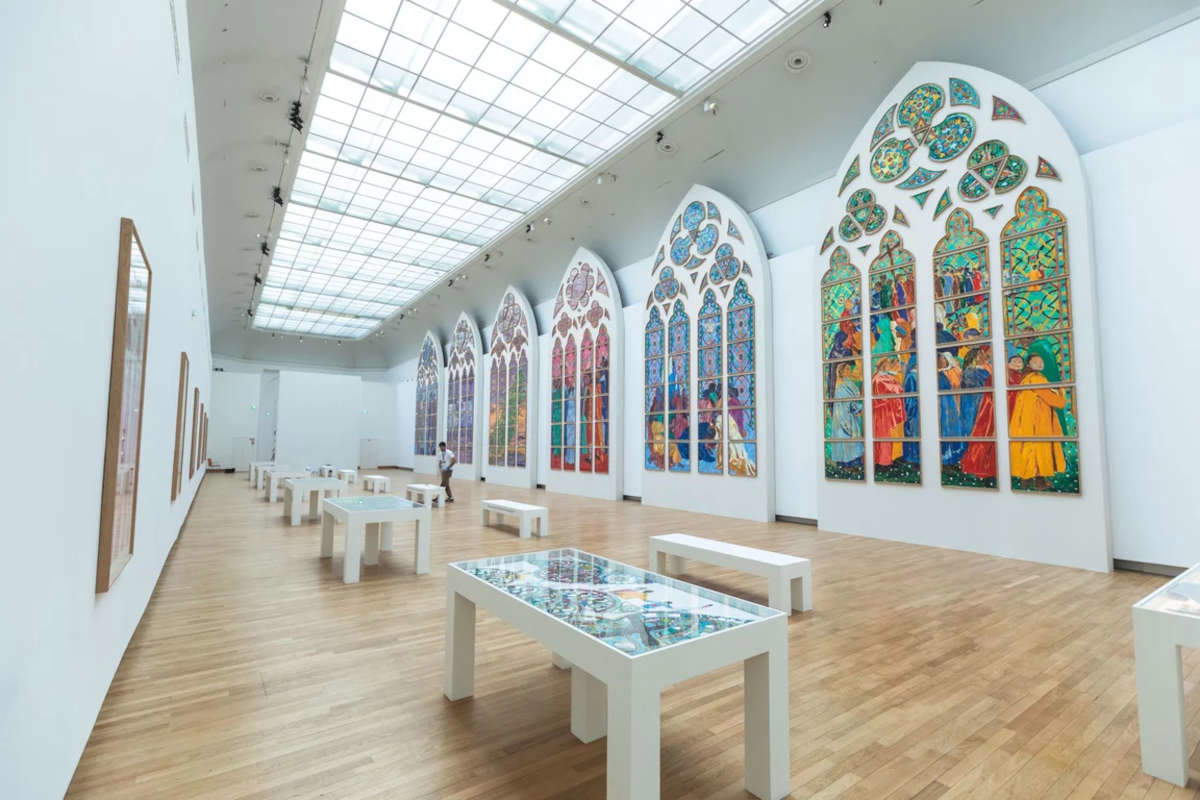
The technical process described by the artist involves the use of ink spread on transparent Plexiglas, working the image inside out and alternating the free movement of the brush with the use of stencils to define sharp outlines, especially for the serial decorative motifs. These elements are then imprinted on very thick paper using a press found in the artist’s studio, a method that the painter herself acknowledges has deep affinities with glass art. The integration of decorative motifs and rosettes through stencils allows for a harmonious transition with references to nineteenth-century stained glass windows remaining visible in the background.
A key requirement of the commission concerned the management of light inside the cathedral. To meet the requirements posed by the consultation of Rebâtir Notre-Dame de Paris, Claire Tabouret opted for a vivid but balanced color palette, specifically designed so that the new insertions would not compromise the building’s white, neutral luminosity. This approach aims to ensure visual continuity with Viollet-le-Duc’s pre-existing stained glass windows, while introducing a contemporary language. Finally, Claire Tabouret’s stained glass windows, through their white light and scenes of Pentecost, represent an attempt at dialogue between modernity and the ancient spirituality of the site.
The theme chosen by the Archdiocese of Paris for this intervention is that of Pentecost, a concept that deeply affected the artist’s sensibility. Claire Tabouret expressed a desire to visually translate the hope for harmony and mutual understanding among people, despite the diversity of languages and divisions that characterize the contemporary world.
However, the project has raised a heated debate in the French cultural scene. At the heart of the controversy is the decision by the President of the Republic, Emmanuel Macron, to replace the original stained-glass windows designed by Viollet-le-Duc in six of the seven chapels on the south side: the point, in fact, is that the stained-glass windows, although covered in toxic dust following the 2019 fire, were cleaned and refurbished, so their replacement was not mandatory. A petition launched as early as two years ago by the newspaper La Tribune de l’Art, which collected hundreds of thousands of signatures, is moving forward (indeed: many signatures were added after the Grand Palais exhibition opened) to strongly support the preservation of the 19th-century works. According to the petitioners and several preservation associations such as Sites & Monuments and SOS Paris, Viollet-le-Duc’s stained glass windows form a coherent whole that is faithful to the cathedral’s Gothic origins, designed to hierarchize architectural space through the use of decorative grisaille.
Criticism focuses precisely on the fact that these stained glass windows were not damaged by the 2019 fire, having in fact recently been cleaned and consolidated during restoration work. Opponents of the replacement point out that these works are classified as a historical monument and that the Ministry of Culture had initially ruled out any removal. The proposal to display the removed stained glass windows in a future museum of the work at the Hôtel-Dieu has been called absurd by the petitioners, who argue that such geometric decorations lose their significance if separated from their original architectural context. The debate raises fundamental questions about the legitimacy of altering a national monument to leave a 21st-century mark, especially when the pre-existing elements are intact and part of a recognized authorial design.
|
| Paris, this is what the new contemporary stained glass windows at Notre-Dame will look like. But it's a controversy |

Warning: the translation into English of the original Italian article was created using automatic tools. We undertake to review all articles, but we do not guarantee the total absence of inaccuracies in the translation due to the program. You can find the original by clicking on the ITA button. If you find any mistake,please contact us.





















 IT
IT FR
FR DE
DE ES
ES CN
CN


