





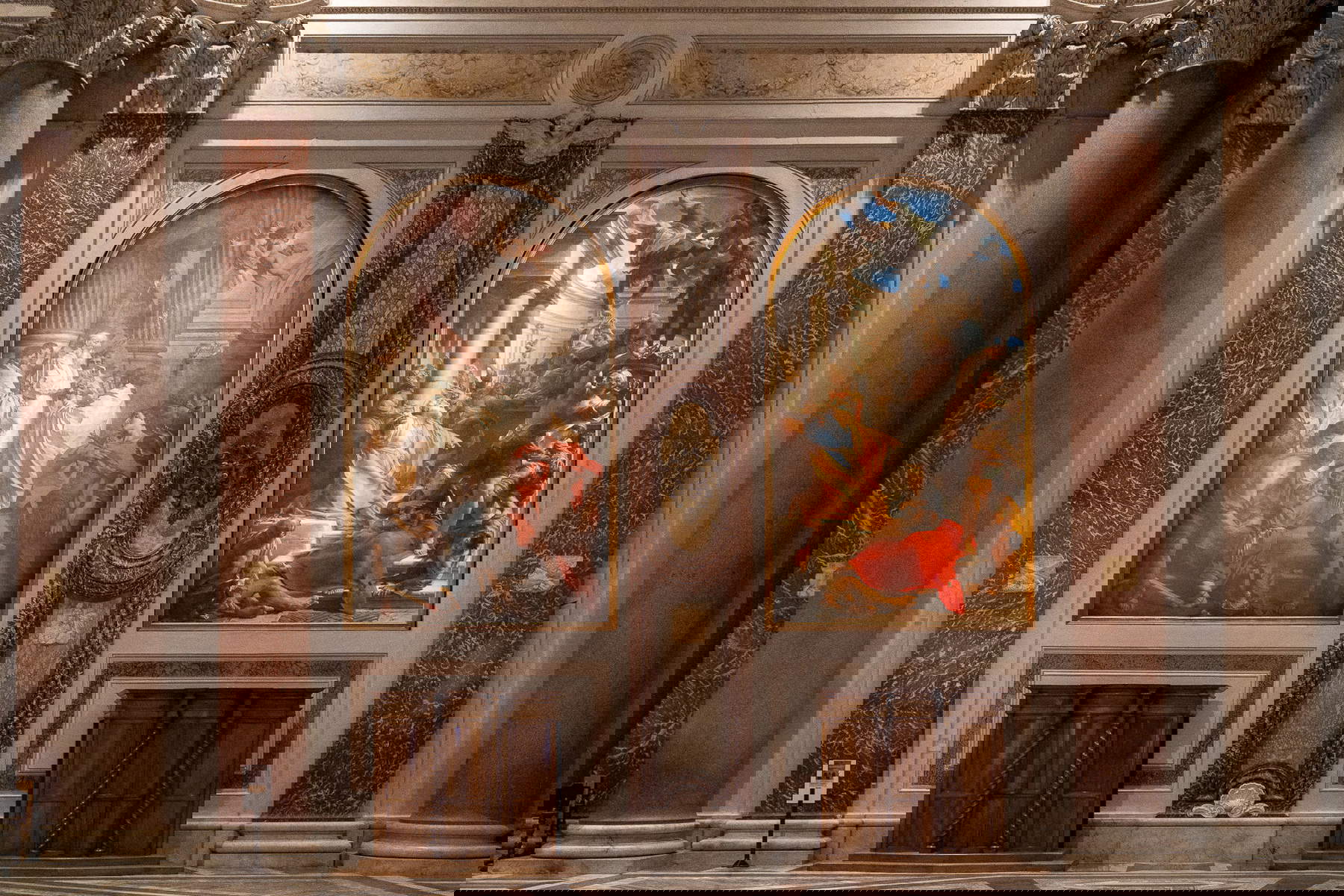
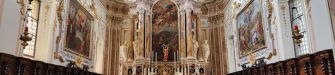
The complex restoration of the 18th-century altarpieces and canvases by Francesco Trevisani and Niccolò Ricciolini in the Basilica of Santa Maria degli Angeli e dei Martiri in Rome has been completed. The intervention, which involved 20 large canvases and lasted six years, was directed by Roberta Porfiri, art historian of the Special Superintendence of Rome headed by Daniela Porro.
For six years the transept of the Charterhouse of Rome was transformed into a vast restoration site. It was an ambitious initiative that made possible a close study of the monumental canvases, originally conceived as altarpieces and cartoons for the mosaics of St. Peter’s Basilica, and later repurposed for conservation and display in Santa Maria degli Angeli on the occasion of the 1750 Jubilee. As Roberta Porfiri illustrated, the removal of the works from their usual location made it possible to study them in detail and reconstruct their complex history through the study of material traces and archival documents.
The paintings, born with different dimensions, were unified in Luigi Vanvitelli’s design or even changed in form. This is the case, for example, with Trevisani’s work depicting the Eternal Father and the expulsion of Adam and Eve from the Earthly Paradise, which was transformed from rectangular to oval, or with Ricciolini’s canvases adapted into half-moons to fit into the sides of the large windows of the transept. The restoration revealed all the expedients adopted to adapt the individual scenes to the architectural spaces of the basilica, while preserving their legibility and image coherence. These interventions of adaptation and reuse are still legible in the cuts and seams of the canvases.
These are works of imposing dimensions, in some cases exceeding forty square meters, and they represented a significant challenge for the restoration team, starting with the delicate handling operations. The intervention was experimental in several respects, not least because of the numerous solutions implemented to intervene on canvases that had hardly been touched since the 18th century. The restoration was conducted according to the criterion of minimal intervention, fully respecting the history of the works and the original materials. “All the altarpieces,” Roberta Porfiri explained, “were removed from their locations and transported to the Albergati chapel, which has become our restoration laboratory, visible to the public of tourists, faithful and visitors to the basilica. Over time we have become more and more refined and have tried to design and create provisional works and systems that can give the works as little stress as possible. For Trevisani, for example, we developed a system with a truss beam that allowed each canvas to be slid and carried forward so that it could be moved away from the wall and allow work to be done on the back as well. In addition, in order to have a complete view of the work at all times, a sliding scaffold on rails was designed on the front so that if necessary it could be easily moved away so that the cleaning, pictorial reintegration and painting operations could be evaluated as a whole. In short, the enormous size of the works required a thorough study and ad hoc design even of everything that was functional for the restoration itself, starting with the scaffolding. The two huge sliding towers on tracks, for example, were designed to restore Ricciolini’s canvases at height. Given the height, in this case we thought to detach yes the works from the niches but not to take them to the ground to restore them but to operate at height. Our workshop, equipped with everything, therefore moved to a height of 25 meters, and we proceeded by restoring two paintings at a time, then sliding the scaffolding so as to occupy the space of the church, which remained open at all times during the worksite, to a minimum. The project designed in this way also made it possible to meet the NRP schedule and achieve significant financial savings.”
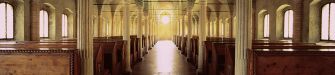
“So today,” added Porfiri, “it is possible to appreciate again, also thanks to new lighting created ad hoc to enhance each restored painting, the extraordinary nature of Cardinal Annibale Albani’s project, which transformed the ancient frigidarium of the Baths of Diocletian into a picture gallery.”
“The restoration,” pointed out Special Superintendent Daniela Porro, “represents a significant example of the work carried out by the Superintendency in recent years. The construction site stands in the middle of a larger and more complex conservation project, which from 2019 to the present, has given new light to the entire monumental complex. In fact, the intervention has made it possible not only to recover and enhance precious testimonies of the national artistic heritage but also, at the same time, to deepen the knowledge of these extraordinary works, which historically link the Basilica of St. Mary of the Angels and Martyrs to the Vatican Basilica, the place for which they were commissioned and from which they come.”
Photo: Fabio Caricchia/SSABAP
 |
| Monumental paintings in the Basilica of St. Mary of the Angels and Martyrs in Rome restored |

Warning: the translation into English of the original Italian article was created using automatic tools. We undertake to review all articles, but we do not guarantee the total absence of inaccuracies in the translation due to the program. You can find the original by clicking on the ITA button. If you find any mistake,please contact us.
















 IT
IT FR
FR DE
DE ES
ES CN
CN