





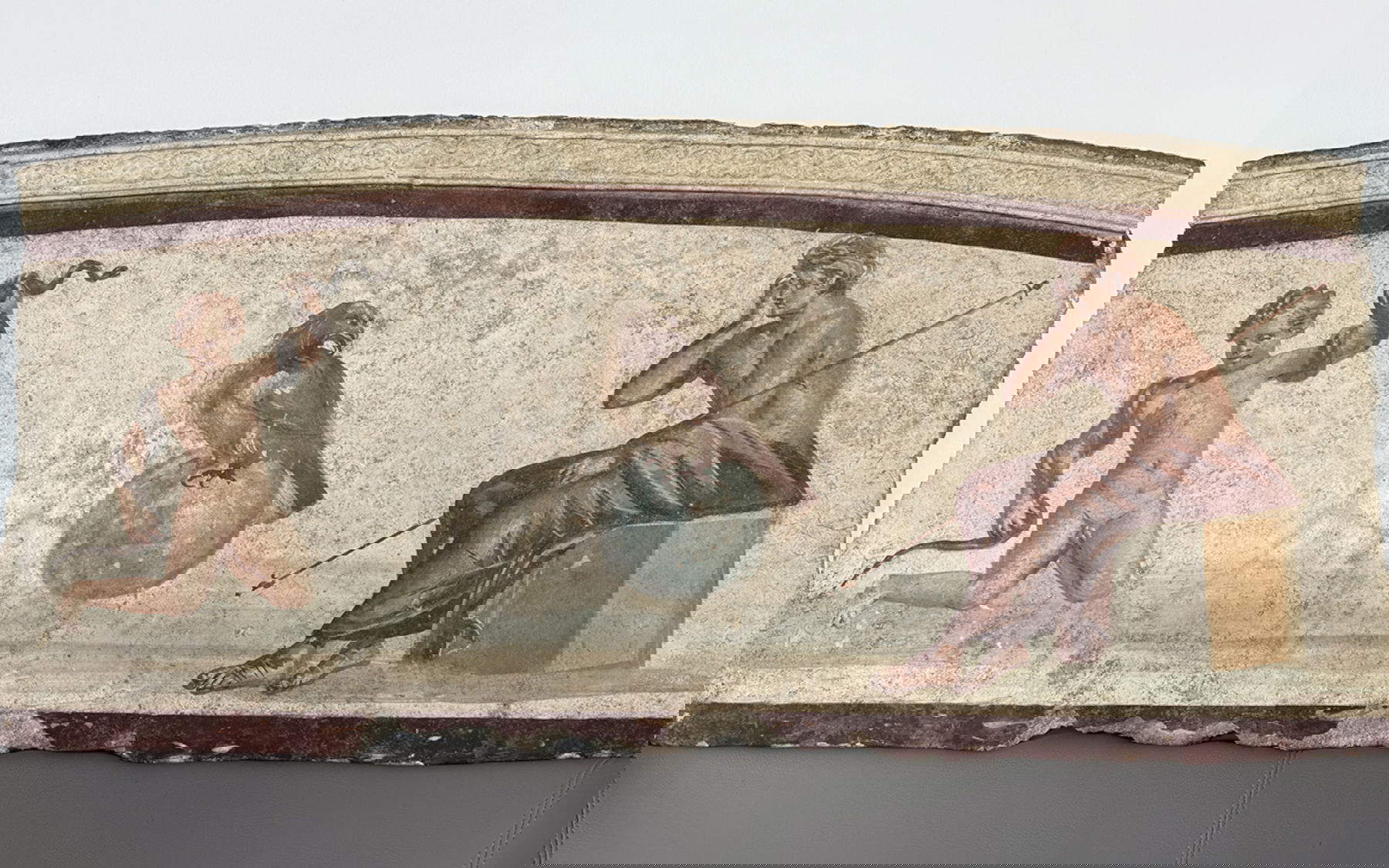
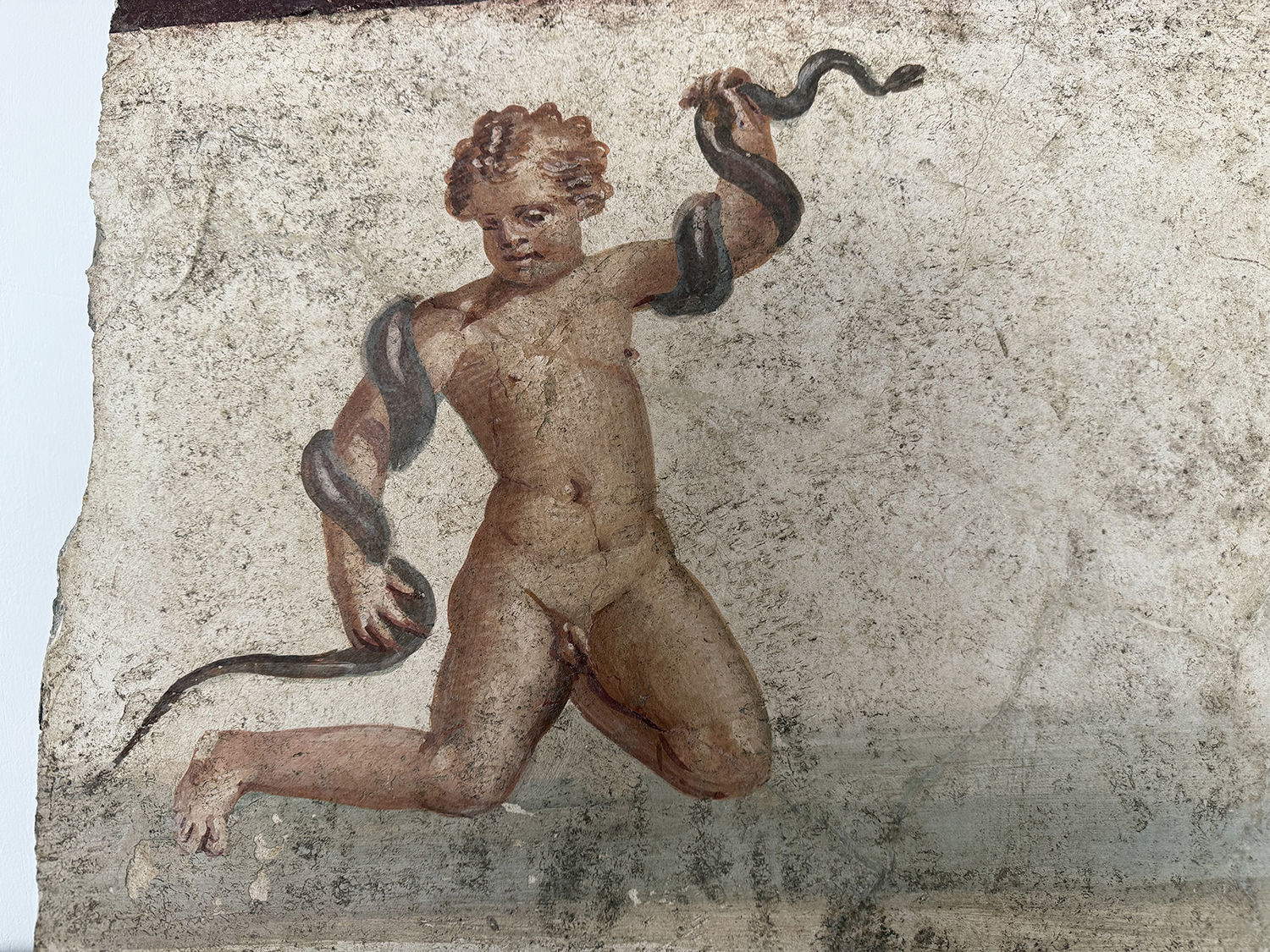
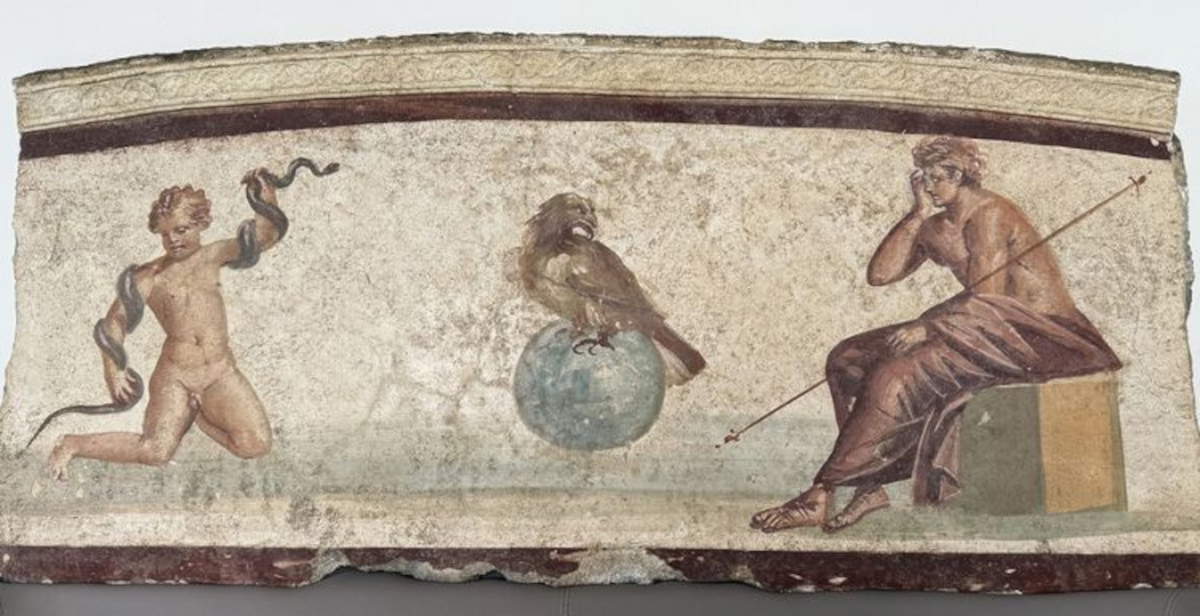
A fragment of a fresco from the suburban villa of Civita Giuliana, north of Pompeii, has returned to the availability of Pompeii Archaeological Park after being spotted within a private collection in the United States. The work depicts Hercules as a child choking snakes and was part of the decoration of a room of a ritual character, identified during recent archaeological investigations as a possible sacellum. The recovery is part of activities to combat illicit trafficking in cultural property conducted jointly by Italian institutions and U.S. authorities. The fragment had been illegally removed years ago from one of the villa’s rooms, long the subject of clandestine activities by grave robbers. It originally occupied the upper lunette of the back wall of the sacellum, as confirmed by the stylistic and dimensional characteristics that attest to its provenance from the Civita Giuliana context. The fresco depicts the mythological episode of Hercules still in swaddling clothes as he kills snakes sent by Hera, in the presence of Zeus, represented by the eagle resting on an orb, and Amphitryon.
“An archaeological find possesses value not only for its materiality, but especially for what it can tell about the past,” explains Park Director Gabriel Zuchtriegel. “Every object found in an excavation is a valuable cultural-historical testimony, because its meaning depends on the context in which it was found. When a find is stolen, this link with its original context is irreparably broken. Even if the object remains physically intact, it loses much of its scientific value. Without knowing where, how, and along with what it was discovered, the find can no longer contribute to historical reconstruction and becomes a mere isolated object, deprived of its testimonial function. Therefore, to steal an artifact is to take away a part of knowledge from all of us and to erase a fragment of human history.”
“This find,” says Torre Annunziata Public Prosecutor Nunzio Fragliasso, “is yet another fruit of the synergistic collaboration between the Archaeological Park of Pompeii and the Torre Annunziata Public Prosecutor’s Office, which has proved to be an extraordinary tool not only in bringing to light archaeological finds of exceptional importance, but also in interrupting thecriminal action of individuals who for years were the protagonists of a systematic looting of the enormous archaeological heritage kept in the vast area, still largely buried, of the Roman villa of Civita Giuliana, recovering valuable historical evidence and returning it to the enjoyment of the community.”
The artifact was recovered in 2023 as part of a criminal case coordinated by the Public Prosecutor’s Office at the Court of Rome. The operation involved collaboration between the Carabinieri Tutela Patrimonio Culturale Command in Rome and authorities in the United States, which arranged for the work to be assigned to the Pompeii Archaeological Park. The restitution is also part of an operation that allowed the return to Italy of 129 artifacts, in application of the protocol signed between the District Attorney of New York County and the Government of the Italian Republic. The case is part of the activities launched since 2017 by the Pompeii Archaeological Park in collaboration with the Torre Annunziata District Attorney’s Office. Judicial investigations and excavation campaigns at the villa of Civita Giuliana, formalized through a memorandum of understanding renewed several times starting in 2019, have made it possible to bring to light historically significant evidence and, at the same time, to counter systematic looting that had already resulted in the irreversible loss of numerous scientific data, as well as the removal of decorations and artifacts.
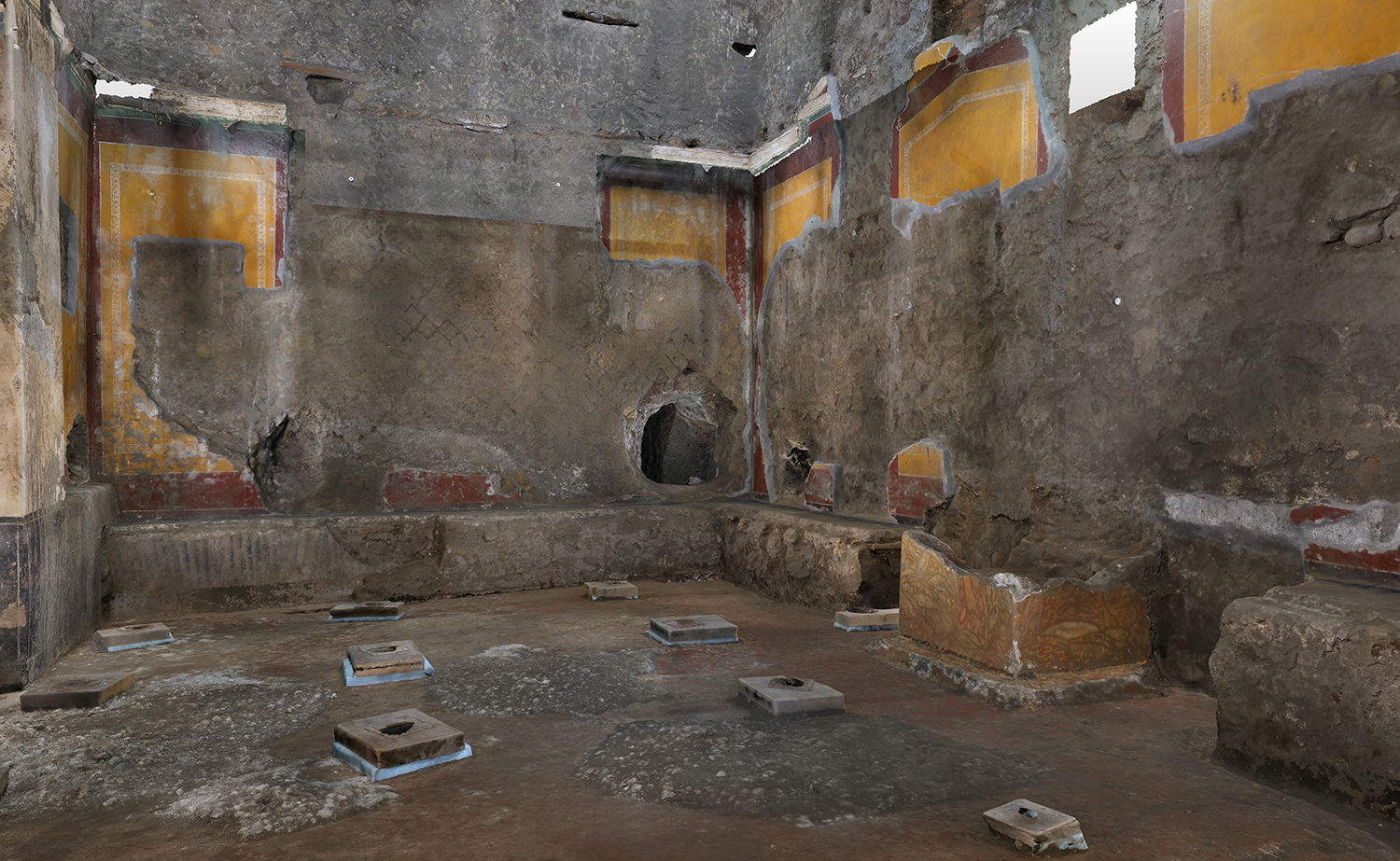
A rectangular room with ritual functions, interpreted as a sacellum or sacrarium, was identified during excavations conducted between 2023 and 2024. Inside was a quadrangular basement, probably intended to support a statue. The room was found to be almost completely stripped of its original decoration, which had been surreptitiously removed, including twelve figured panels and the upper frescoed lunette, to which the fragment depicting Hercules is now traced with certainty. At the time of its return, although the Pompeian provenance of the work was established, its original location could not be determined. Subsequent investigations conducted by Pompeii Archaeological Park officials, who were engaged in the extra-urban excavation in parallel, and comparison with additional information acquired, including that which emerged from environmental eavesdropping, made it possible to confidently attribute the fragment to the Civita Giuliana sacellum.
The iconography of the fresco assumes an important role within the decorative program of the environment. The episode of the child Hercules is not part of the cycle of the twelve labors, but rather constitutes a foreshadowing of it. Given the original presence of twelve figured panels on the walls of the sacellum, which were illegally detached, it can be assumed that these depicted precisely the hero’s labors. In this context, the scene placed in the lunette would have had an introductory function, alluding to Hercules’ prodigious strength and anticipating the feats he would accomplish in adulthood. Technical analyses and in-depth studies on the recovered panel are currently underway, aimed at clarifying the geometries and points of connection with the fresco fragments still preserved in situ. The investigations aim at a future and possible relocation of the work in its original context, as part of the projects of valorization and fruition of the archaeological site of Civita Giuliana. Investigative activities will also continue with the aim of tracing the other frescoes removed from the sacellum. The fresco with Hercules as a child will be on display starting mid-January at theAntiquarium of Boscoreale, which already houses a room dedicated to finds from the Civita Giuliana villa.
 |
| Pompeii recovers a valuable fresco that was in the U.S. in a private collection |

Warning: the translation into English of the original Italian article was created using automatic tools. We undertake to review all articles, but we do not guarantee the total absence of inaccuracies in the translation due to the program. You can find the original by clicking on the ITA button. If you find any mistake,please contact us.



















 IT
IT FR
FR DE
DE ES
ES CN
CN


