




by Redazione 20/02/2026



Categories: Ancient art / Disclaimer
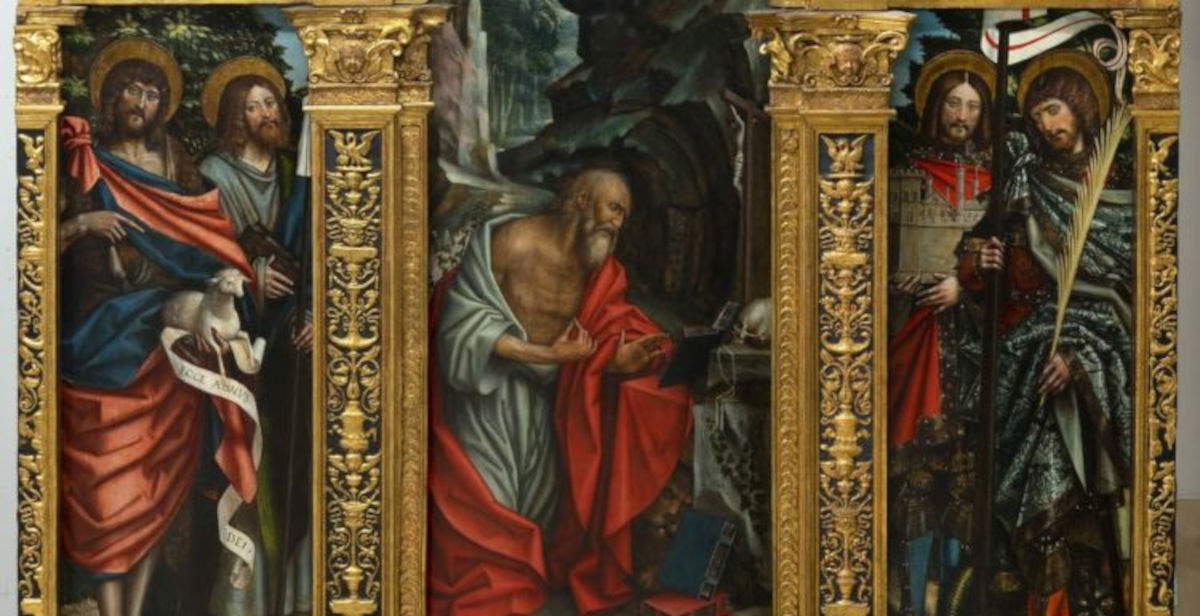
In Turin, Defendente Ferrari's Polyptych with Saint Jerome and Saints, Annunciation and Scenes from the Passion returns to the public after a complex restoration funded by lawyer Marziano Marzano, restoring structural stability and pictorial legibility to the work.

On Friday, February 20 at 11:30 a.m., Turin ’s Palazzo Madama hosted the presentation of the restoration of the Polyptych with Saint Jerome and Saints, Annunciation and Scenes from the Passion by Defendente Ferrari (Chivasso, ca. 1475 - 1540), a work of significant importance for the history of early 16th-century Piedmontese painting. The intervention, made possible by the generous funding of lawyer Marziano Marzano, former alderman and deputy mayor of the City of Turin for more than a decade, has made it possible to return to the public a masterpiece of Turin’s civic collections, preserved with its original frame. The presentation was held in the Sala Feste of Palazzo Madama, in Piazza Castello, in the presence of Massimo Broccio, President of the Fondazione Torino Musei, Rosanna Purchia, Councillor for Culture of the City of Turin, Marziano Marzano, Valeria Moratti of the Soprintendenza Archeologia, Belle Arti e Paesaggio for the Metropolitan City of Turin, Giovanni Carlo Federico Villa, director of Palazzo Madama, Simone Baiocco, museum curator, and restorers Leone Algisi, Carla Grassi and Silvia Covelli.
The polyptych, painted on wood and acquired by the museum in 1932, required a particularly articulated restoration intervention due to the complexity of the wooden structure and the condition of the supports. The presence of the original woodwork, a rare element for polyptychs of this era, made it necessary to review and update the conservation solutions adopted in previous restorations. The central panel, in particular, had an ancient fracture that was precisely recomposed, providing stability and continuity to the entire ensemble. At the same time, the restoration involved the pictorial surface, with targeted interventions aimed at preserving the legibility of details and the original chromatic quality. Leone Algisi’s workshop in Gorle (BG) conducted the work on the wooden and structural part, while Carla Grassi followed the operations on the painting.


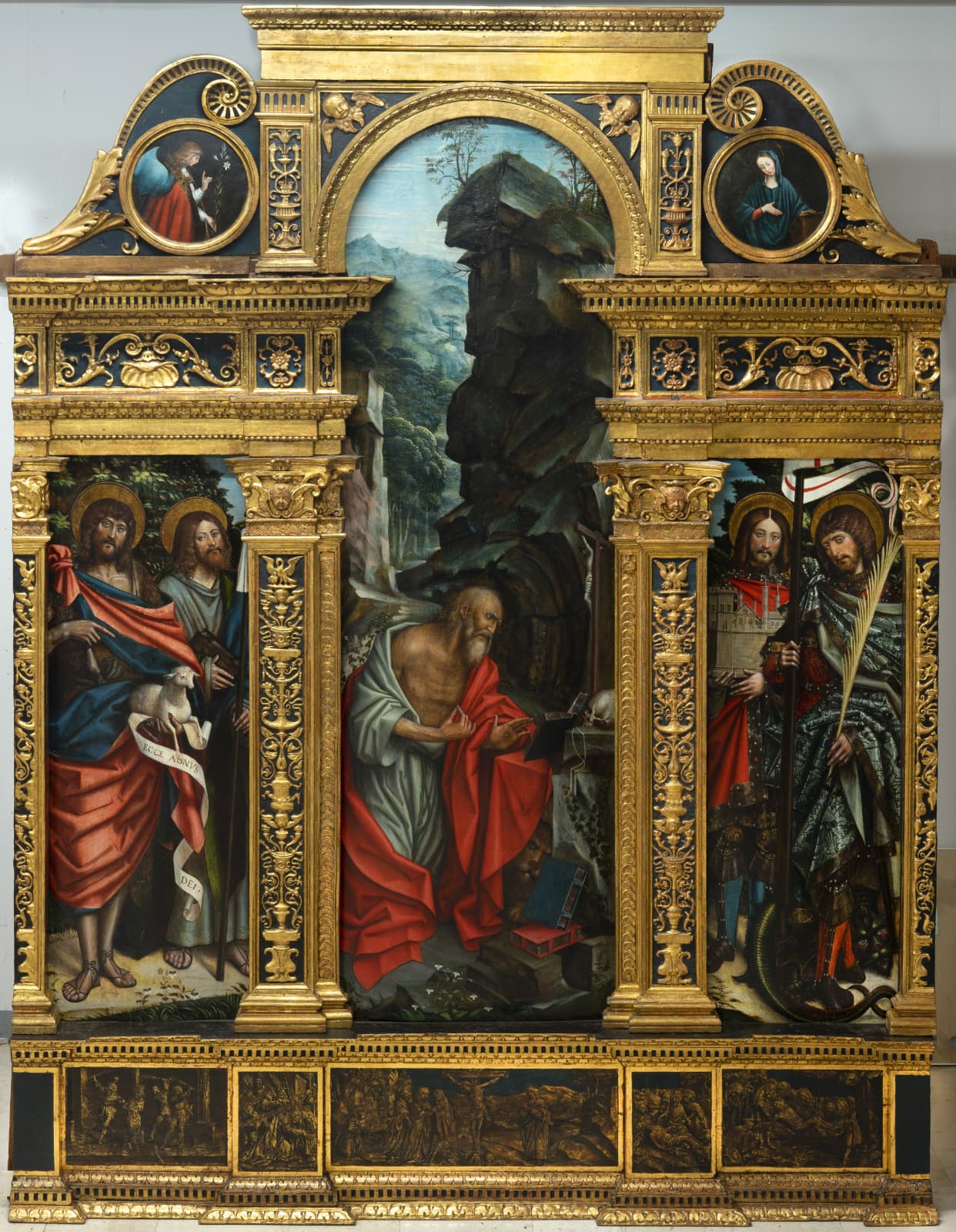
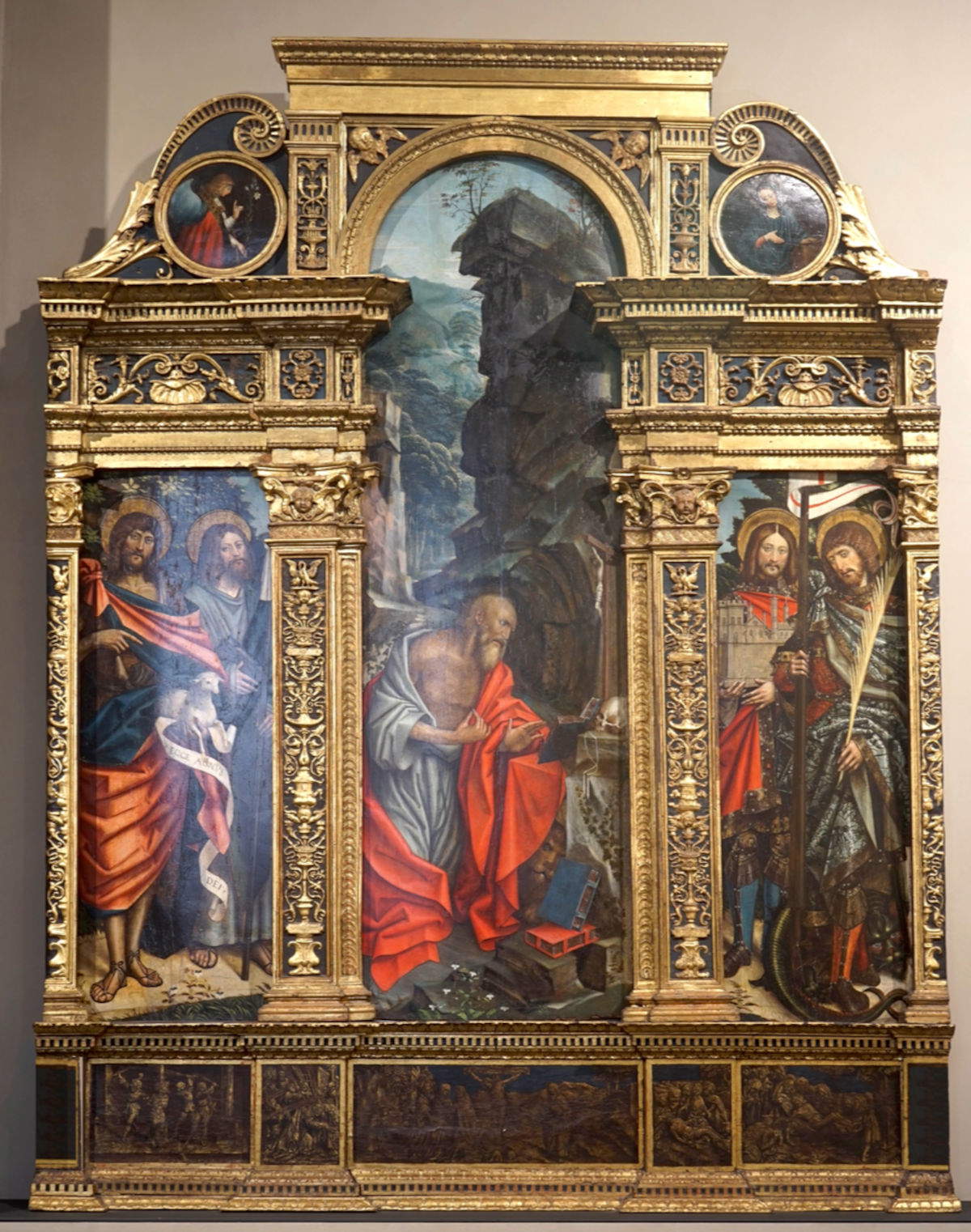
Defendente Ferrari, the author of the work, was a pupil of Giovanni Martino Spanzotti and collaborated with him in the late 15th and early 16th centuries. Later, with his own workshop, he spread throughout the Duchy of Savoy a pictorial language characterized by elegance and refinement, mediating the influences of Po Valley painting with French and Flemish ones. Attention to detail, from natural motifs to the precious details of clothing, is a hallmark of his production. The polyptych features St. Jerome in his hermitage in the center, flanked by side panels with pairs of saints, while the predella displays refined gold-hatching work that recalls Renaissance engraving techniques and goldsmithing. The original frame retains decorations with pastille candelabras. Having entered the civic collections thanks to patronage in the early decades of the twentieth century, with contributions from Giovanni Battista Devalle, Isaia Levi and Silvio Simeom, the polyptych now returns fully legible and structurally restored thanks to a contemporary act of patronage, parallel to that which had secured its acquisition. At the end of the restoration, the polyptych will be displayed in the Sala Acaia of Palazzo Madama, on the ground floor, in the same space where it was located before the intervention, resuming its dialogue with the museum’s permanent itinerary.
 |
| Turin, Defendente Ferrari's restored polyptych returns to Palazzo Madama |
Warning: the translation into English of the original Italian article was created using automatic tools. We undertake to review all articles, but we do not guarantee the total absence of inaccuracies in the translation due to the program. You can find the original by clicking on the ITA button. If you find any mistake,please contact us.