





Piazza Mignanelli has been filled with mirrors since Joana Vasconcelos brought us her I’ll be your mirror, the work that, if you will, acts as an overture to her solo show Venus, set up a few meters ahead in the rooms of PM23, the Valentino Garavani and Giancarlo Giammetti Foundation space opened to the public last year. There is a kind of stage right in front of the column of the Immaculate Conception, and Vasconcelos’ mask has been hoisted on the platform that faces the monument pulled up in the mid-19th century, when the Church was to celebrate the proclamation of the dogma of the Immaculate Conception. Now, for a few months, Giuseppe Obici’s statue will be mirrored in Joana Vasconcelos’ mask, the result of the assembly of many mirrors with Baroque moldings, designed by the artist. Consider it, then, an iconographic addition to the column. In one of the most famous images of the Immaculate Conception, the one painted by Francesco Vanni for Montalcino Cathedral, there is a mirror to remind us of the Virgin’s purity. And one has always looked in the mirror, after taking off one’s mask, to have an intimate conversation with oneself. A sincere conversation, a pure conversation. Joana Vasconcelos, who is Portuguese, has probably never been to Montalcino, but she certainly knows Fernando Pessoa, she knows his verses(Depus a máscara e vi-me ao espelho, “I laid down my mask and saw myself in the mirror”), and then she knows one by one the words that Lou Reed had written for Nico on the Velvet Underground’s debut album. And so he tried to translate into an image all the delicate duplicity of the title song, and all the naked, profound simplicity of Pessoa’s poetry. It is an ambiguous proclamation of clarity, the work that introduces the exhibition.
Joana Vasconcelos has always professed her own femininity; less so, however, does she claim those feminist instances that critics have often read in tralice when looking at her works. Works that are usually monumental, intrusive, even disturbing at times, and yet so festive, so familiar, so collected. For a few years now, the Portuguese artist seems to have stopped provoking the public: gone are the days when, in his early thirties, he commanded the attention of those visiting the Venice Biennale with a titanic chandelier made of tampax, or when he attached giant doilies to medieval castles. Or rather: Joana Vasconcelos has not ceased to provoke, the world around her has changed, and her art, while retaining that kitschy Oldenburg-style gigantism transmuted into the feminine, while not losing that deeply political soul that has always accompanied her since her beginnings, while not divesting that irony, that lightness, that softness of form that permeates her visionary repertoire of’everyday objects, she has adapted and become more intimate, with an intimacy that makes it possible to read between the lines of the project designed for the rooms of PM23, a sort of homage, explicitly declared, to the feminine critically investigated through the lens of love and beauty (hence the dedication to the goddess).
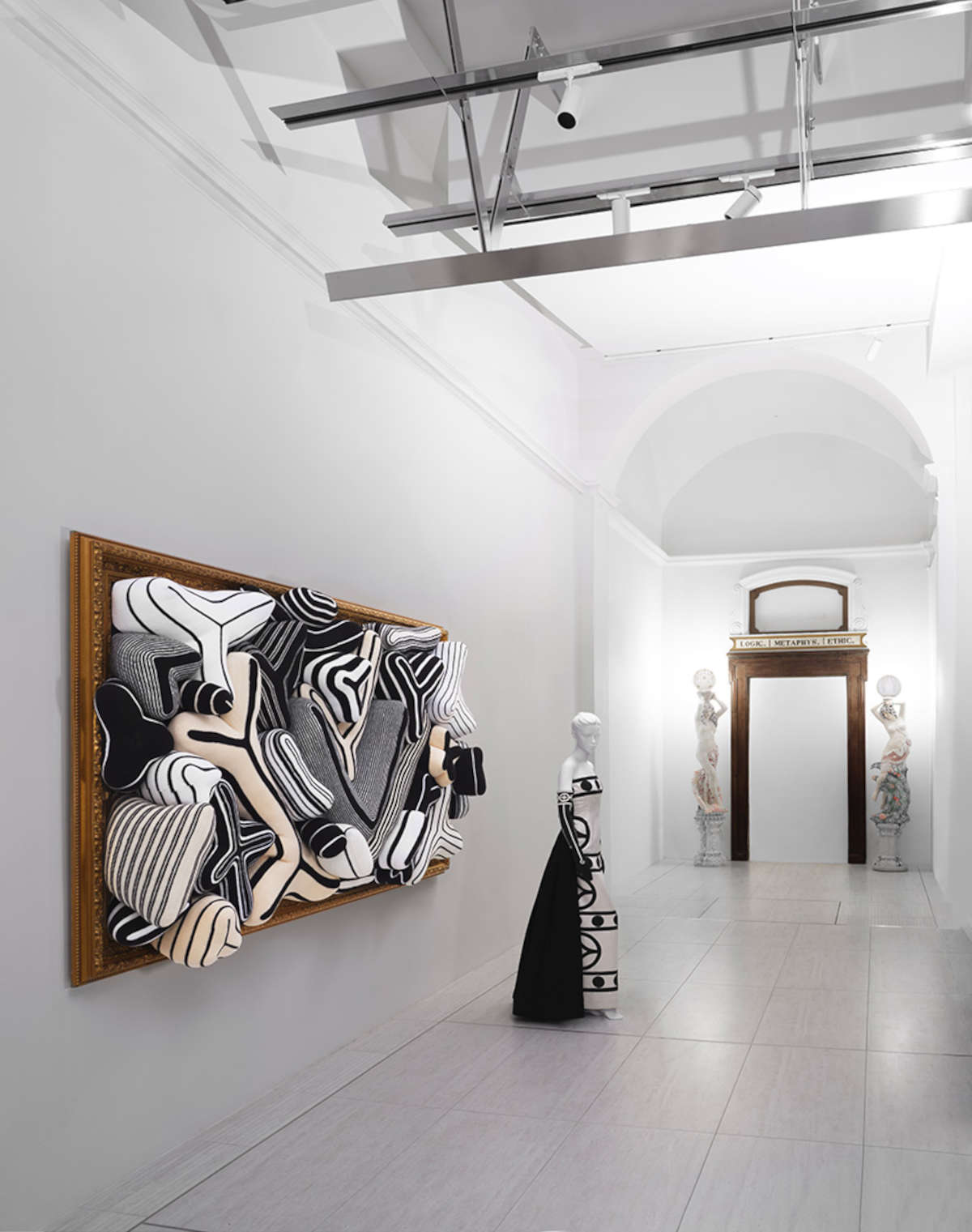
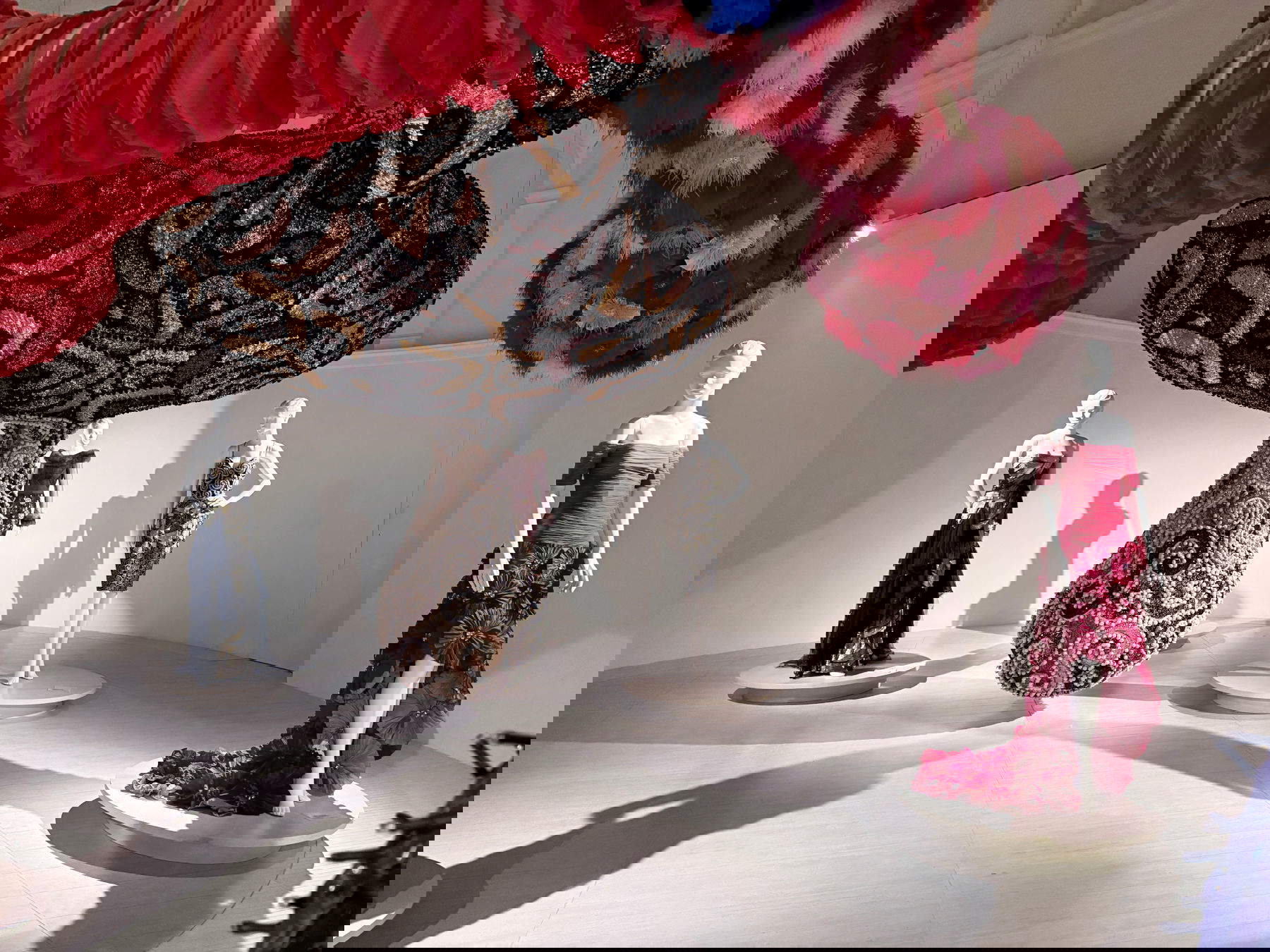
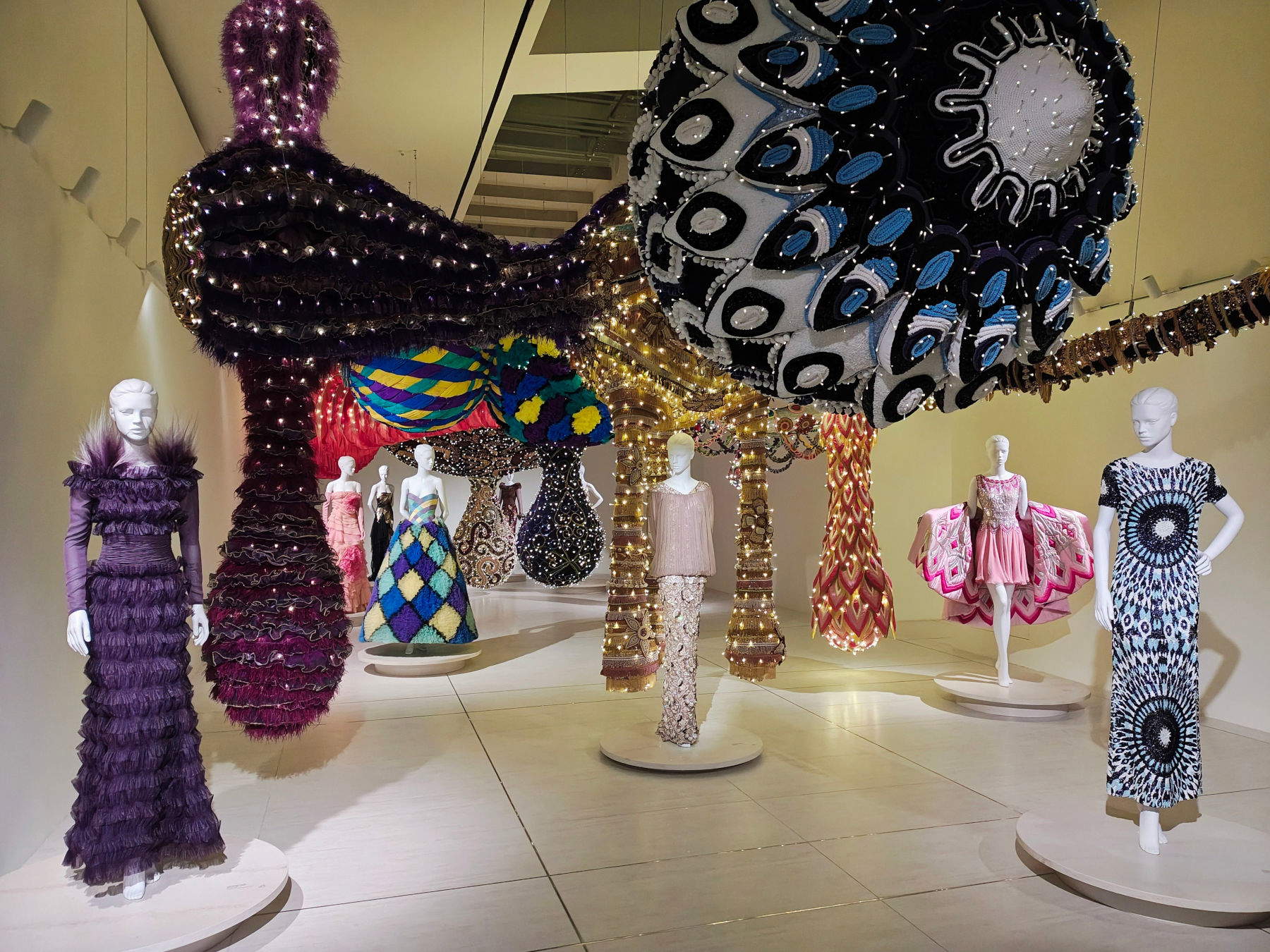
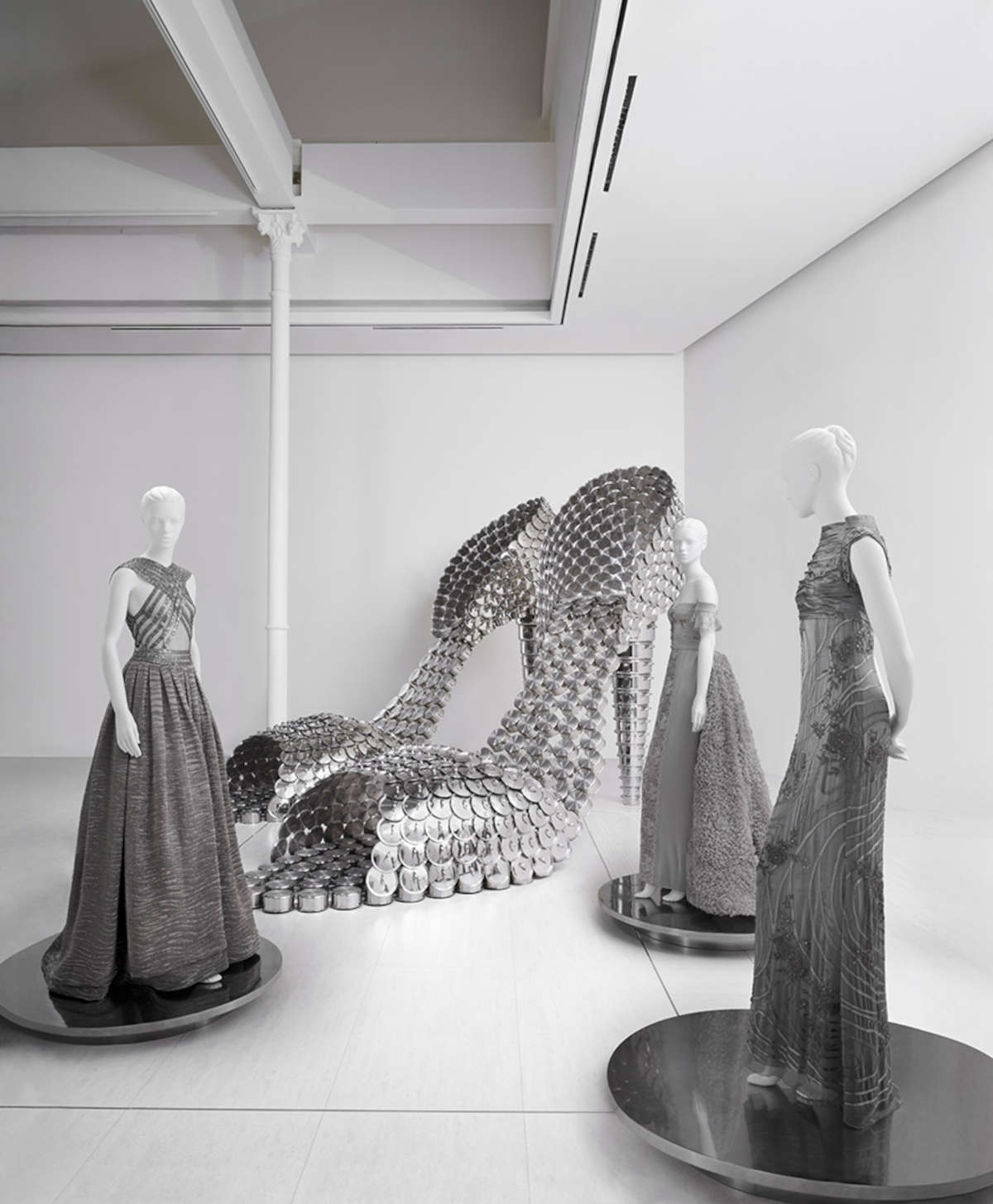
We catch a glimpse of something more than a tribute, however, because Vasconcelos’ works do not just fill the rooms of Palazzo Mignanelli. Venus is not, as is often the case, a celebration of an international star who has landed in a random place and brought a sequence of her works, a patched-up anthology, a kind of greatest hits collection designed for the sole purpose of filling a setting. Sure: the Foundation had the merit of bringing one of the great names of world art to Rome, and in a new space, to the second exhibition of his life. However, it is one thing to ask an artist to make available to the frame on duty one of his best of, to be replenished as needed with a couple of works executed for the occasion, which may even have some relevance to the space, but are disconnected from everything else. On the other hand, it is one thing to summon an artist and have him reason about a project that has a hold from top to bottom, that is not just a succession of relics, but serves to flesh out an idea. That’s it: very few can do it, and if PM23 succeeds in persevering in its intent, in guaranteeing the same approach to the exhibitions to come, in giving life and body to projects that have a soul and a brain, then we will be able to say that we have here, in Rome, attached to the Spanish Steps, one of the peaks of contemporary art in Italy.
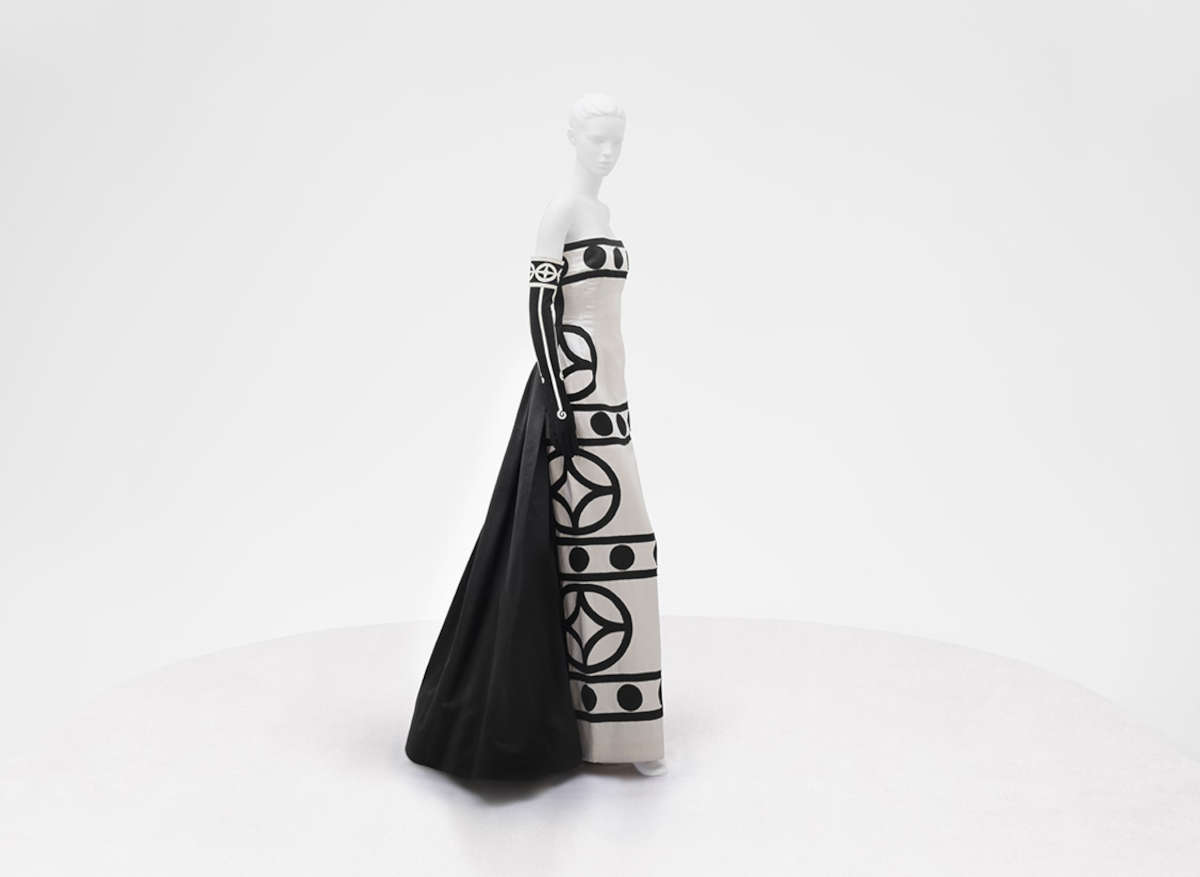
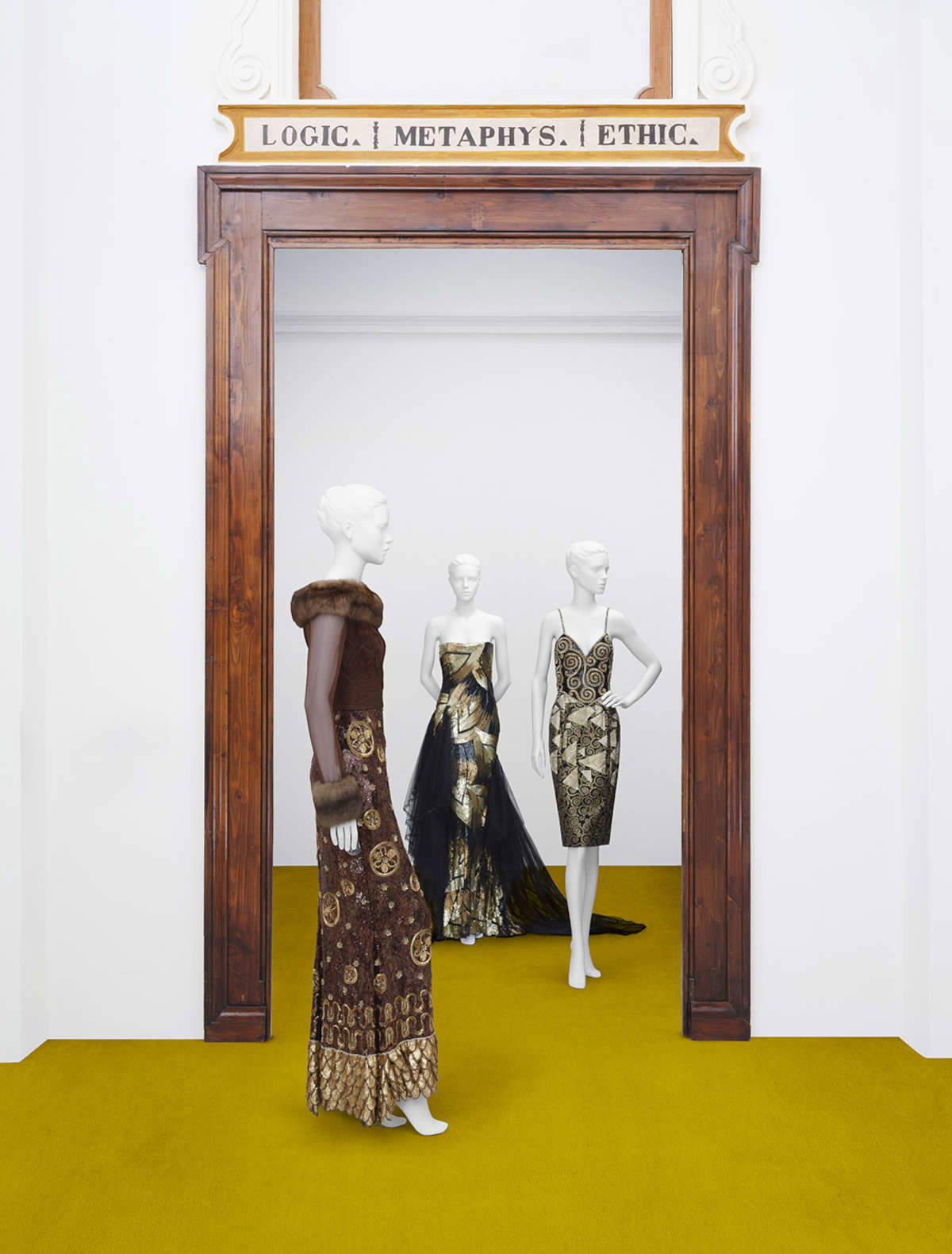
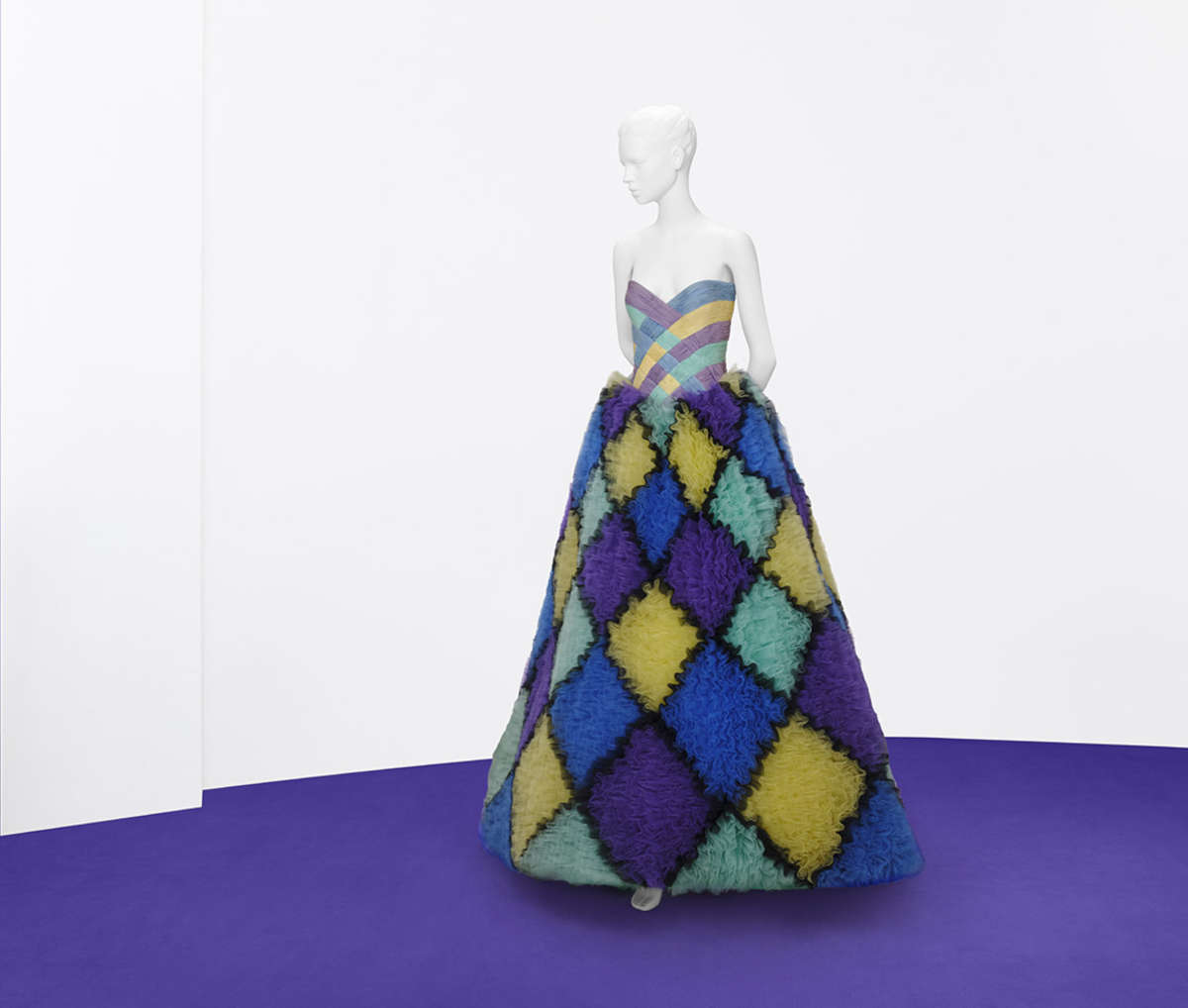
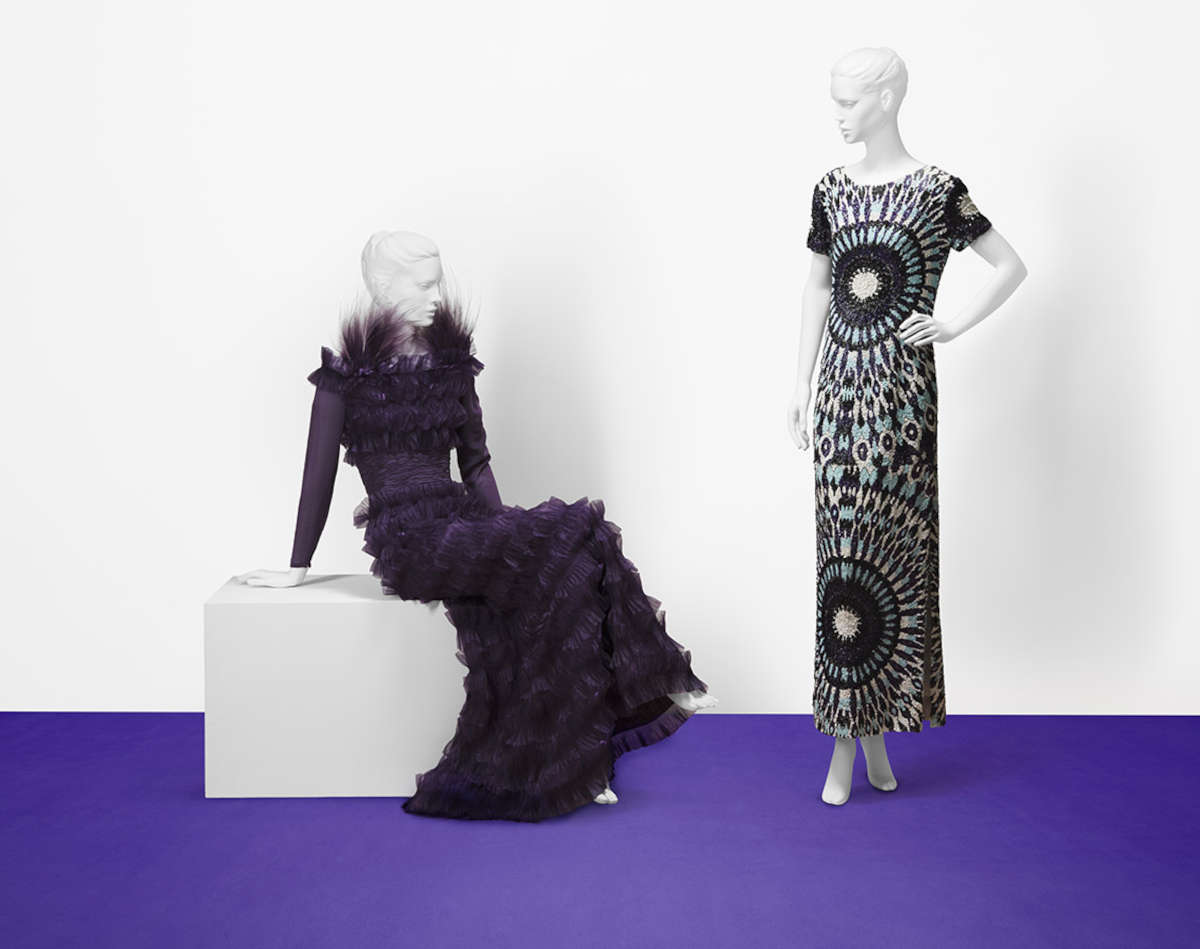
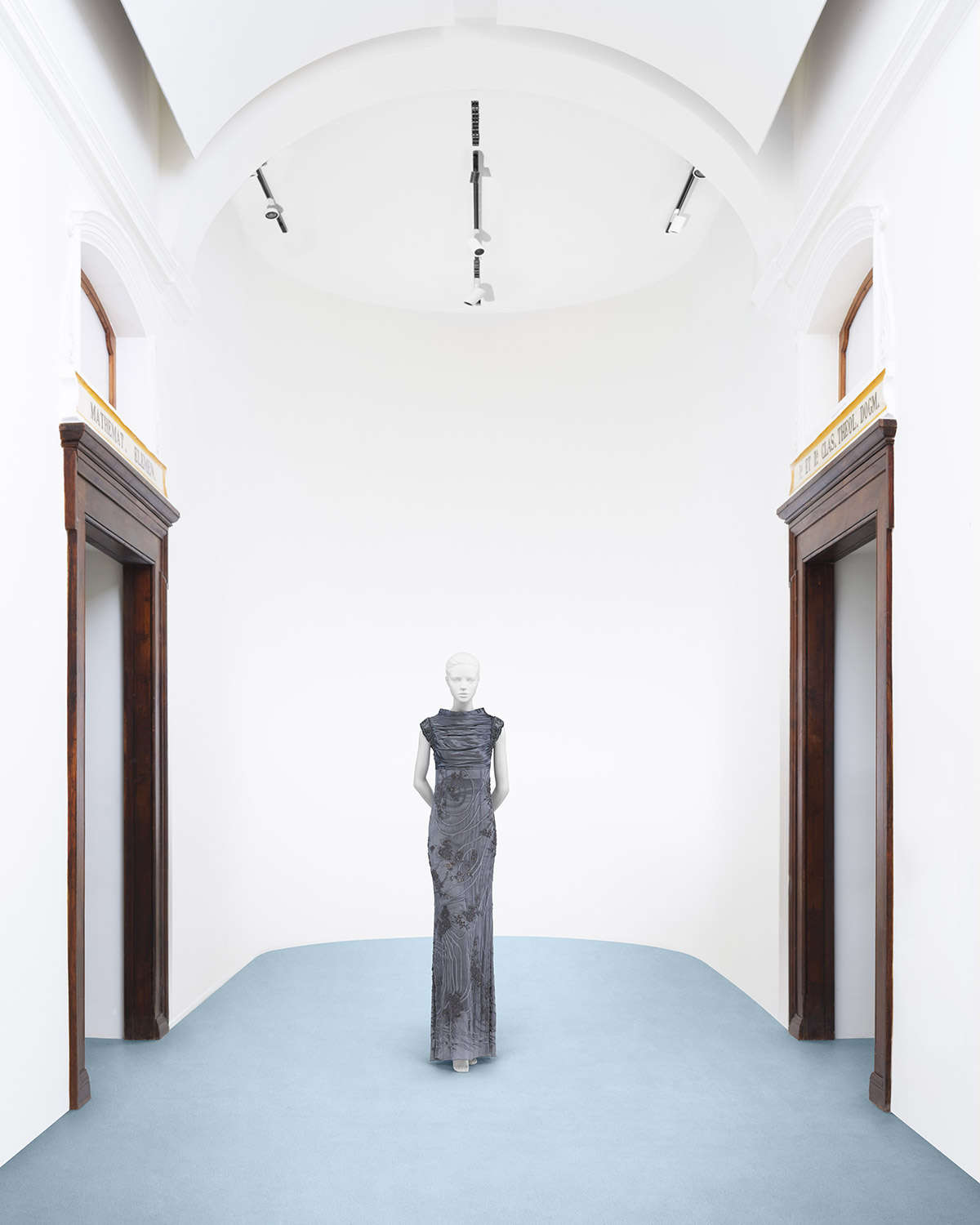
It was said that in the exhibition at Palazzo Mignanelli it is given to glimpse something more than a tribute. There is, meanwhile, a kind of communion of purpose between the artist and the designer. The tenor of the exhibition becomes immediately clear at the start, in the first room, where Venus. The Painting, one of the works Vasconcelos executed especially for the exhibition, recalls two Haute Couture designs by Valentino for the 1991 Fall-Winter collection, themselves modeled on the pure, almost geometric lines of Josef Hoffmann. That year, it was the 30-year anniversary of the fashion house, an article by Ugo Volli came out in Epoca defining Valentino’s woman in these terms: “longilinear, not showy; more romantic than sensual, but always practical and decisive, more Mediterranean than Nordic, willing to show of her body only a few perfect details: often the shoulders, a deep neckline on the back, and of course a well-behaved face and hands. The colors are the famous red, and then lots of white, black, floral patterns. The accent of almost all the dresses falls not on the breasts or the legs, but on the waist, from which a soft elongated hourglass usually starts: they are very well constructed architectures, of studied simplicity, in which the drapery, the exactness of the details, the perfect rendering of the contrasts of form and texture of the fabric ensured by the handmade packaging counts a lot.” Here: take these words, try them on Joana Vasconcelos’ sculptures, and you will find not a few similarities. Federico Zeri saw in Valentino’s clothes something of Greek sculpture, of the relationship between figure and space in classical art. In the work of Joana Vasconcelos, the references to antiquity are more ideal and conceptual than formal (although sometimes they are more uncovered: the two Bond girls escorting the visitor inside the exhibition are, after all, two classical statues), but it matters little: even the least observant visitor cannot help but notice continuous overlaps.
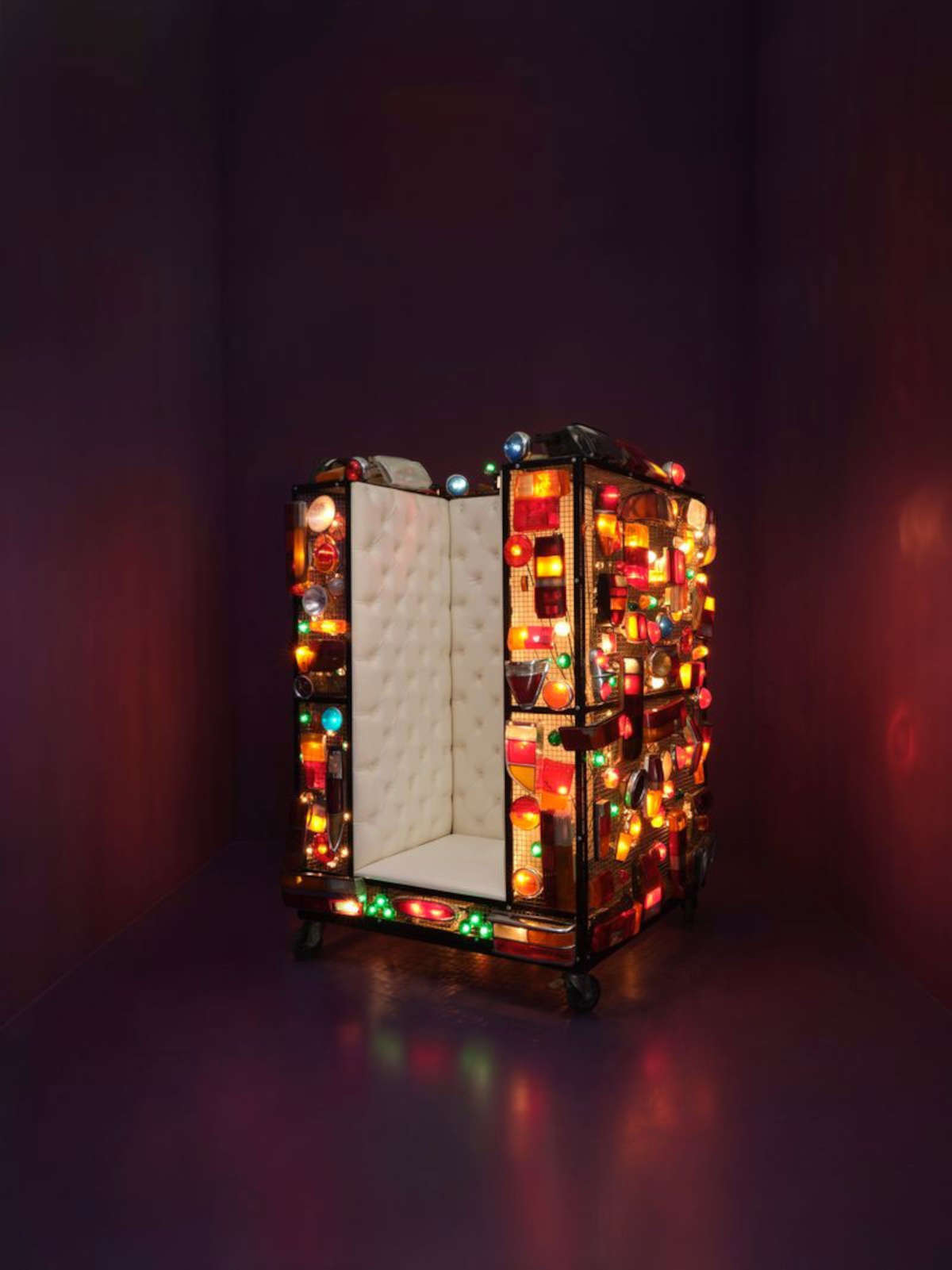
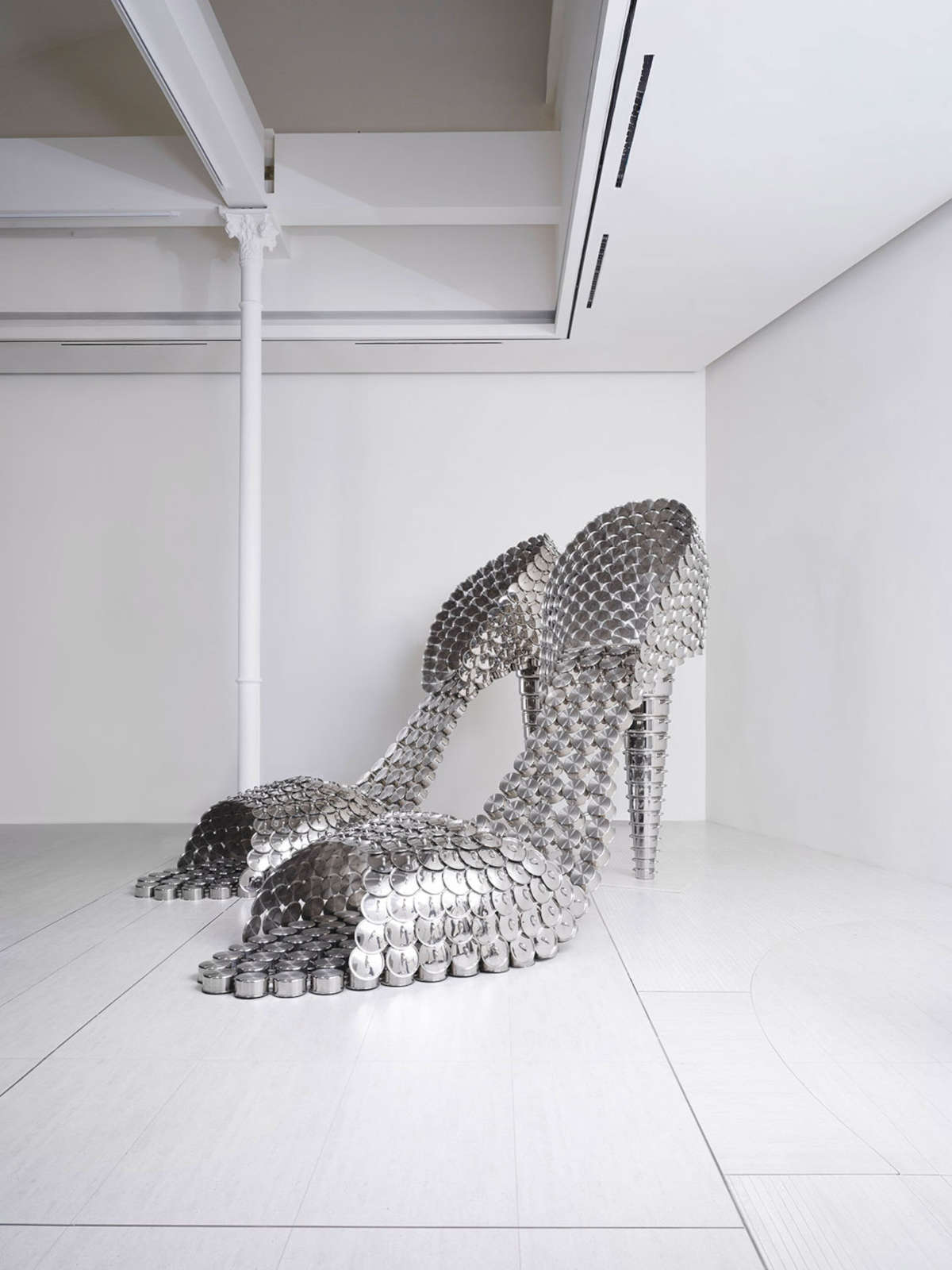
And it couldn’t be otherwise, after all. Before getting to work for Venus, Joana Vasconcelos took a few months to study Valentino’s historical collections. Pamela Golbin selected some dresses from the house’s archives, and the artist now offers her interpretation to the public in Rome. At times, the pairing has sprung up with a certain spontaneity: look at the light, bright, peach and orange colored gown that introduces Strangers in the Night, a cabin chock-full of car headlights that turn on and off to the rhythm of Sinatra’s song, evoking the possibility of’a nocturnal love to be consummated on the streets of Lisbon (curious to recall that some 20 years before Vasconcelos, the work is from 2000, Giancarlo Giannini also sang Strangers in the night seeking that same ephemeral warmth along the streets of Warsaw). Or step into the room where three evening gowns guard Marilyn, one of Joana Vasconcelos’ most famous works, the pair of huge heeled shoes composed of humble pots of a brand popular in Portugal, “an unlikely association,” as theartist calls it, between a domestic, intimate and familiar dimension, the dimension to which most stereotypes of women are reduced, and a glamour that is sublimated into consciously and proudly kitsch monuments, a decorative excess that is functional to unveil the contradiction, to bring out the idea that the roles we associate with women are nothing but constructions, artifices. In the large room where Venus is located, the imposing installation that was created especially for the exhibition, the dialogue was instead studied at the table and the work is the result of a reflection on some of the most significant dresses in Valentino’s history. The work, indeed, can be considered a kind of extension of the clothes. It is difficult to wander around the room and not find, everywhere, a direct reference to the clothes, spanning fifty years of the house’s history. Venus is a work from the Valkyrie series, which began more than two decades ago: Giantesses made of hand-knitted wool crochet , textile goddesses, soft and colorful, invading the space, stretching their tentacles across the rooms, hovering in midair, rising to the ceiling and descending to skim the floor, swelling like breasts, like wombs, enveloping and embracing and then, lightly, vanishing. Each of them is dedicated to a woman who had the ability and strength to change her and other women’s destinies. Joana Vasconcelos’s Valkyries retain the strength of the warlike Norse virgins, but they have lost their fighting nature: they are peaceful warriors. Benevolent. Motherly. Protective. It is here that we recognize the world of Joana Vasconcelos, fairy and witch, enchantress who rules a round realm, a soft, golden cavern, a garden that invades the walls, a primordial repertoire, an explosion, a spell, a womb, a symphony, a vision.
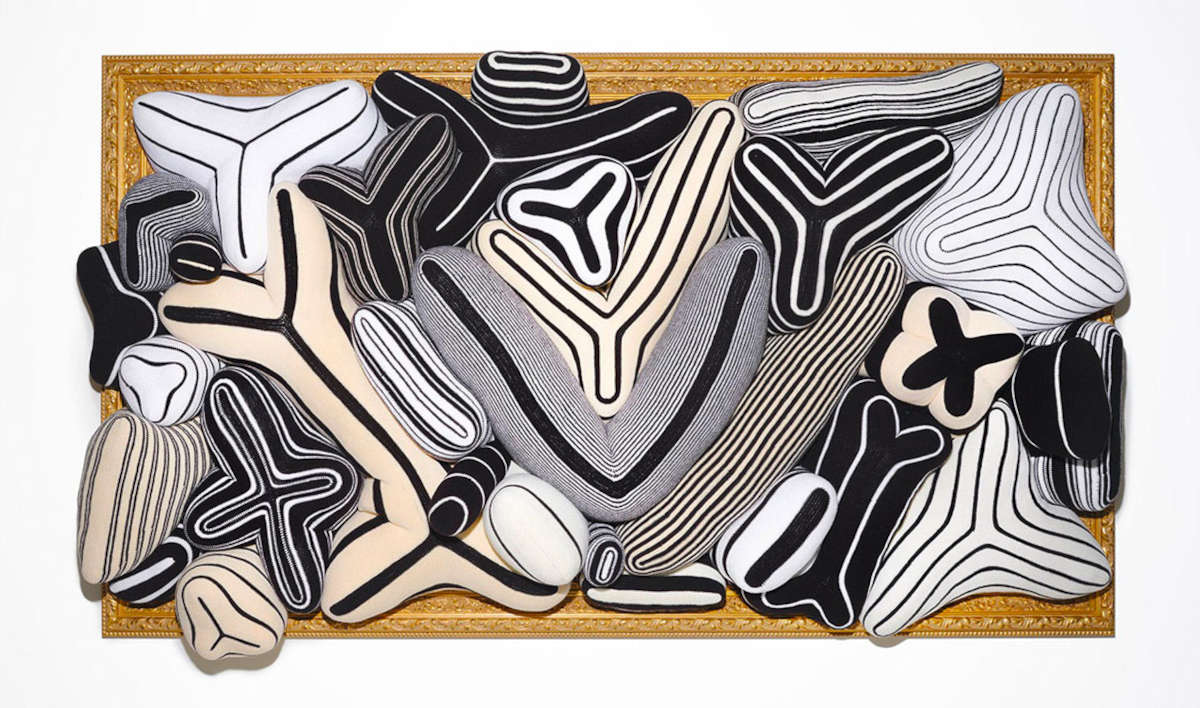
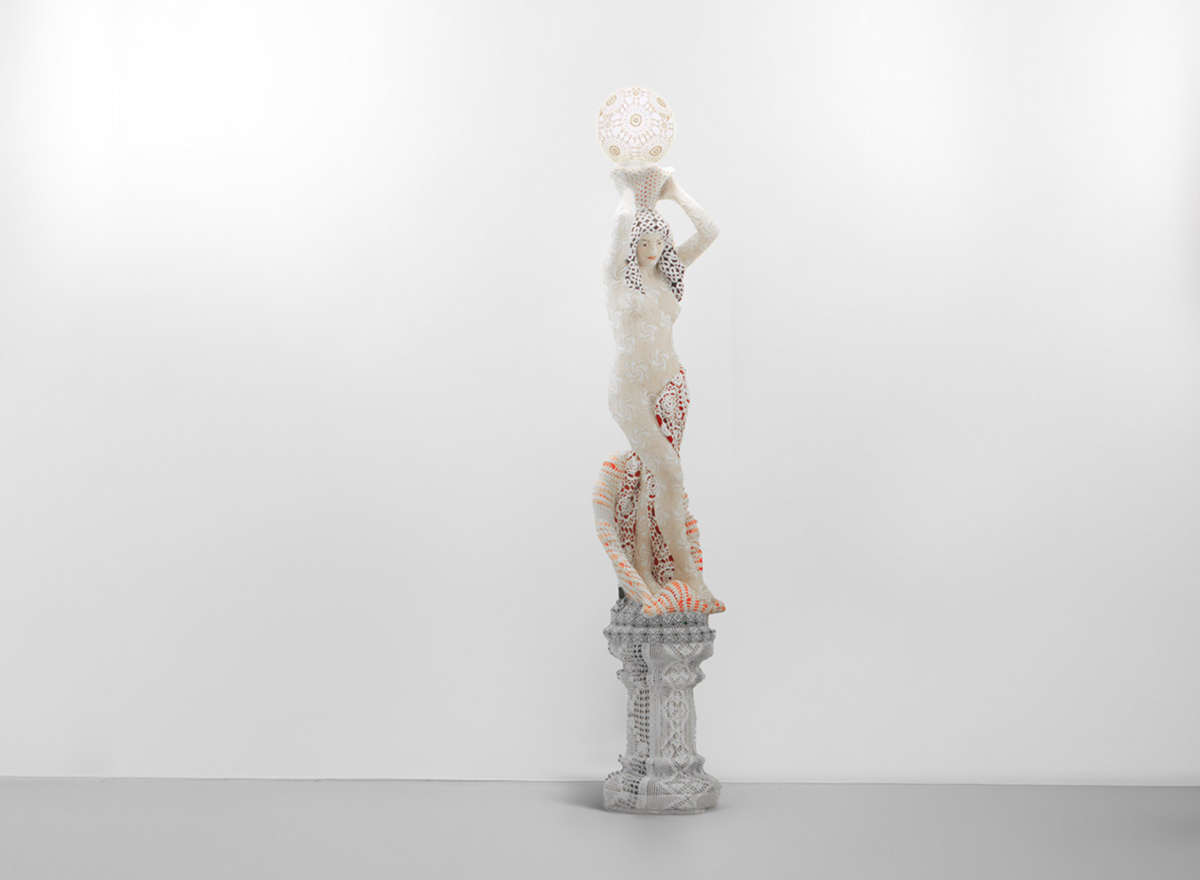
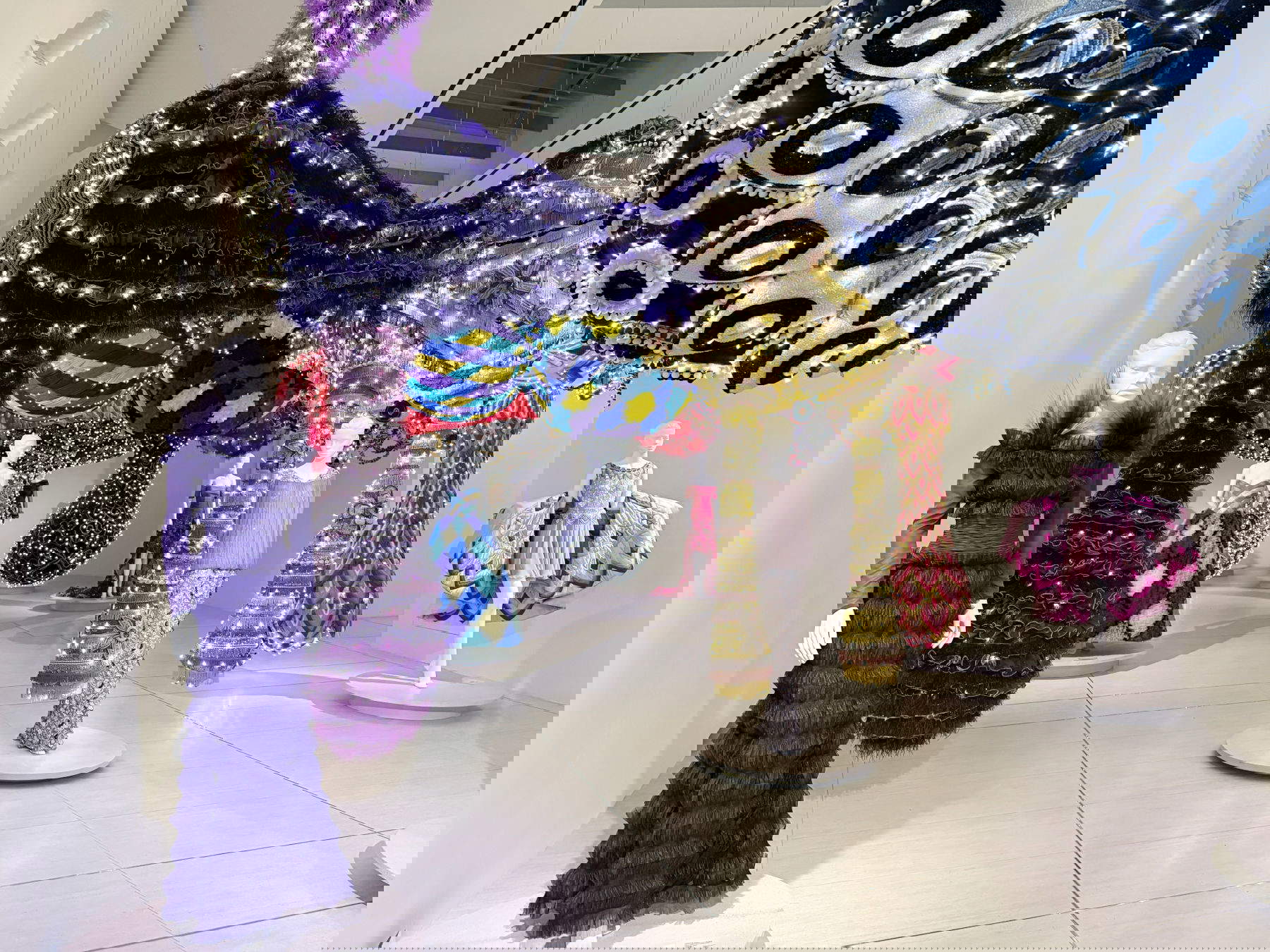
Venus required six months of crochet work, hundreds and hundreds of hours of collective work involving more than two hundred women (students, migrants, inmates, women in anti-violence programs) for whom the work became a means of social redemption. The artist provided patterns, some crochet teachers taught the participants of the workshops how to transform them, and the work, piece by piece, was born from the hands of a community of women who were then amazed, stunned, moved, almost incredulous, says those who were there, to see the fruit of their labor at the end. Their testimonies then flowed into a documentary by Daniele Luchetti designed to preserve a memory of this choral work that activated a process of participation, of rebirth, of enfranchisement. It must be said that Joana Vasconcelos is not the only artist whose work is largely based on a choral effort, a shared commitment, the activity of dozens of people who take part in the making of the work. On the contrary, this mode of participatory work has become common practice in contemporary art: it is now not uncommon to attend exhibitions, galleries, Venice Biennials and more and find works that have sprung from hours of manual labor and craftsmanship, if not even artists and artisans engaged in weaving, sewing, weaving, modeling, decorating, knotting, basting, patching, twisting, assembling. However, Joana Vasconcelos must be credited with a pioneering role, and it is also in this dimension that the international relevance of her art lies.
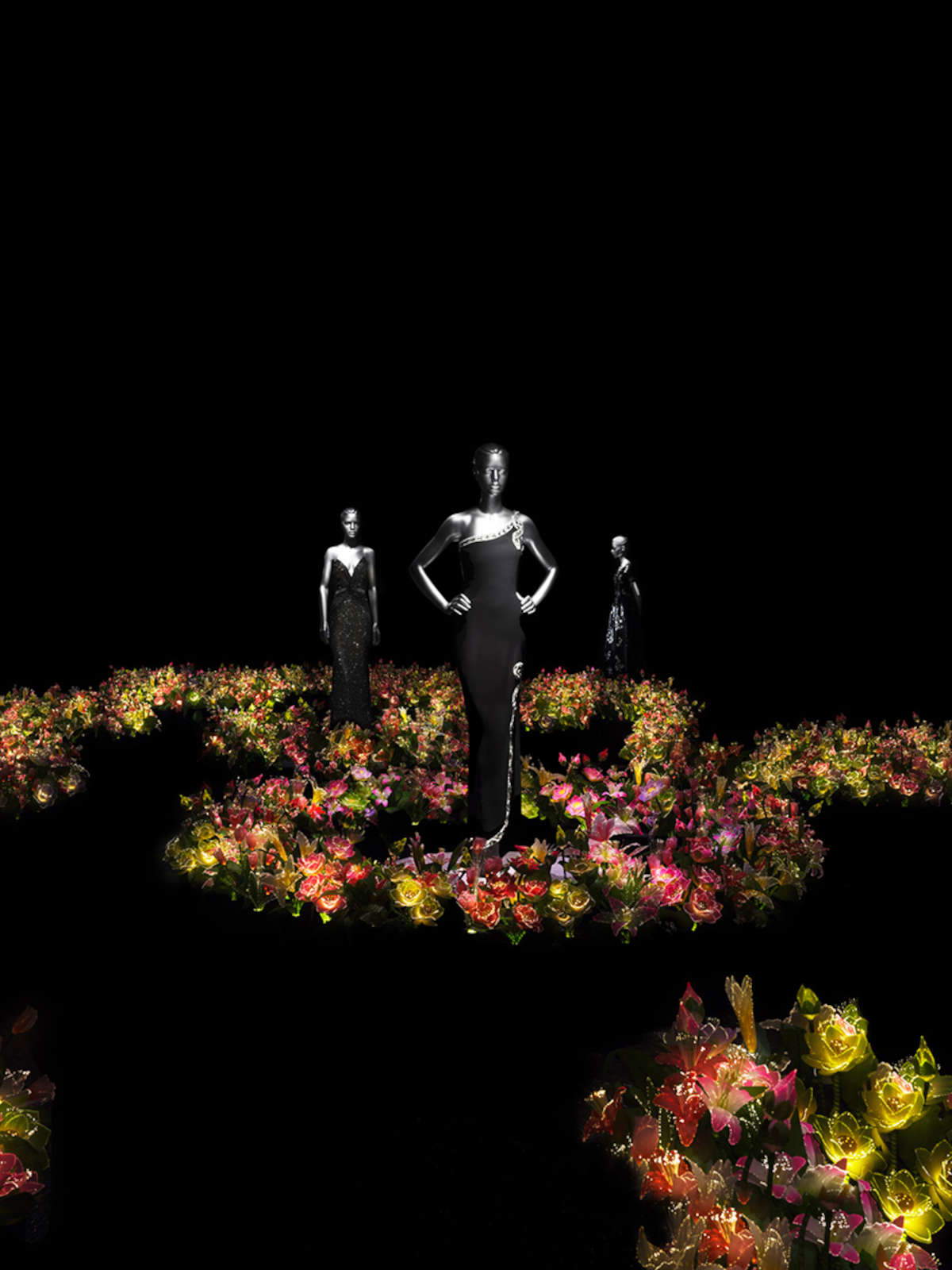
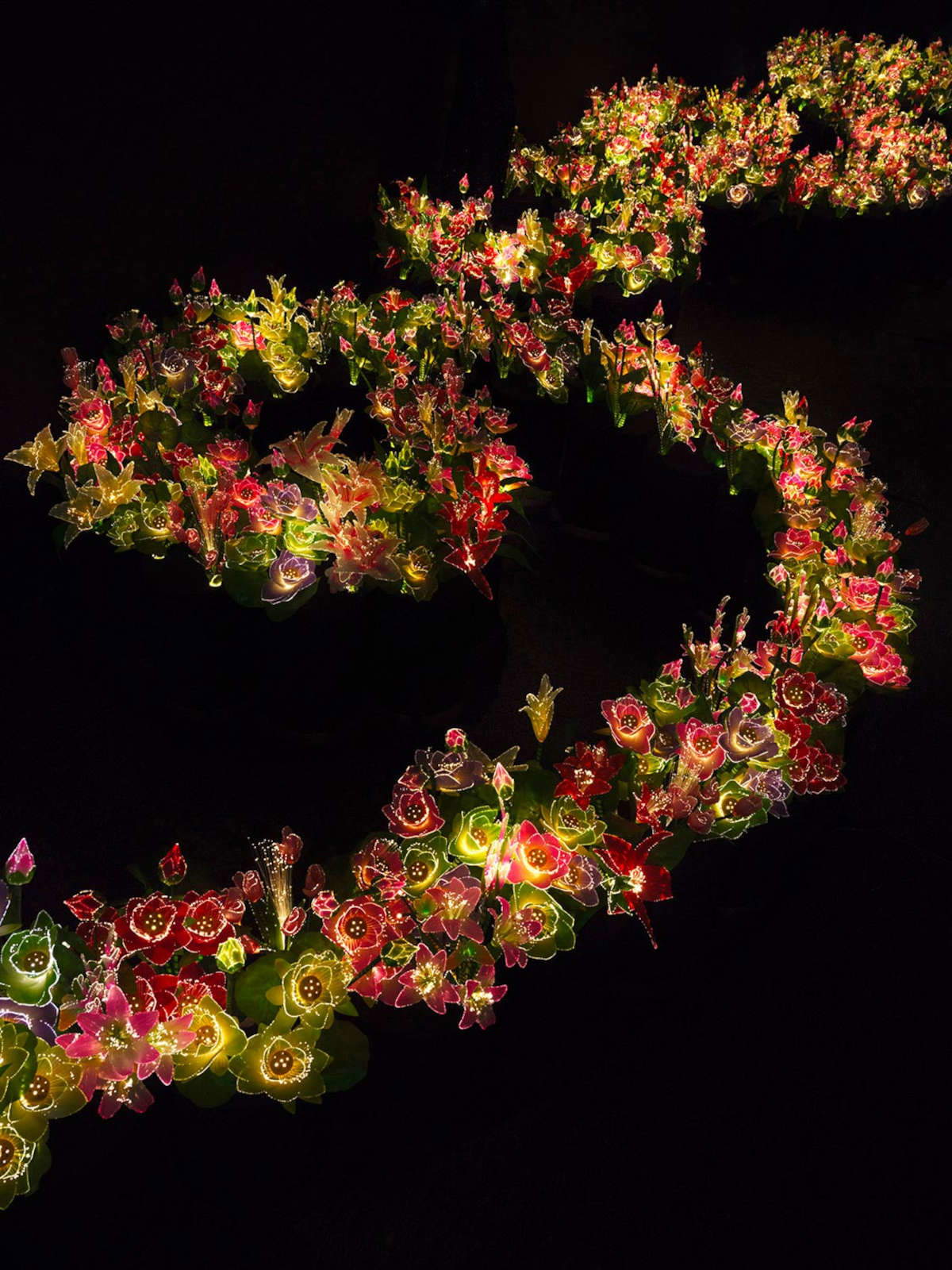
If the exhibition had started from the column of the Immaculate Conception that is mirrored in the mask of Joana Vasconcelos and, traversing a kind of story-telling of the history of women, went through all its archetypes, in the final room, the culmination of the exhibition, a dreamlike environment in which the earthly paradise of theartist(Garden of Eden), all those archetypes (the Valkyrie, the seductress, the prostitute, the Cinderella, and so on), each represented on this occasion by a dress, rediscover their source, their original purity, the place where femininity arises: one sinks into the darkness of a material dream made of flowers and lights, an artificial garden where the glitter of LEDs suggests the caresses of a wind that is not there, a pure yet ambiguous paradise, where everything seems clear but where everything is artificial. And one tries to find an exit.

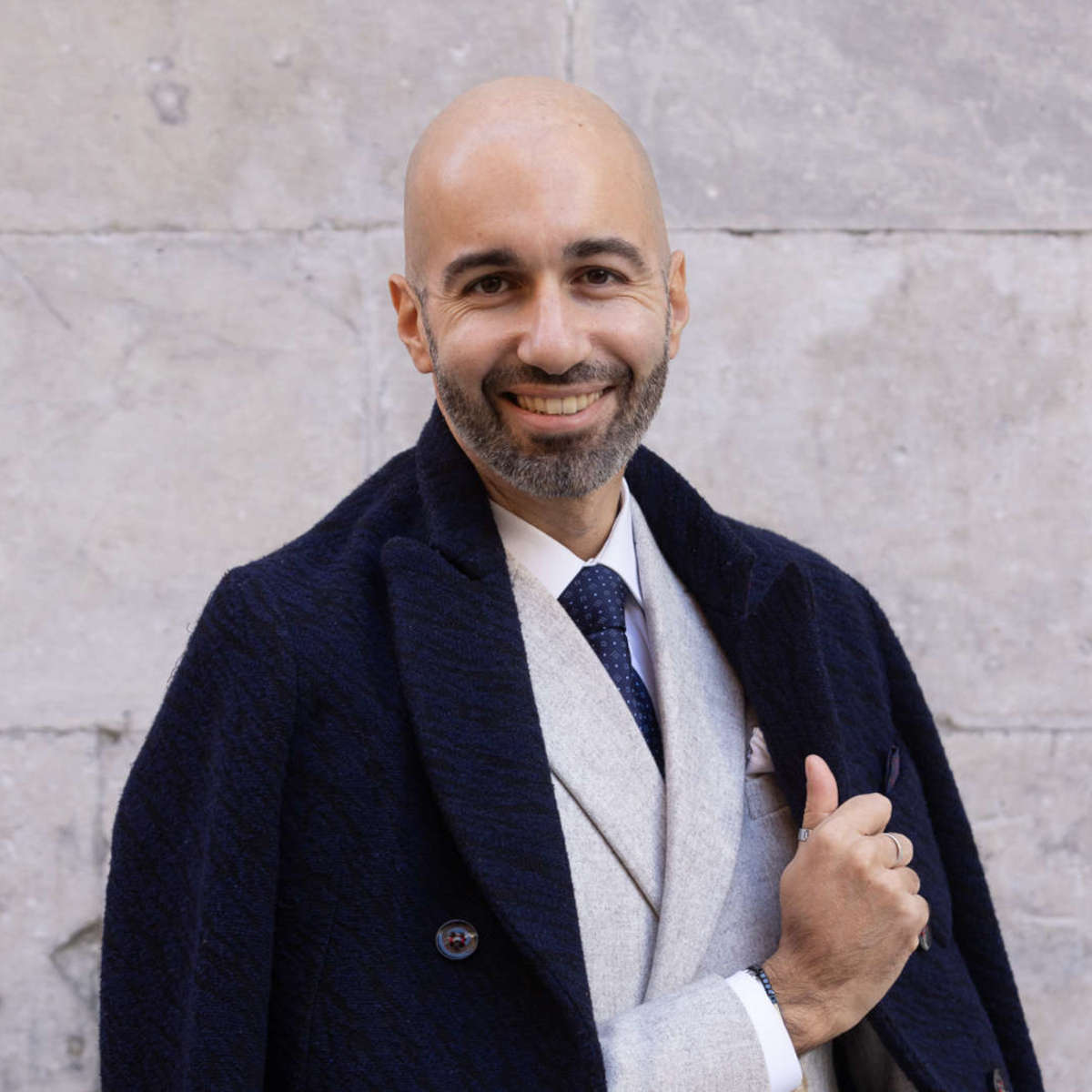
The author of this article: Federico Giannini
Nato a Massa nel 1986, si è laureato nel 2010 in Informatica Umanistica all’Università di Pisa. Nel 2009 ha iniziato a lavorare nel settore della comunicazione su web, con particolare riferimento alla comunicazione per i beni culturali. Nel 2017 ha fondato con Ilaria Baratta la rivista Finestre sull’Arte. Dalla fondazione è direttore responsabile della rivista. Ha scritto i libri Vero, Falso, Fake. Credenze, errori e falsità nel mondo dell'arte (Giunti editore, 2025) e Immagini del potere. Arte e propaganda da Augusto a Trump (Giunti editore, 2026). Collabora e ha collaborato con diverse riviste, tra cui Art e Dossier e Left, e per la televisione è stato autore del documentario Le mani dell’arte (Rai 5) ed è stato tra i presentatori del programma Dorian – L’arte non invecchia (Rai 5). Al suo attivo anche docenze in materia di giornalismo culturale all'Università di Genova e all'Ordine dei Giornalisti, inoltre partecipa regolarmente come relatore e moderatore su temi di arte e cultura a numerosi convegni (tra gli altri: Lu.Bec. Lucca Beni Culturali, Ro.Me Exhibition, Con-Vivere Festival, TTG Travel Experience).
Warning: the translation into English of the original Italian article was created using automatic tools. We undertake to review all articles, but we do not guarantee the total absence of inaccuracies in the translation due to the program. You can find the original by clicking on the ITA button. If you find any mistake,please contact us.























 IT
IT FR
FR DE
DE ES
ES CN
CN


