




by Redazione 05/02/2026


Categories: Exhibitions / Disclaimer
At the Sede di Rappresentanza Castagneto Banca 1910 in Livorno, an exhibition traces the work of Giovanni Bartolena, a Leghorn artist who developed an intense and personal painting style in the 20th century, dialoguing with the legacy of Giovanni Fattori and the instances of modernity.
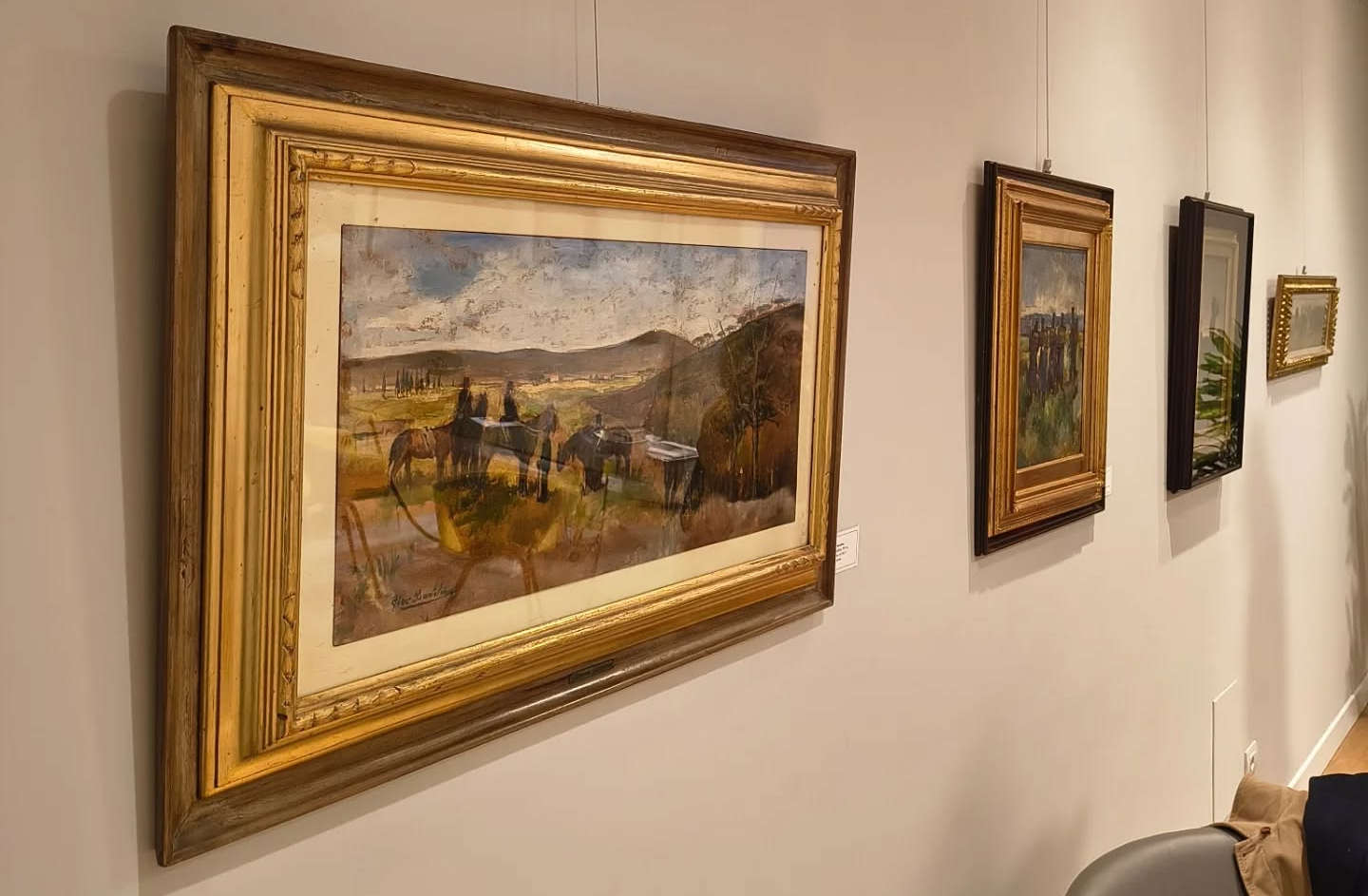
Until Feb. 14, 2026, the Sede di Rappresentanza Castagneto Banca 1910 in Livorno, Via Rossini 2, is hosting the exhibition Nel Novecento di Giovanni Bartolena, tra innovazione e riflessione sul magistero fattoriano, sponsored by Fondazione Castagneto Banca. The exhibition offers a selection of works dedicated to one of the most significant artists on the Livorno scene between the nineteenth and twentieth centuries, Giovanni Bartolena (Livorno, 1886 - 1942), restoring to the public the complexity of a figure who made color a deeply personal distinguishing mark.
The exhibition was created with the intention of investigating Giovanni Bartolena’s artistic journey, highlighting the constant dialogue between tradition and innovation that characterized his painting. The reference to the magisterium of Giovanni Fattori, at whom Bartolena trained at the Accademia di Belle Arti in Florence, is not read as a simple school link, but as a critical and often problematic confrontation that accompanied the artist throughout his life, pushing him toward an autonomous and recognizable research.
Giovanni Bartolena was born in Livorno on June 24, 1866, into a wealthy family, within which he had from a very young age the opportunity to cultivate passions that would accompany him for a long time, such as a love of horses and horseback riding. The Bartolena family already boasted the presence of prominent artistic figures in the local context, including a relative of the same name who was a painter of still academic taste, and above all his paternal uncle Cesare, a well-known and appreciated artist who played a decisive role in directing Giovanni toward painting.


Under his uncle’s guidance, Bartolena began painting and then continued his training at the Accademia di Belle Arti in Florence, where he followed the teaching of Giovanni Fattori. During these years, however, the young Bartolena showed a not always constant interest in the academic discipline, often turning out to be more attracted to social events than to lessons. This attitude contributed to gradually wearing down his relationship with Fattori, so much so that the intervention of his uncle was necessary to recompose the disagreements with the master.
The turning point in Bartolena’s life came in the 1890s, when a sudden financial collapse of the family forced him to take the painting profession more seriously. From that moment, art became not only a vocation but a necessity, pushing him to seek visibility and recognition on the national exhibition circuit.
His debut came in 1892 at the Promotrice in Turin, where he presented two works, followed by participation in the exhibition of the Society of Fine Arts in Florence in 1893-94 and a new invitation to the Turin Promotrice in 1896. Despite these early recognitions, economic difficulties and a natural inclination to solitude contributed to the outline of an increasingly isolated existence, marked by frequent moves and a not always continuous artistic production.
Around the 1910s a new phase opened, characterized by the establishment of solid relationships with a number of collectors, including the Prato industrialist Giovanni Querci, the journalist Paolo Fabbrini and Luciano Cassuto. With the latter Bartolena entered into a contract committing him to the production of a certain number of works. It was Cassuto who in 1926 organized the artist’s first solo exhibition in Milan, at the “L’Esame” Gallery, marking a decisive step in his career. The Milanese experience allowed Bartolena to come into contact with an attentive and participatory critical environment. The critics of the time recognized in his painting a linguistic tradition akin to the “macchia,” but at the same time they grasped its consonances with certain expressions of the avant-garde. This dual belonging, between rootedness in tradition and openness to the new, represents one of the most interesting aspects of his research.
Bartolena’s favorite themes were natural ones: landscapes, horses, flowers and seascapes. Subjects tackled with an extraordinary coloristic intensity, in which the hue becomes thick, material, capable of building the image through dense and vibrant stratifications. The compositions, often simple and thinned, return an emotional vision of nature and the world, far from mere descriptive data and deeply linked to the artist’s sensitivity.
In 1930 Bartolena participated in the 17th Venice Biennale, confirming the recognition of his work at the national level. The following year he took part in the I Quadriennale d’Arte Nazionale in Rome and exhibited at the “Milano” Gallery, further consolidating his presence in the Italian art scene of the time. The artist passed away on February 16, 1942, in complete solitude in his hometown.
The exhibition set up by the Castagneto Banca Foundation aims to return this human and artistic parable to the public, offering an in-depth reading of Bartolena’s role in the context of the Italian twentieth century. Through the works on display, the consistency of a research based on color as a primary expressive tool and the ability to transform traditional themes into visions charged with emotional intensity emerges clearly.
The exhibition can be visited Monday through Friday from 9:30 a.m. to 12:30 p.m. and on Friday, Saturday and Sunday from 4 to 7 p.m. Guided tours are scheduled on Saturday at 4 p.m. and 5:30 p.m. and on Sunday at 5:30 p.m. For information and reservations, you can contact the Castagneto Bank Foundation by phone (340 2375748) or email at info@fondazionecastagnetobanca.it.
|
| Giovanni Bartolena, color as the cipher of the twentieth century on display in Livorno |
Warning: the translation into English of the original Italian article was created using automatic tools. We undertake to review all articles, but we do not guarantee the total absence of inaccuracies in the translation due to the program. You can find the original by clicking on the ITA button. If you find any mistake,please contact us.