





Starting February 7, 2026, Triennale Milano presents the new exhibition itinerary of the Museum of Italian Design, renewed in its curatorship, layout and narrative structure. The project is curated by Marco Sammicheli, Director of the Museum, and Marilia Pederbelli, with a layout signed by Roberto Giusti. At the center of the new itinerary is the institution’s permanent collection, which is reread and expanded through a close dialogue with the cultural, industrial and social context in which the objects were designed and produced.
“Triennale presents the new edition of the Museum of Italian Design, a collection of extraordinary furnishings and objects that have made the history of our country and have remained in the memory of each of us,” says Stefano Boeri, president of Triennale Milano. “A museum designed as a school and as an increasingly accessible space. We also decided to make admission free for students of all ages and from all parts of the world.”
“The Museum’s new itinerary gives voice to the link between Italian history and companies by bringing out the relationship between design, innovation and industry,” says Marco Sammicheli, Director of the Museum of Italian Design at Triennale Milano. “The reflection is developed around themes that have been decisive for the world of design, which are addressed within the path with interactive, playful and educational modes. This narrative also brings Triennale’s recent acquisitions into play, bringing to life the dialogue between new needs, productive disciplines and changes in society.”
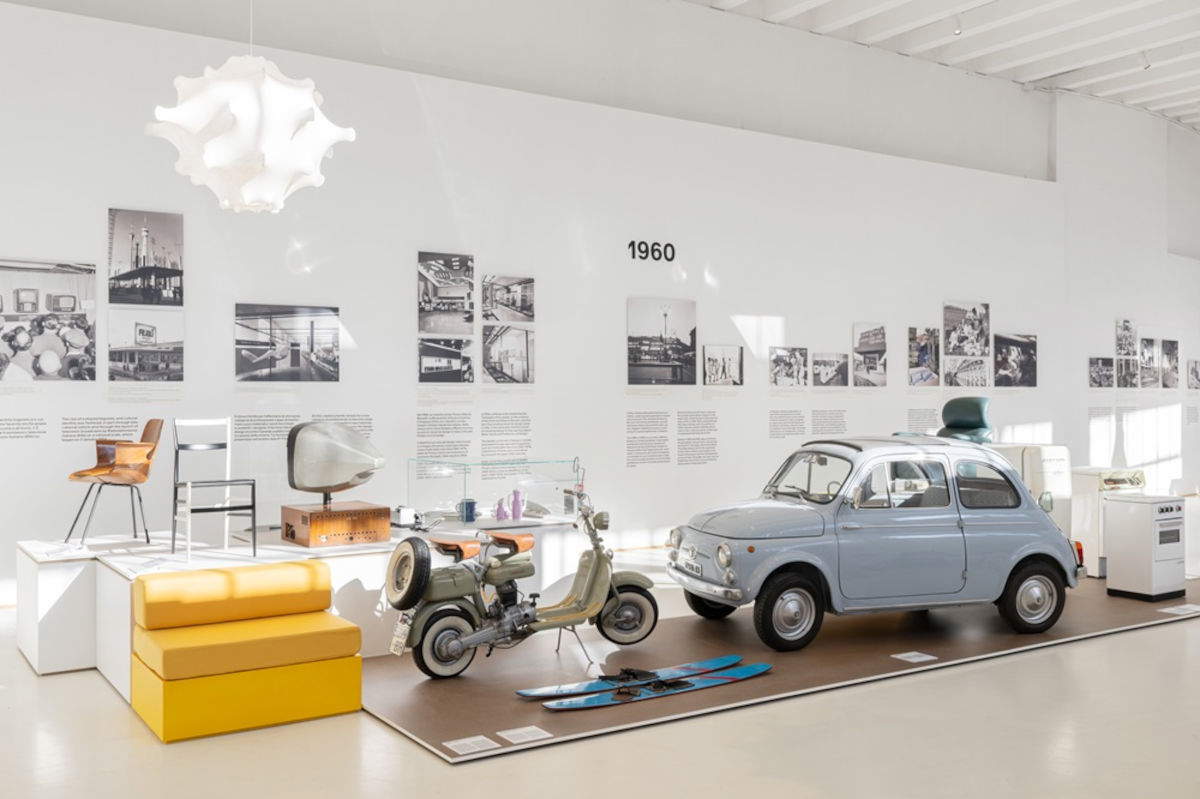
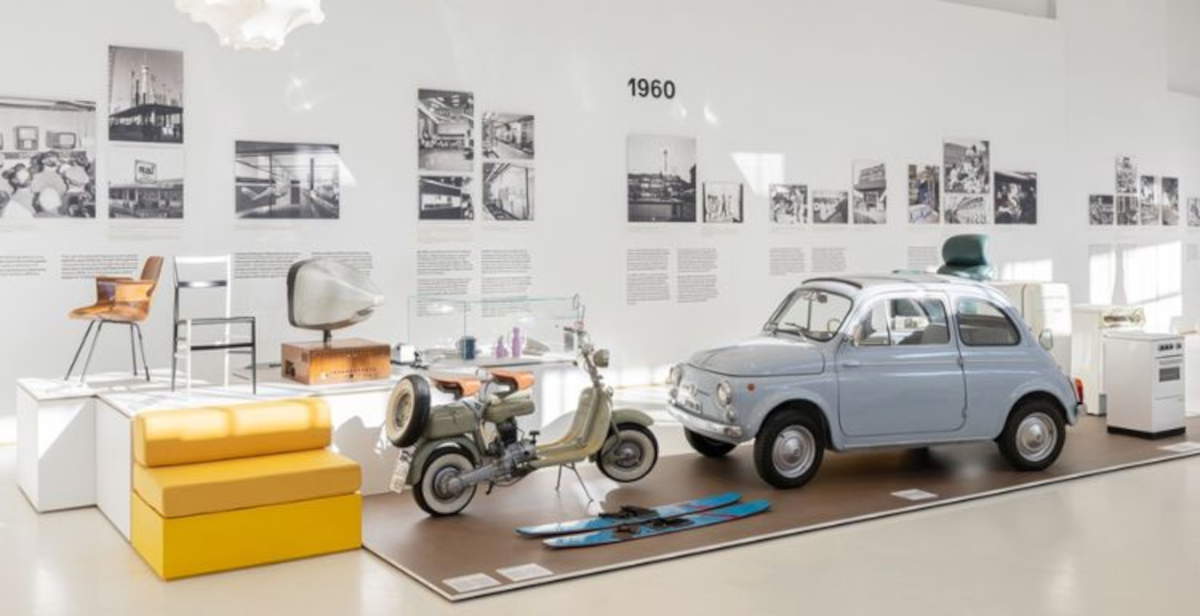
The path is developed through a selection of more than 400 objects, projects and documents made between the late 1920s and the early 2000s. The intent is to return an articulated vision of the experimentation and transformations that have crossed the history of Italian design, relating the forms of design to the country’s economic, political and social changes. The entrance to the museum introduces the visitor to a timeline placed along the left wall, marked by decades, which reconstructs a series of key passages in Italian history, from the post-World War II period to the economic boom, from 1968 to austerity, and the advent of postmodernism.
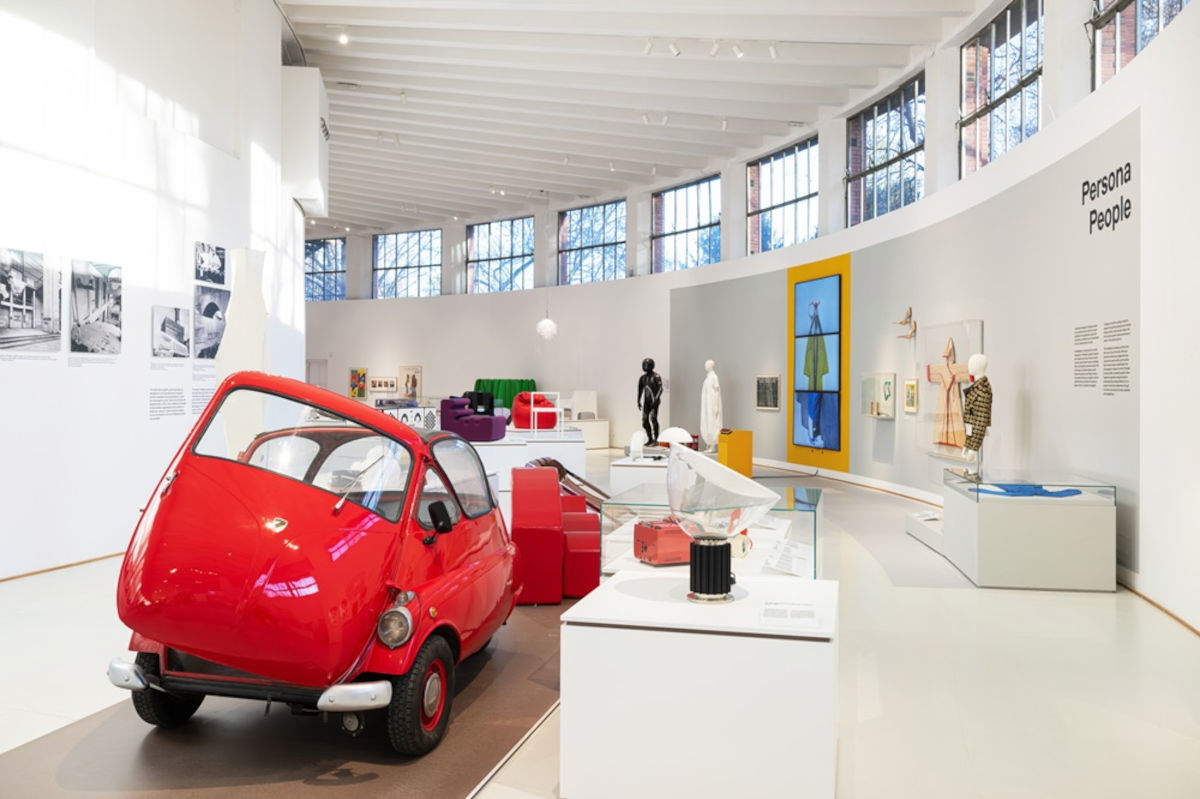
Alongside historical events, the timeline integrates references to the history of businesses and companies that contributed to national industrial development. Thus moments such as the inauguration of the freeway network, the Milan Trade Fair exhibitions, and the birth and spread of television appear, elements that help contextualize the projects on display within a network of productive and cultural relations.
The Museum of Italian Design, entirely curated and created by Triennale Milano’s in-house departments, confirms free admission for students of all levels. The new itinerary is designed to offer an accessible experience to a wide and diverse audience. In this direction is the collaboration with Associazione Culturale Fedora, Associazione L’abilità and Laboratorio COmeta of the Milan Polytechnic, realities specialized in accessibility. Thanks to this consultancy, the museum provides tools designed to facilitate fruition, such as materials in Easy to Read, content in Alternative Augmentative Communication, texts in Braille and enlarged characters, videos translated into LIS and International Sign, audio descriptions, tactile maps and sensory kits for adults and children.
The exhibition itinerary is enriched by five cross-thematic insights, developed as site-specific interactive installations in collaboration with Mammafotogramma. The sections address the themes of decoration, trade magazines, people, self-design, and lightness, ranging from aesthetic and formal issues to methodological reflections on the tools of design communication and dissemination. The section devoted to decoration features a large tactile tapestry and a table with a three-dimensional puzzle, inviting interaction based on decorative fragments taken from objects, drawings and photographs preserved in Triennale’s collections and archives. The area reserved for magazines presents numerous examples of Italian and international magazines and a video animation that illustrates, through techniques such as stop motion, live action and 2D animation, some fundamental aspects of editorial design, from format to grids, fonts to layout, and images.
The theme of the person is explored through projects related to fashion and accessories and is interpreted through a playful device inspired by the game “turn fashion around,” popular in the 1980s. The installation consists of three overlapping monitors that, operated by buttons, scroll images as in a slot machine. Each screen shows a detail from Triennale’s archival photographs and their combination generates ever-changing figures, human or not.
Self-design is approached from the perspective of non-human design, thanks to the development of an algorithm capable of activating a generative process that composes furniture from real data. The last section, dedicated to lightness, takes as its reference Gio Ponti’s Superleggera chair, considered a paradigm of this concept. Visitors are invited to compare the weight of different objects with that of the Superleggera, experiencing in a direct way the meaning of “designing lightness.”
The new layout also highlights the implementation of the collection, which has seen a significant increase in the number of works and a broadening of research areas. Recent acquisitions include works by masters such as Ettore Sottsass, Carlo Mollino, Piero Bottoni, and Antonia Campi, alongside contemporary figures such as Antonio Citterio, Patricia Urquiola, and Andrea Vallicelli. Sectors explored include transportation, with automotive, vehicles and nautical; fashion, with objects by Monica Bolzoni, Carla Crosta and Cinzia Ruggeri, as well as the archive of Giusi Ferrè; and illustration and graphics with authors such as Giorgio Forattini, Saul Steinberg and Armando Testa.
The presence of traditional wares, such as ceramics, glass and enamels, has also been strengthened through projects by designers who have participated in the Triennials, including Guido Andlovitz, Rosanna Bianchi Piccoli, Vinicio Vianello and Del Campo. From a historical point of view, the chronological arc extends more decisively toward the contemporary, with an important presence of projects created between 1999 and 2005 by Italian and international designers such as Ron Arad, Nathalie Du Pasquier, Naoto Fukasawa, Piero Lissoni, Tomás Maldonado, Jasper Morrison, Marc Newson, and Fabio Novembre. To mark the new itinerary, Triennale Milano has produced a new edition of the Italian Design Museum Junior Album, a publication aimed at children and families that includes video content in LIS, an illustrated sign language glossary and an audio description. The Museum of Italian Design project is supported by Technical Partner Saviola and Institutional Partners Deloitte and Fondazione Deloitte, Lavazza Group and Salone del Mobile.Milano, which also support Triennale Milano in its museum activities.
 |
| The Museum of Italian Design gets a makeover: Triennale Milano presents a new journey between industry and society |

Warning: the translation into English of the original Italian article was created using automatic tools. We undertake to review all articles, but we do not guarantee the total absence of inaccuracies in the translation due to the program. You can find the original by clicking on the ITA button. If you find any mistake,please contact us.























 IT
IT FR
FR DE
DE ES
ES CN
CN


