





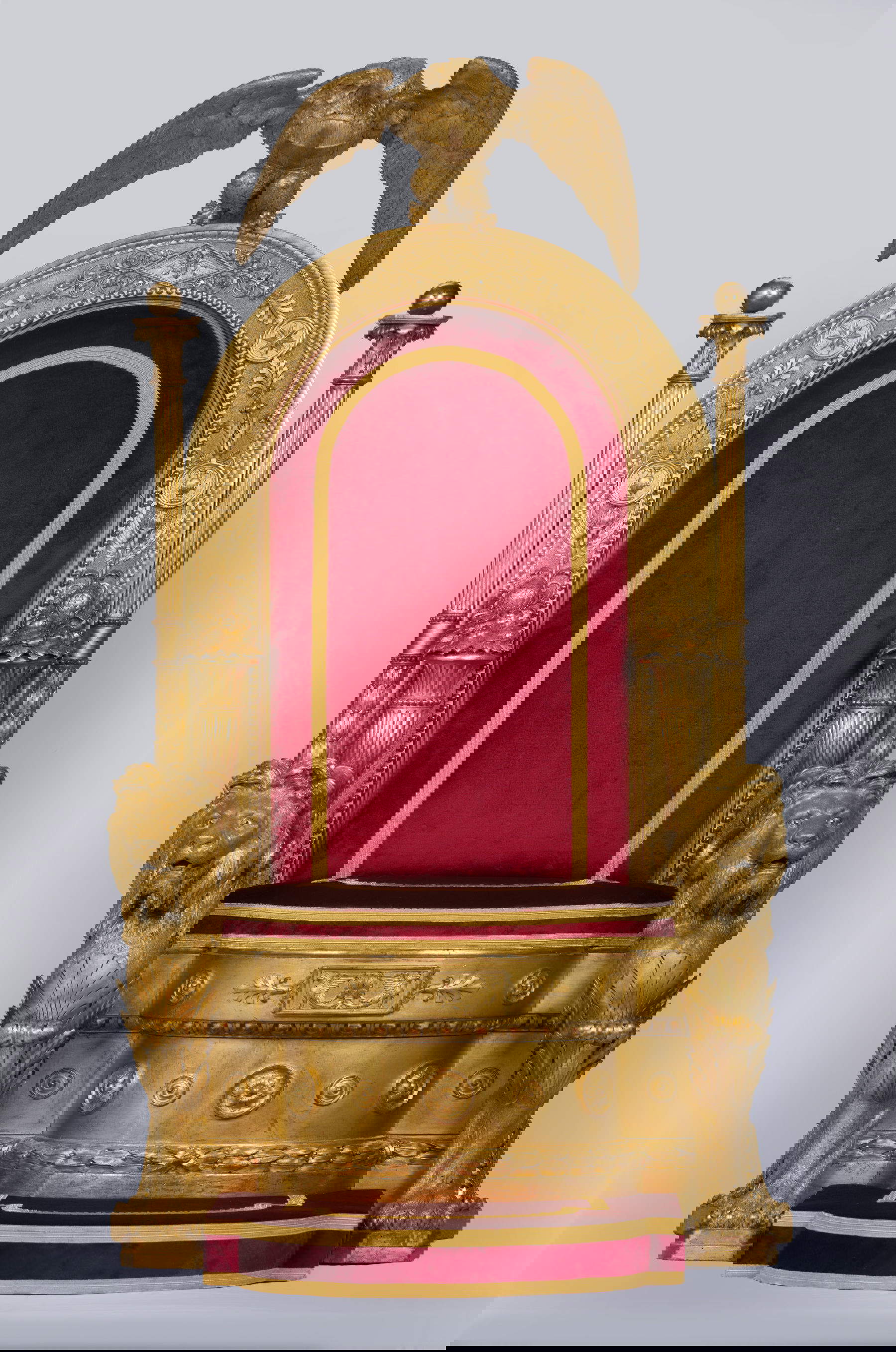
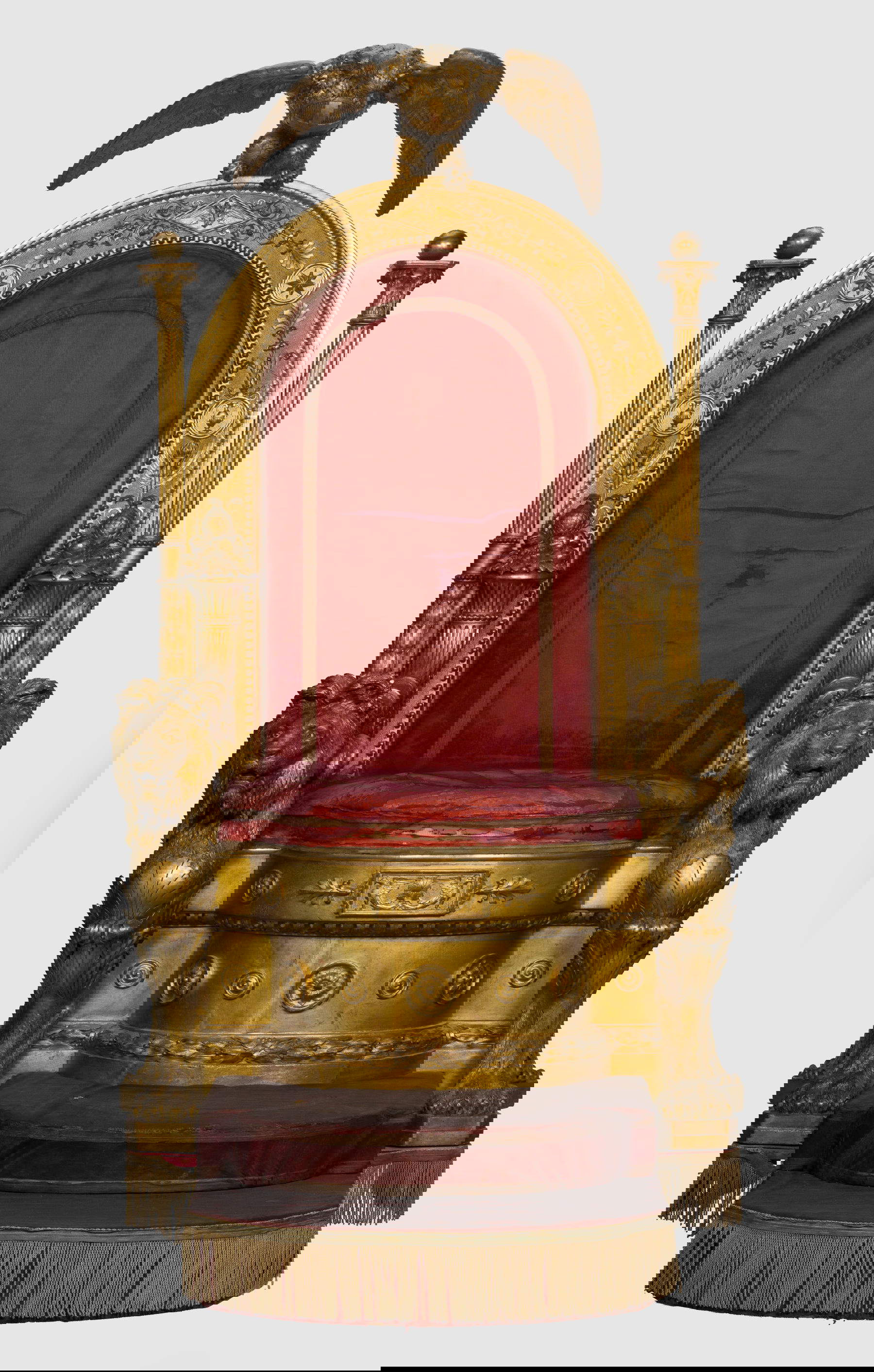
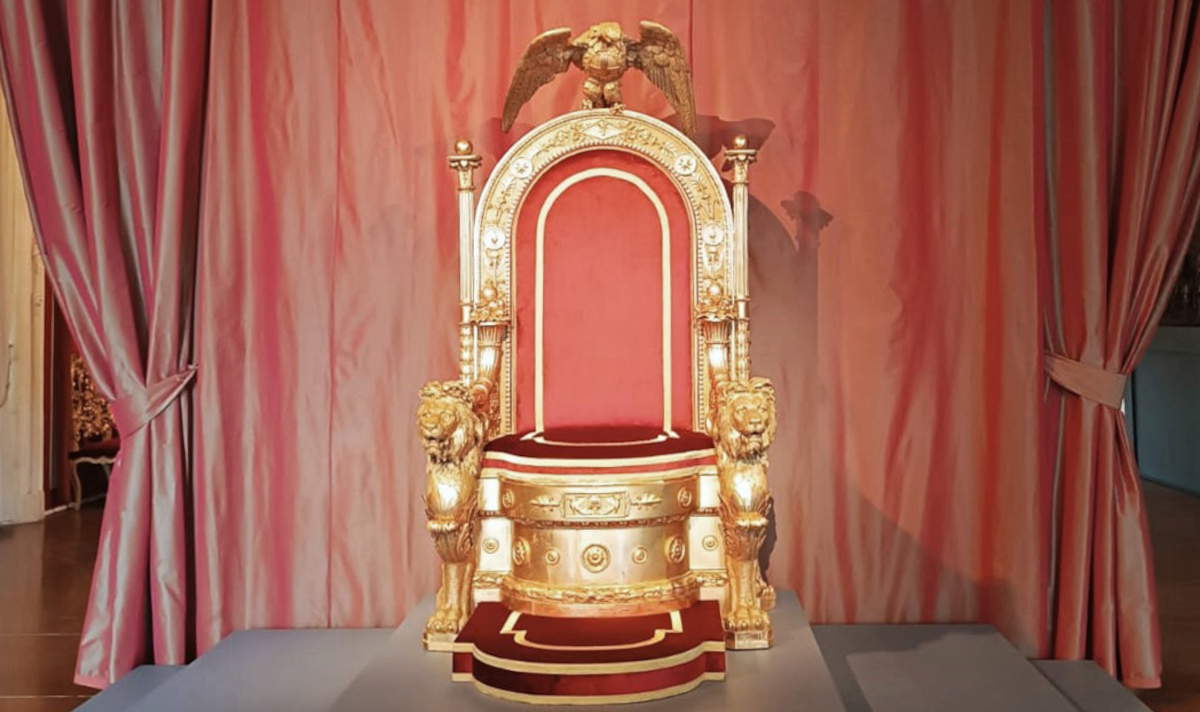
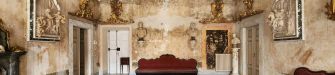
After more than sixteen months of absence, the throne in the Royal Palace of Naples has returned to the Throne Room, at the end of a restoration that substantially redefined its historical framework. The work is presented with a gilding that restores legibility to the decorative apparatus and with a new documentary attribution that shifts its commission from the Bourbon to the Savoy sphere. The official presentation brought together those involved in the intervention, including funders, restorers and art historians. The meeting was opened by managing director Tiziana D’Angelo, who introduced Antonio Denunzio, deputy director of the Gallerie d’Italia in Naples, representing Intesa Sanpaolo. The restoration is in fact part of the 20th edition of the Restituzioni project, promoted by the banking institution in collaboration with the Ministry of Culture.
The throne had left Naples on Sept. 12, 2024, to reach the “La Venaria Reale” Conservation and Restoration Center in Turin, where it underwent a seven-month intervention. During the period of absence it was replaced in the room by an 18th-century Bourbon seat. Before conservation operations began, the artifact underwent an inspection conducted with advanced technologies thanks to the contribution of CNR scientists. Restorers from the Turin center applied an analysis and intervention protocol already adopted for similar furnishings, including the throne of the Quirinal Palace. The phases of the restoration were illustrated by Michela Cardinali, director of the center’s laboratories, while Paola Ricciardi, the project’s scientific contact person for the Royal Palace, reconstructed the study path. Parallel to the conservation work, art historian officials at the palace initiated archival research that led to a revision of the hitherto accepted chronology. The throne, cataloged as a Bourbon work datable between 1845 and 1850, turns out instead to have been commissioned by the Savoy family and liquidated in 1874. The new dating shifts the making of the furniture forward about thirty years and affects the reading of the palace’s nineteenth-century transformations.
Antonella Delli Paoli, art historian functionary, and Ilaria La Volla, restoration functionary of the Royal Palace, accompanied the tour of the room, dwelling on the documentary discoveries and the reorganization of the textile apparatus. The work on the textiles involved the carpet on which the seat rests, the side bands covering the dais, the curtain valances and the canopy. The operations, coordinated by the palace’s restorers and entrusted to Graziella Palei of the firm Conservazione e Restauro Opere d’Arte, took place over the past three months directly in the Throne Room, allowing the public to observe live the stages of a complex and delicate work. After the restoration was completed, in May 2025 the throne was previewed at the Reggia di Venaria as part of the preview of the 20th edition of Restituzioni, one of the main initiatives of Intesa Sanpaolo’s Progetto Cultura. The exhibition was then held in Rome, at the Palazzo delle Esposizioni, from October 28, 2025 to January 18, 2026.
“The return of the Throne to the Royal Palace in Naples marks the completion of an articulated process of study, restoration, research and enhancement that has profoundly renewed knowledge of this significant,” says Massimo Osanna Director General of Museums. “The study activities conducted by museum professionals have made it possible to clarify precisely the origin and dating, while the conservation intervention, carried out as part of Intesa Sanpaolo’s Restituzioni project in collaboration with the Conservation and Restoration Center ”La Venaria Reale,“ and the subsequent temporary exhibitions at the Reggia di Venaria and the Palazzo delle Esposizioni in Rome, have contributed decisively to the enhancement of the work and the expansion of its modes of enjoyment. This experience confirms how museums today are active places of knowledge production, where study, conservation and valorization proceed together, and highlights the value of virtuous collaborations, both within the National Museum System and in the dialogue between public and private.”
“The throne, a symbol of the Royal Palace of Naples, makes its return to the Label Apartment, to the room to which it belongs and which today rediscovers its own identity,” says Tiziana D’Angelo, Deputy Director of the Royal Palace of Naples. “A restoration made possible by Intesa Sanpaolo’s Restitutions project, but one that is part of a larger and more complex intervention on the Throne Room coordinated and directed by our restorers, which also included work to rearrange and restore the textiles, the carpet and the canopy.So an important team effort complemented by the studies of our art historians and archivists, who traced the commissioning and making of the throne back to the Savoy era, shedding new light on one of the most representative works of the Reggia.”
“The way in which we have taken care of the precious artifact of the Royal Palace,” says Michele Coppola, Executive Director Art, Culture and Historical Heritage Intesa Sanpaolo and General Director Gallerie d’Italia, “clearly demonstrates the spirit of Restituzioni, the program that for more than thirty-six years has seen us alongside public institutions in the defense and enhancement of Italy’s cultural heritage.The restoration of the throne entrusted to the best professionals, the new knowledge that has emerged from the studies, the path of sharing the work, first in Venaria Reale and then in Rome, to ”give it back“ today, in a guise of renewed beauty, to its community: all this tells of the Bank’s concrete commitment to preserving and promoting the country’s artistic testimonies, of which Naples, one of the cities of our Gallerie d’Italia to which we are particularly attached, is very rich.”
“The collaboration between the Fondazione Centro per la Conservazione ed il Restauro dei Beni Culturali ”La Venaria Reale“ (CCRR) and the Royal Palace of Naples,” says Alfonso Frugis, President of the Centro Conservazione e Restauro “La Venaria Reale,” “was born years ago as part of a preventive and programmed conservation project, which led the Center’s professionals to conduct a campaign of conservation filing and definition of direct activities on the works of the Palace’s collections. Thanks to the joint work, the Royal Palace of Naples was able to have a map of restoration priorities, including the need to intervene on the throne.”
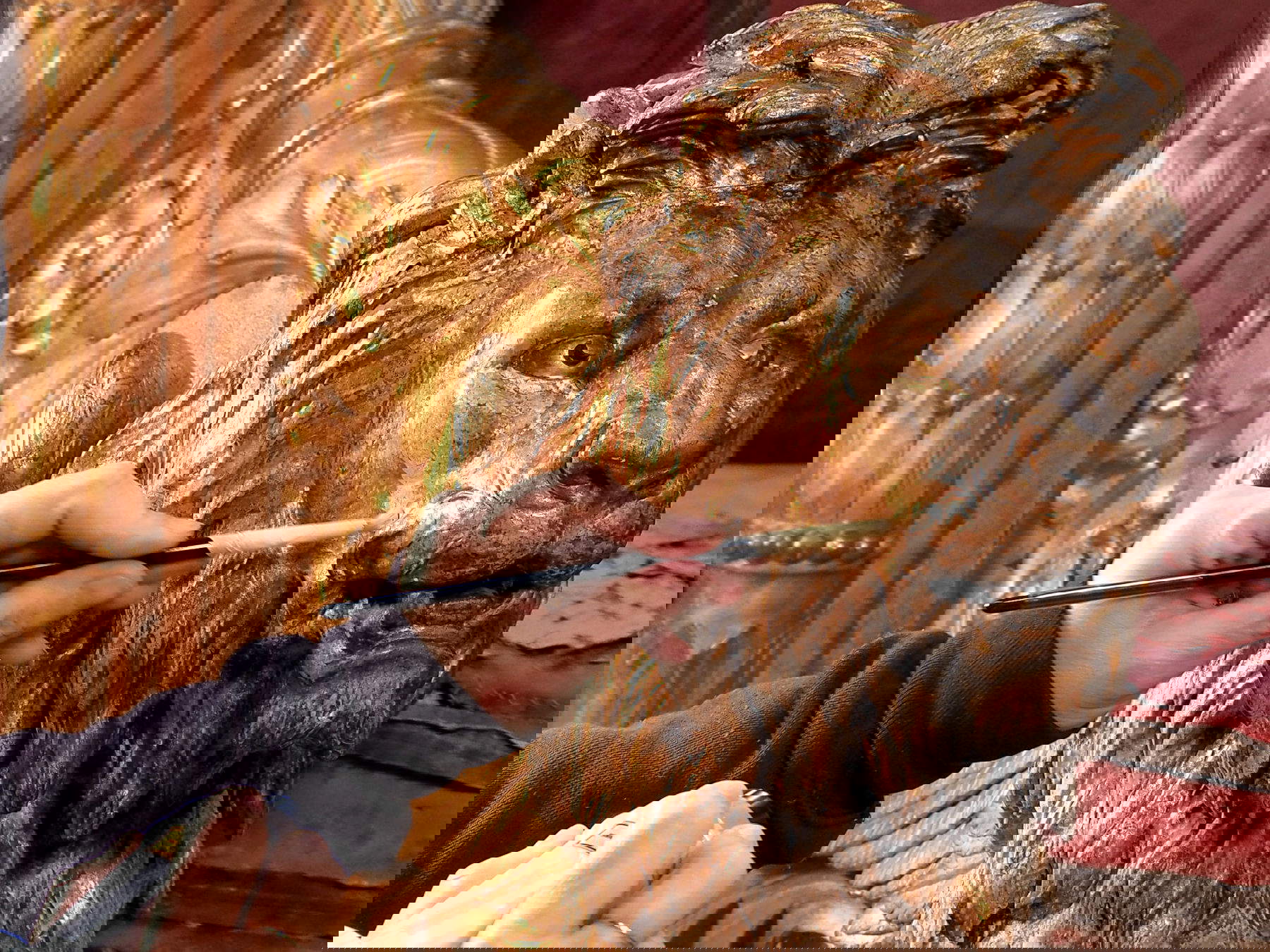
“Thanks to Intesa Sanpaolo’s Restitutions review,” says Michela Cardinali, director of Restoration Laboratories and School of Higher Education and Study at CCR “La Venaria Reale,” “it was possible to carry out this challenging restoration that combined the expertise of officials from the Royal Palace of Naples and restorers and scientists from CCR. We were able to take complete digital X-rays on the throne, to understand its complex construction, thanks to a radio-tomographic apparatus that our laboratories are equipped with to carry out analysis on large objects. We then performed selective gilding cleaning without the use of harsh chemicals thanks to LASER technologies and a sustainable and eco-friendly approach that the JRC has long looked to.”
 |
| Royal Palace throne returns to Naples: restoration reveals its Savoy origin |

Warning: the translation into English of the original Italian article was created using automatic tools. We undertake to review all articles, but we do not guarantee the total absence of inaccuracies in the translation due to the program. You can find the original by clicking on the ITA button. If you find any mistake,please contact us.























 IT
IT FR
FR DE
DE ES
ES CN
CN


