




by Redazione 09/01/2026



Categories: Ancient art / Disclaimer
Presented in Spoleto Cathedral are the results of the restoration work on the crypt of San Primiano, one of the oldest and least known places in the episcopal complex, returned to the city after years of closure.

Spoleto rediscovers one of its oldest and most meaningful places with the presentation this afternoon of the end of the restoration of the crypt of San Primiano, located inside the Cathedral Basilica of Santa Maria Assunta. The restoration work on the crypt of San Primiano totaled approximately 97,000 euros and involved various structural and conservation aspects. A priority intervention was the remediation of the rooms, necessary to solve the problem of rising damp from the floor, which over time had compromised the wall surfaces and plasterwork. At the same time, the arrangement of the access room to the crypt was carried out, improving the conditions of usability and safety. Particular attention was paid to the cleaning and consolidation of the ancient plasters and what remains of the paintings belonging to the pictorial cycle, fragments of great historical and iconographic value. The project also included the provision of electrical and air conditioning systems, which are essential to ensure proper preservation over time and future opening to the public in adequate conditions.
The restoration project was supervised by architect Bruno Gori, while the execution of the work was entrusted to Tecnireco Srl Restauro e Conservazione Beni Culturali di Sergio Fusetti e Paolo Virilli, a company specializing in the restoration of historical and artistic heritage. The contracting station was the Ministry of Culture, through the Regional Secretariat for Umbria, and the role of Single Project Manager was played by Dr. Giovanni Luca Delogu, an ABAP Umbria official, ensuring the technical and administrative coordination of the intervention.


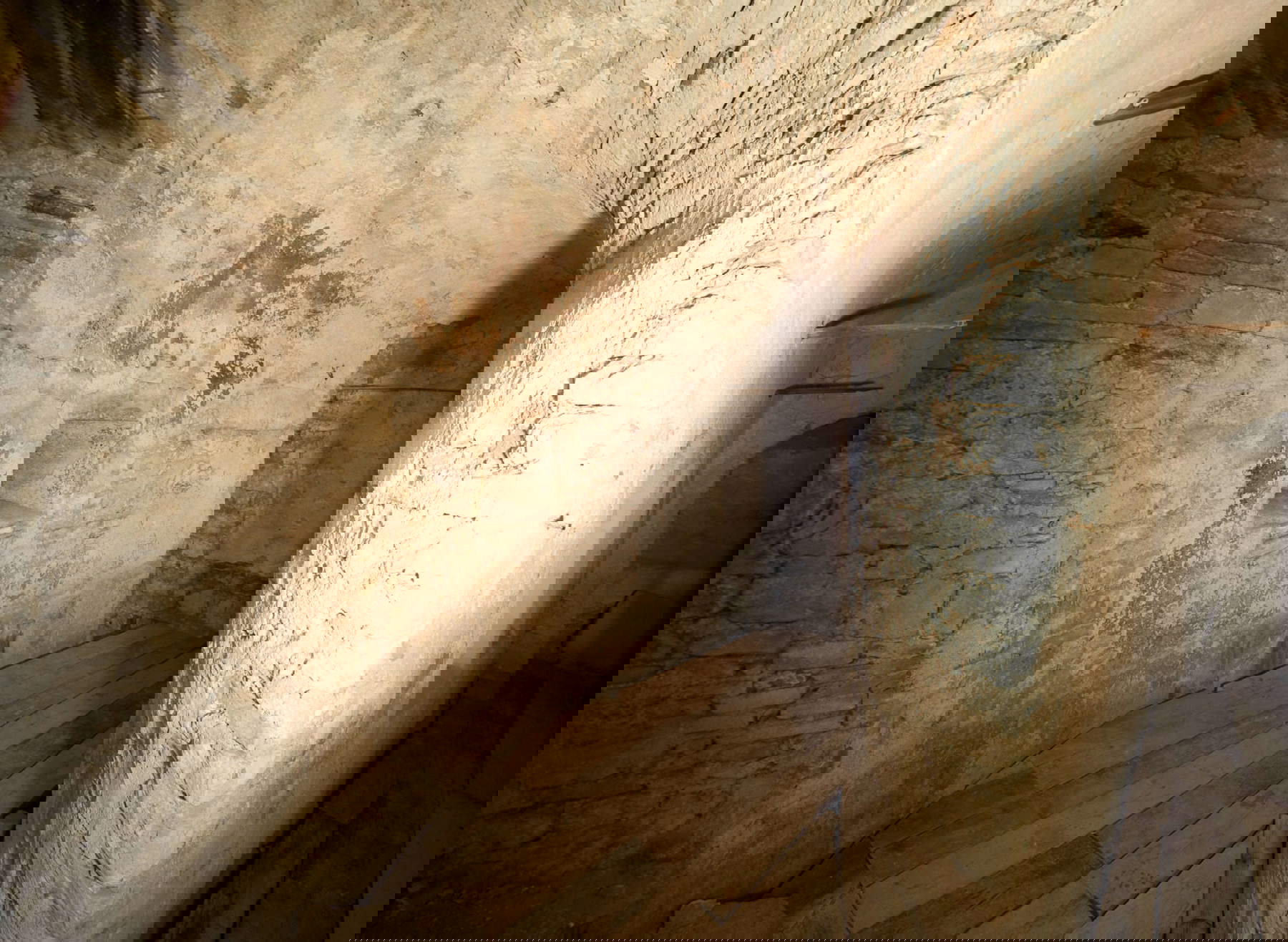
The crypt of San Primiano represents an architectural element of extraordinary importance, whose origin is intertwined with the oldest phases of Spoleto Cathedral. The building that in 1067, at the time of Bishop Andrew, was referred to as a “tribune” was identified by the scholar Sordini in a room below the Chapel of Relics, which protrudes from the left aisle of the Cathedral at the sixth bay. This is a crypt of semi-annular form, an architectural type already present in the early Christian period and widespread before the emergence of the oratory crypt. Similar examples are known mainly in Rome, but they are also found in other Italian centers and in different areas of Europe, such as Switzerland, Germany, and Belgium.
The design of this type of crypt was closely linked to the desire to arrange a special arrangement of the martyr’s relics, taking advantage of the semicircular space below the apse. The axial corridor made it possible to reach the cell that held the relics, placed in such a way that the presbytery altar, raised above it, seemed to ideally originate from it. The ambulatory, on the other hand, allowed for an orderly flow of the faithful: descending from the upper hall, they could access one end, walk down the semi-annular corridor and ascend back into the church on the other side, according to a devotional path that combined movement, prayer and veneration of the relics.
Analysis of the remains of the crypt’s pictorial decoration and comparison with similar examples from the Roman area offer further useful elements for orienting the dating of the ensemble toward the 9th century. A still partially legible inscription, with the formula “ubi terribilis ... percussit,” leaves little doubt that the upper area of the ambulatory was intended for the telling of the deeds of a martyr, strengthening the link between the architectural space and the hagiographic memory of St. Primianus. For many years the crypt remained closed and visible from the outside only for a stretch of a few meters, fueling an aura of mystery around one of the oldest places in the cathedral, as also recorded in the sources collected in the manuals for the area dedicated to Spoleto.
The figure of Primian of Spoleto, a martyr around 302, is central to understanding the historical and religious significance of this space. His ancestors came from the city of Ancona, but he was born in Spoleto and here proudly professed his Christian faith during a period marked by persecution. Denounced, captured and imprisoned during the rule of the emperors Diocletian and Maximian, Primianus was invited to worship the Roman gods, but he steadfastly refused. He endured torture and imprisonment without denying his faith, demonstrating a steadfastness that hagiographical sources describe as superior to the violence of his persecutors. Taken to the Bloody Bridge, he was beheaded on or about August 31, 302.
His body was buried in the cemetery area on the slope of St. Elias Hill, where a small church dedicated to him was later built. On this very hypogeum, around the first half of the 6th century, the catacomb church of St. Primian and the church of St. Mary of the Bishopric were structured. The area thus assumed a central role in the sacred topography of the city until, in 1067, Bishop Andrew had the Cathedral of St. Mary built there. In this context the church of St. Primian took the name of the saint’s tribune, integrating into the episcopal complex that still characterizes the heart of Spoleto today.
|
| Spoleto, restored the crypt of San Primiano |
Warning: the translation into English of the original Italian article was created using automatic tools. We undertake to review all articles, but we do not guarantee the total absence of inaccuracies in the translation due to the program. You can find the original by clicking on the ITA button. If you find any mistake,please contact us.