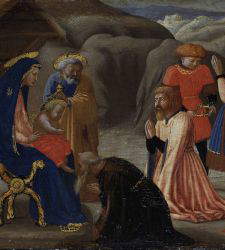
In the center of a roundel housed in the Uffizi Gallery, a mother offers her child a split pomegranate, its seeds a vivid red verging on purple. This is no ordinary gesture: in 15th-century Florentine religious painting, that fruit carries with it ce...
Read more...
Nestled among the marble-rich mountains of Carrara, in a narrow and secluded valley, the monumental cemetery of Marcognano is a place of great charm, both for the richness of its artistic heritage and for its historical, civic, and scenic value. Alth...
Read more...
Two charming winged cherubs support and lift into the air the green, precious banner of honor embroidered in gold, as if they wished to set apart the Virgin Mary, the Child, and Saint Christopher from the rural landscape surrounding them—the very lan...
Read more...
A sky shifting from pink to gray, the moment when the light of day gives way to twilight. In this twilight light, against a background devoid of architecture, we see a young boy smiling as he tips, with a sudden, decisive gesture, a woven basket onto...
Read more...
The history of the depiction of labor in art is long and complex, but in Italy it took on particular significance throughoutthe 19th century—not only in the most explicit forms of social critique, but also in the more subdued and less overt expressio...
Read more...
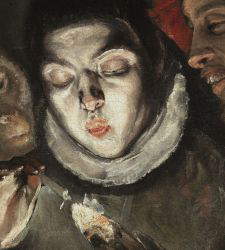
Echo and Narcissus. A young woman and a young man bound by myth. Two lives that intertwine, leading to a sad and tragic ending. Falling in love with an unrequited or impossible love is a source of anguish and death for them, yet neither has ever ce...
Read more...
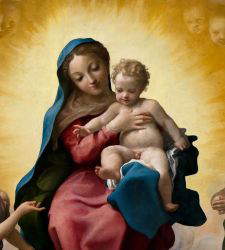
Among the countless commentators on Correggio, I like to choose the sincere definition given by Édouard Pommier in a personal autograph letter to me in August 2006, where he considers him "an immense artist." Such a judgment coming from the then...
Read more...
The author revisits here the article that appeared on January 31, 2022, in this same journal, but has now expanded it with the necessary in-depth analysis. This study of Correggio, in fact, focuses on that great Renaissance artist who embodied th...
Read more...
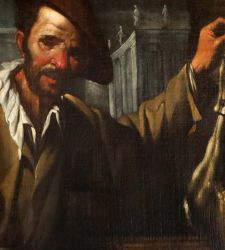
One could almost say that Caravaggio’s*Bacchus* (Michelangelo Merisi; Milan, 1571 – Porto Ercole, 1610), now housed in the Uffizi Gallery, is a 20th-century painting: for more than three centuries, in fact, the painting depicting the Ro...
Read more...
We cover our faces even before we know which part of ourselves we’re seeking shelter from.
It happens when pain catches us off guard and our hands fly up to our eyes with animal-like speed, when shame makes us bow our heads, when someone looks at us...
Read more...
Disturbing. Everything is extremely disturbing: that is the adjective I would use to describe George Grosz’s*Solar Eclipse *. Despite its title, the painting has nothing to do with the extraordinary and extremely rare astronomical phenomenon (the las...
Read more...
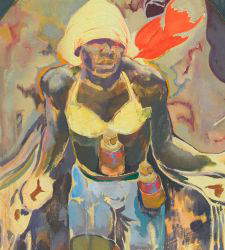
There are artists who construct images, and others who push them to the point where they cease to be containable, recognizable, or stable. Giuditta Branconi’s work occupies this zone of tension, where painting does not organize the visible but rather...
Read more...
Perhaps night did not enter the history of gardens late. It entered late into the history that we have written about gardens. The history of gardens has almost always been told in the light of day. From the sacred enclosures of the ancient East to Ro...
Read more...
A fruit that symbolizes summer, the watermelon has always been associated with the idea of freshness and refreshment during the hottest months of the year. Its presence on our tables, however, tells a much older story, linked to the places and cultur...
Read more...
For nearly five hundred years, anyone who enters the Hall of Olympus at Villa Barbaro in Maser, in the province of Treviso, has had the impression of being watched—and, in a certain sense, protected—by the principal deities of the Greek pantheon. Ar...
Read more...
We tiptoe into the Medici villa at Poggio Imperiale, on the hill of Arcetri, a quarter-hour’s ride on horseback from the Pitti Palace. It is the spring of 1768, and the sumptuous residence, after three decades of neglect, is bustling with activ...
Read more...