





In fact, it had been too long since anyone last hatched an editorial about how despicable the exhibitions we see in Italy each year are. We were getting worried. Why has no one complained yet this fall about the vile garbage heap that is the Italic exhibition industry? Where are all those intrepid elzeviristi to whom it is enough to see five or six exhibitions a year in order to arrive at impeccable diagnoses on the inexorable putrescence of the whole patriotic exhibition sector? How is it that no one has yet come to the rescue of the bohemian bourgeois of our house who snarls against the Italian exhibitions reported by the stacks of free press with which he fills his jute bag at Artissima and then, indignant, s’boards a flight to Roissy-CDG, locks himself inside the Fondation Vuitton all weekend and when he returns says that to see a minimally commendable exhibition you have to go to Paris? Fortunately, all our apprehension melted away as soon as we read the intervention of Alberto Salvadori, who a few weeks ago, in the Giornale dell’Arte, used the courtesy to revive the now asphyxiated art circus by reminding us of what we haven’t heard for months, unfortunately: that in Italy there is a shortage of noteworthy exhibitions. This time, however, with a slightly different nuance: if Nicola Lagioia declared that he had enlisted among the ranks of compatriots dreaming of France (“in Paris [...] an exhibition on Mark Rothko is being held that Italy can dream of [...]. It is chasms of this kind that should be filled”), and Vincenzo Trione hinted that in the pantheon of his cultural references there is also a place for the Boar brush (“There is a need for a shot to make great exhibitions and not great exhibitions”), Alberto Salvadori directs his ramblings toward a very specific and identifiable subject, namely public museums, namely national museums.
Salvadori, like everyone else who works and has no time to waste on dabbling with second- or third-rate exhibitions, went to see the Beato Angelico exhibition in Florence, and like everyone else he came away admiring, astonished, enraptured. An exhibition “that we can call epochal,” he says, and he is right. Just as he is right when he asserts that this project demonstrates “the skill of those who manage the Strozzi Foundation, alternating such important and perhaps unrepeatable exhibitions with others that are less intense, but capable of capturing the general public.” Where he is perhaps a little less right is when he adopts Palazzo Strozzi as a paradigm to deplore the “parallel progressive emptying of content of national museums due to their precise commitment to ordinary management, aimed above all at frenzied ticketing, causing the loss of that propositional capacity for study and research, ascribable to the times of the great superintendents, which has produced memorable exhibitions over time.” The inescapable laudatio temporis acti, as timely as the F24s before the holidays, comes soon after: Salvadori rambles on about the marvelous times of Sfortuna dell’Accademia of 1972, Curiosities of a Royal Palace of 1979, Magnificence at the Court of the Medici of 1997-1998, moreover exhibitions that were all held in the same museum (and we do not know if Salvadori mentions only Palazzo Pitti because he believes that the Palatine Gallery of the 1970s is the ultimate museological model to look at even in the third millennium, or because at the time they had imprisoned him in Buontalenti’s cave and allowed him just an hour of air time at each opening: we will remain with the doubt), then moving on to the cahier de doléances: “Italy’s cultural heritage is preserved and managed to a very large extent by the public, therefore in the financial charge of each of us, at least that 50 percent who pay taxes. Therefore, we would be entitled to obtain a commitment that is not almost exclusively conservative or tourist-consumer oriented of this wealth.” It is not quite clear how it is that ministerial officials can simultaneously work exclusively for conservation and exclusively for tourist consumption, since the two purposes are antithetical, but it doesn’t matter: the point is that those who manage state museums “are producing a lot of damage, which is difficult to repair” and “this situation denotes a general decay in the performance of the functions and people in charge of them.” Grand finale with the inevitable mythologizing of the private sector: “in the absence of political diktats, private entities create and hire the best professionals to carry out and manage projects, see precisely the Beato Angelico exhibition.”
Now, we would be sad to upset Salvadori by revealing to him that half of the board of the Strozzi Foundation is publicly appointed and that, reading the latest financial statements of the entity that organized the Beato Angelico exhibition, one can discover that, minus the income from exhibitions, more than a third of the contributions the Foundation receives come from its institutional supporters, but that is not the point: the point is that even public museums, and even state museums, in this country of ours are able to think of and mount “memorable” exhibitions, as Salvadori calls them, and this even in the difficult context of a ministry that is perennially starved of human resources, that has gone through even long phases of drastic cuts and downsizing, that is coming out of a phase of radical rethinking of almost the entire national museum landscape (the era of autonomy inaugurated by Franceschini has given priority, and it is true, to the complete reorganization of almost all the institutes, and in many cases there was great need since some were stuck on the visitation routes of the 1970s-1980s, and consequently resources went on refurbishments, but even in this period there were exhibitions of the highest level), which has often emphasized numbers over research, which without a broad strategic vision runs the serious risk of getting bogged down in the difficulty of long-term planning, and which, should it sooner or later stubbornly nail its objectives to the mere profitability of the actions of individual directors, will in the long run collapse research and turn museums into commercial centers (and in any case, in the event, the danger appears to us to be rather remote to date).
There is no denying, of course, that the ministry has some minor problems. But we were talking about exhibitions, and to remember important exhibitions one need not go back to the first Andreotti government, to the time when the Riace bronzes slept peacefully in the waters of the Ionian Sea, Picasso was still alive and the only South Tyrolean of some success in world sports was named Gustav Thöni and did not play tennis. No: a few more field trips would be enough to realize that our state museums have not abandoned that tradition of research exhibitions of the highest quality, unimpeachable, fundamental, capable of attracting relevant international loans, audiences, resources, truly capable of advancing knowledge. On the contrary: that tradition appears to us to be very much alive. Just looking at the current year, one could take the example of the exhibition on Pietro Bellotti at the Gallerie dell’ Accademia in Venice, one of the best exhibitions of theyear, the first ever on this important seventeenth-century painter, an exhibition that shed light on so many obscure points, moreover organized by three young curators, that brought works from all over the world to the lagoon to build a solid discourse and to establish a new milestone in the research on the so-called “painters of reality.” an exhibition, in short, with which from now on anyone who wants to study the painting of the everyday of that historical period will necessarily have to contend. And going down the Adriatic, again this year one could stop in Urbino, where the Galleria Nazionale delle Marche has collected almost everything there was to collect on Simone Cantarini to give life to a surprising exhibition especially in terms of density of masterpieces. And how can we not mention then, again at the Galleria Nazionale delle Marche in Urbino, also to give an example of project continuity, last year’s exhibition on Federico Barocci, which was also voted the best Italian exhibition of the year by the Finestre sull’Arte jury that gathered more than a hundred experts, including museum directors, curators, journalists, critics, and insiders (and all obliged to reveal themselves in public in order to be part of it)? Or how can we not mention, again last year, the exhibition on the relationship between painting and poetry in the seventeenth century, which at the Galleria Borghese practically translated Giovan Battista Marino’s Galeria into images? Or the exhibition on Guido Reni at the Pinacoteca Nazionale in Bologna, which juxtaposed for the first time in Italy after almost forty years the two versions ofAtalanta and Ippomene, obtaining from the Prado the difficult loan of one of the greatest masterpieces of the seventeenth century, and above all producing a sequence of important scientific discoveries?
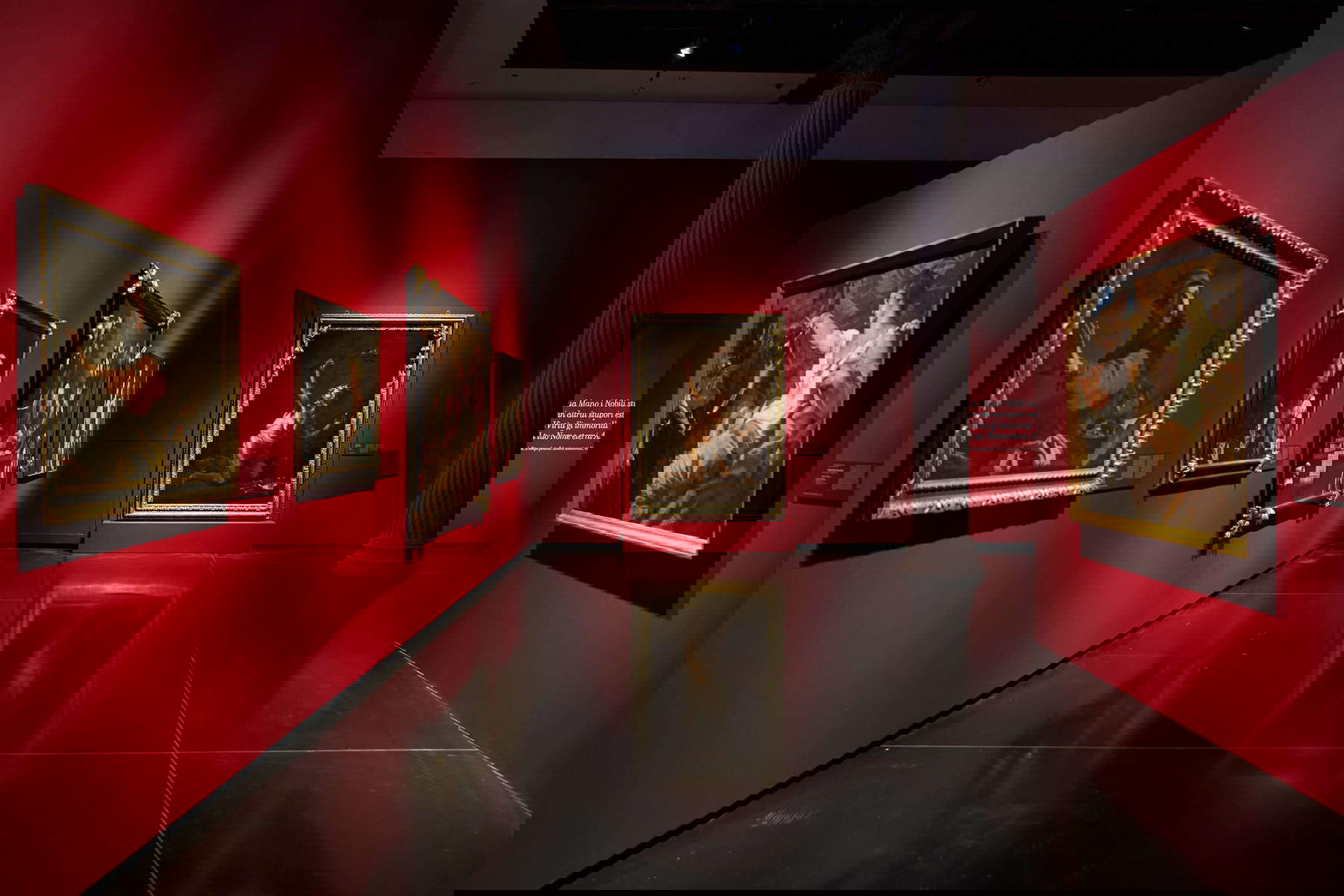
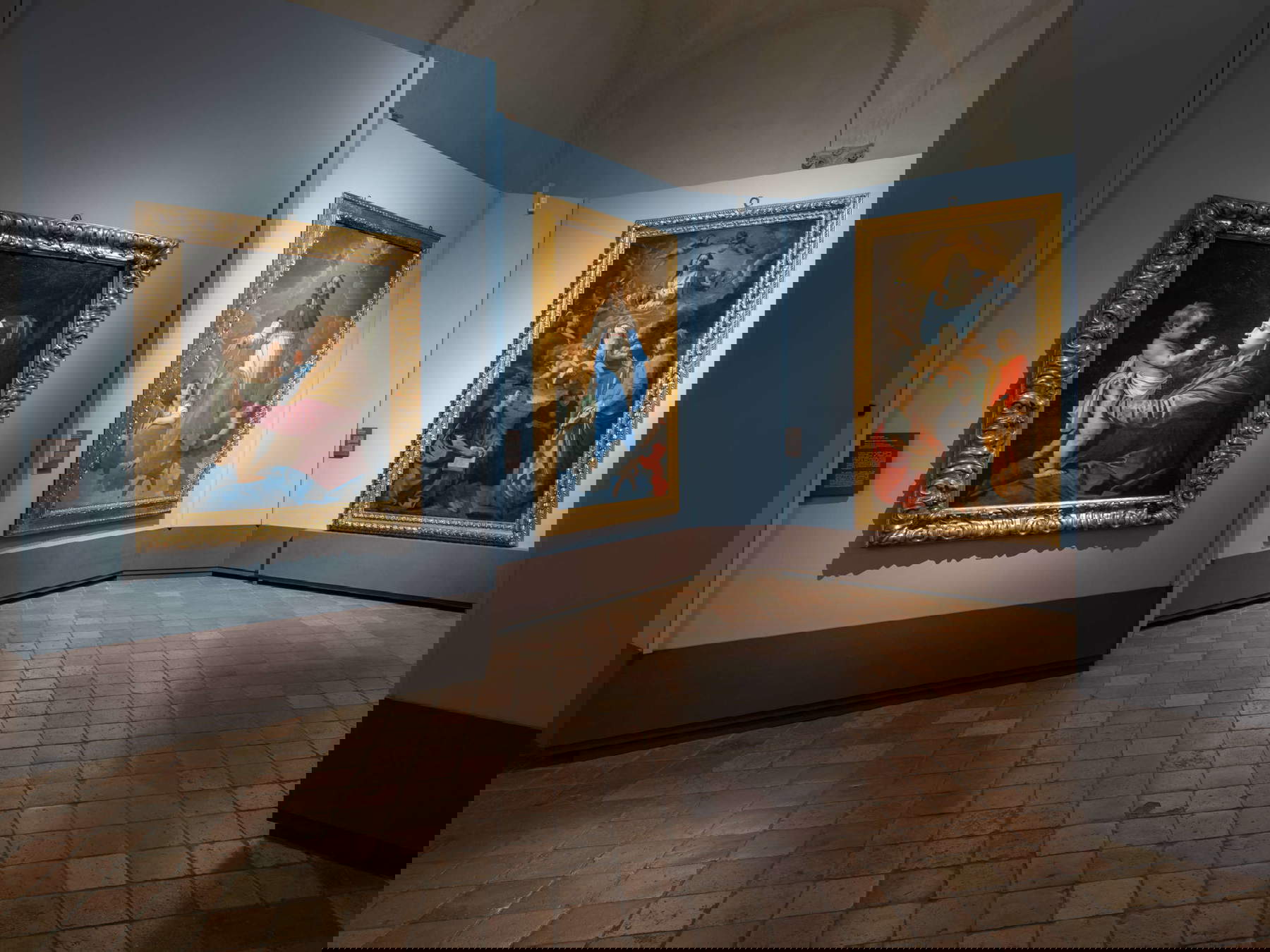
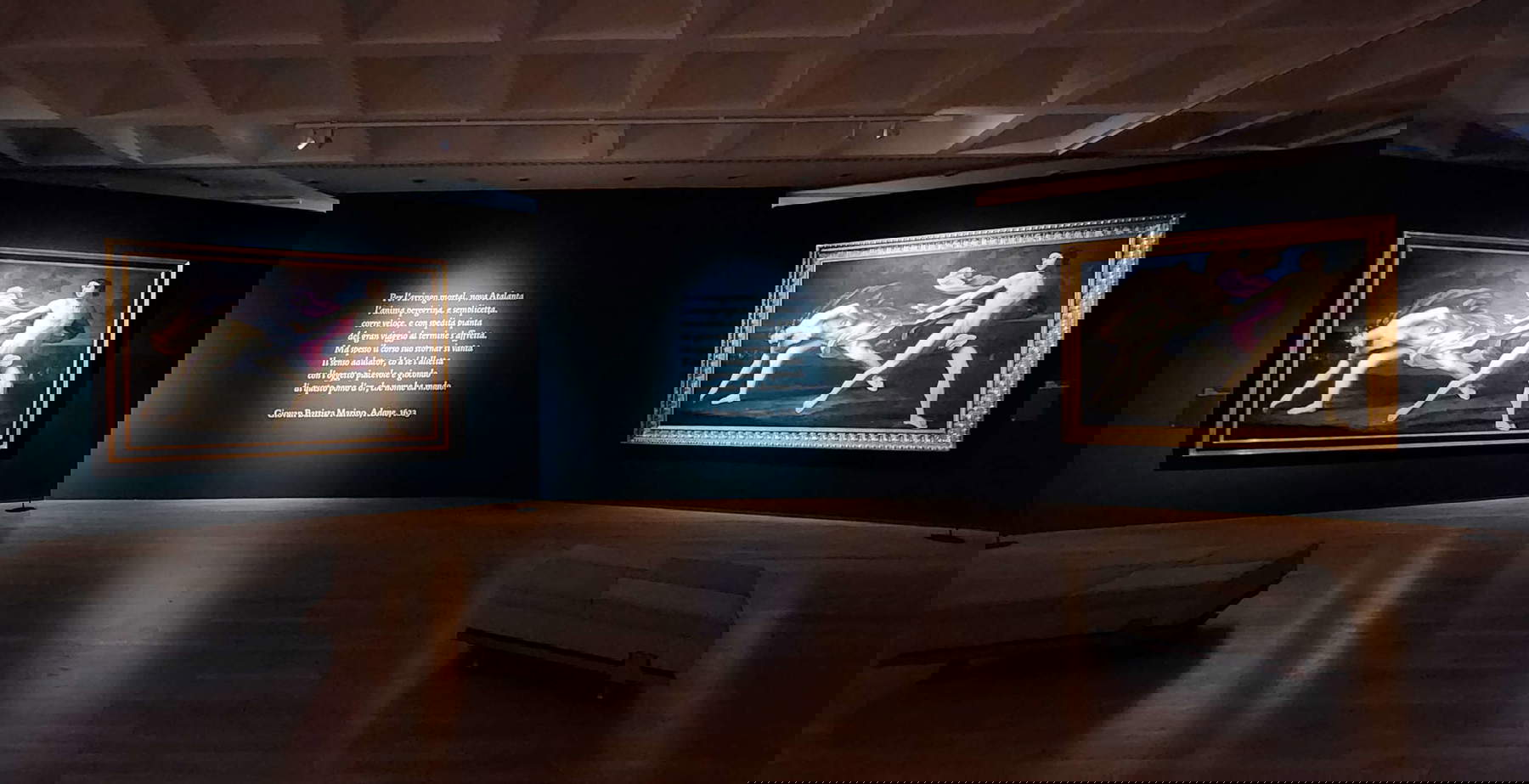
Of course: we are talking about Bellotti, Cantarini and Barocci, will say the customary italivist who sees three exhibitions a year, two of them beyond the Alps, and who must be reading this piece leaning against a lamppost in front of the Arc de Triomphe before boarding the shuttle to the Fondation Vuitton during the well-deserved Christmas vacation. Beyond the fact that there is no problem of compatibility between the memorability of an exhibition and the name of an artist who does not enjoy the same fame as a Leonardo, a Raphael or a Van Gogh, and beyond the fact that we can agree that memorability is to be understood more as the ability to mark by quality than as the power to astonish with special effects, one could cite, to show that there is no shortage of admirable exhibition opportunities on textbook names either, the exhibition on Caravaggio that was held this spring at Palazzo Barberini. Everyone can say what they want about the exhibition (yours truly panned it, but there was no shortage of enthusiastic comments, both in the Italian press and in foreign publications), yet no one can deny one fact, namely that theonly museum that has been able, in the last seven to eight years, to bring together some twenty Caravaggio works in one place, and to bring in not some twenty dubious works, but twenty textbook pieces, has been an Italian state museum. So, to recapitulate: if by memorability is meant the combination of quality, research, novelty, charm, density, originality, innovation, go see the exhibition on Bellotti that is still open, or buy the catalogs of those on Cantarini and Barocci. If, on the other hand, we mean the ability to impress the public and to attract tens of thousands of visitors ready to queue up to see a bombastic exhibition that is sure to remain imprinted in the memory of many for a long time, whether detractors or enthusiasts, remember the one on Caravaggio. And, mind you: we are not talking about exceptions. Italian state museums are capable of doing everything. And this, of course, only by limiting the look to the last two years, without even mentioning everything that should be mentioned, and without considering the many civic museums that certainly do no worse work than their national counterparts (since the title of Salvadori’s piece called into question the entire category of “public institutions,” but the articulation referred only to national ones).
For now, we can rest assured: our public institutions know how to work. Italy’s public museums are perfectly capable of organizing memorable exhibitions: clear and original content, functional and sometimes even scenic layouts, international loans, lasting impact, curatorial precision, experiences that stick, catalogs that become landmarks. The commitment of our ministerial officials, those few who are left and who more often than not put in even more effort than they should because they are undersized in relation to the needs (and that is an issue, this yes, a little more urgent than that of the quality of the exhibitions), they work neither only for conservation nor only for tourists, but they work to procure for the public a service that is up to the standards of our heritage, and this service also passes through a high level of exhibition offerings (which are not lacking in Italy). Of course, we must also be careful to avoid acquittals with a full formula: there is no denying that often the quality, in such a vast and varied panorama, is oscillating, that there are also exhibitions that are not up to par, uninteresting exhibitions, reckless exhibitions, exhibitions with a commercial soul aimed above all at ticketing, and that all this is a reflection of issues that lie further upstream and about which it would be appropriate to speak more in depth. What is certain is that the memorability of exhibitions is not really the problem of Italian public museums. There are certainly many problems, and they are likely to emerge especially in the long run, but generalizations, idealizations and simplifications only serve to make them lose sight.

The author of this article: Federico Giannini
Nato a Massa nel 1986, si è laureato nel 2010 in Informatica Umanistica all’Università di Pisa. Nel 2009 ha iniziato a lavorare nel settore della comunicazione su web, con particolare riferimento alla comunicazione per i beni culturali. Nel 2017 ha fondato con Ilaria Baratta la rivista Finestre sull’Arte. Dalla fondazione è direttore responsabile della rivista. Nel 2025 ha scritto il libro Vero, Falso, Fake. Credenze, errori e falsità nel mondo dell'arte (Giunti editore). Collabora e ha collaborato con diverse riviste, tra cui Art e Dossier e Left, e per la televisione è stato autore del documentario Le mani dell’arte (Rai 5) ed è stato tra i presentatori del programma Dorian – L’arte non invecchia (Rai 5). Al suo attivo anche docenze in materia di giornalismo culturale all'Università di Genova e all'Ordine dei Giornalisti, inoltre partecipa regolarmente come relatore e moderatore su temi di arte e cultura a numerosi convegni (tra gli altri: Lu.Bec. Lucca Beni Culturali, Ro.Me Exhibition, Con-Vivere Festival, TTG Travel Experience).
Warning: the translation into English of the original Italian article was created using automatic tools. We undertake to review all articles, but we do not guarantee the total absence of inaccuracies in the translation due to the program. You can find the original by clicking on the ITA button. If you find any mistake,please contact us.





























 IT
IT FR
FR DE
DE ES
ES CN
CN


