Works and artists


123...77Page 1 of 77


Empoli 1925: when a small room changed the artistic destiny of a province

Empoli 1925: when a small room changed the artistic destiny of a province

Empoli, summer of 1925: a small room located at the end of a vegetable garden on Via Tripoli becomes the center of gravity for a new generation of creative artists and returns to us today the image not of a motionless and silent province, like the on...
Read more...
How ugly envy is: its depictions in art

How ugly envy is: its depictions in art

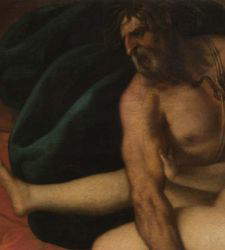
It is perhaps one of the oldest feelings in existence:envy lurks in the minds of those who desire but do not possess, whether it be personal qualities, achievements, relationships or material goods, and arises from the awareness of one's own lack or ...
Read more...
Places of Pegasus. Traces of the myth in Tuscany

Places of Pegasus. Traces of the myth in Tuscany

The blood slid to the ground in thin threads, each with a rhythm all its own, the moment Perseus severed Medusa's head. The ground, hit by that heat so intense it seemed like breathing, changed consistency with a speed that does not belong to things ...
Read more...
Where is Chagall's pure soul hidden? Against goodist views

Where is Chagall's pure soul hidden? Against goodist views

If one steps outside the Chagallian interpretive scheme that interweaves Chassidic Judaism and a certain ethnic-religious idea of fairy-tale reality that finds in the flying sweethearts and in certain upside-down world situations typical of the fairy...
Read more...
Why do we say a landscape "looks like a painting"? A brief history of the gaze

Why do we say a landscape "looks like a painting"? A brief history of the gaze

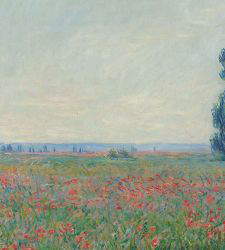
A three-story mansion overlooking the Grand Canal, opposite the Fabbriche Nuove del Sansovino. It is called Palazzo Bolani Erizzo and from its windows, if you look to the left, you can see the Rialto Bridge. In the sixteenth century Pietro Aretino li...
Read more...
Beyond the reflection: the mirror as threshold in twentieth-century art

Beyond the reflection: the mirror as threshold in twentieth-century art

There are places intwentieth-century art where reality suddenly seems to open up, multiply, slip out of its usual form. All it takes is a mirror, a sheet of glass that, instead of returning a faithful image, betrays it, doubles it, reinvents it. The...
Read more...
Hellenistic Etruria: how the Greeks influenced Etruscan art, religion and society

Hellenistic Etruria: how the Greeks influenced Etruscan art, religion and society

The cultural interaction between Etruscans and Greeks, in what is referred to as Hellenistic Etruria, represents one of the most significant phenomena of antiquity, which left a profound imprint on art, religion and social organization. Indeed, Etrur...
Read more...
Jacopo Bassano's rhetoric-free Nativity that anticipated Caravaggio

Jacopo Bassano's rhetoric-free Nativity that anticipated Caravaggio

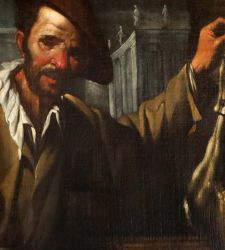
The happy event has taken place: the Virgin lifts two flaps of the white cloth covering the cradle inside which lies the sleeping newborn Child, to reveal Him to the shepherds who have come to adore Him along with their lambs, an ox and a dog. One, ...
Read more...
Kandinsky and Italy: the whole story of a dialogue

Kandinsky and Italy: the whole story of a dialogue

The relationship between Vasily Kandinsky (Moscow, 1866 - Neuilly-sur-Seine, 1944) andItaly is a complex affair, made up of missed encounters, long-distance admiration, and fruitful reworkings that in some ways marked the history of 20th-century art ...
Read more...
The She-wolf of Siena: the tale of the fair that became a symbol of the city

The She-wolf of Siena: the tale of the fair that became a symbol of the city

The figure of the She-wolf with twins occupies a foundational role in Siena's imagery because it recalls the city's legendary origins and embodies its deepest identity value. The animal's watchful posture, combined with the vitality of the two infant...
Read more...
Dragons in Tuscany: from mythology to the works of the great masters

Dragons in Tuscany: from mythology to the works of the great masters

The dragon, a mythical figure that has always populated the human imagination, has gone through centuries of iconographic transformations until it became the fire-breathing winged monster we know today. Its presence in the figurative arts recounts a ...
Read more...
"The ancients always copy us". The Etruscans in contemporary art

"The ancients always copy us". The Etruscans in contemporary art

When, in the eighteenth century, Johann Joachim Winckelmann tries to give a comprehensive shape to the history of ancient art, his gaze constructs a map in which Greece occupies the incandescent center. In the pages of Geschichte der Kunst des Altert...
Read more...
Andrea del Sarto's Madonna of the Harpies: symbols and theology behind the monsters

Andrea del Sarto's Madonna of the Harpies: symbols and theology behind the monsters

We owe to Giorgio Vasari the title by which one of Andrea del Sarto 's (Andrea d'Agnolo; Florence, 1486 - 1530) greatest masterpieces is known, the Madonna of the Harpies, a panel more than two meters high that is kept in the Uffizi and is placed at ...
Read more...
Lia Pasqualino: the silent portraitist who captures the soul in waiting

Lia Pasqualino: the silent portraitist who captures the soul in waiting

A singular portraitist: this could be the definition of photographer Lia Pasqualino (Palermo, 1970), whose work is imbued with a deep sense of humanity and silence. Granddaughter of the painter Lia Pasqualino Noto (Palermo, 1909 - 1998), she trained ...
Read more...
The Etruscans in comics: a journey into reinterpretations of an enigmatic civilization

The Etruscans in comics: a journey into reinterpretations of an enigmatic civilization

When in 1985 the Region of Tuscany dedicated an entire year to the promotion of Etruscan civilization, the project that developed took on a pioneering role in defining new ways of disseminating historical and archaeological heritage. TheYear of the E...
Read more...
The advertising vehicles that defined the imagery of Italian fashion.

The advertising vehicles that defined the imagery of Italian fashion.

From the post-World War II period until the early 2000s, Italian fashion built its public identity through a complex bond of communicative tools and aesthetic codes that today represent the heritage of the national imagination. Of great importance, t...
Read more...

123...77Page 1 of 77